

Red circle — a step-by-step lesson for grown-up and child
This lesson starts the colour chapter of card time: one day, one colour, one real red thing found in your home. Everything else — matching, naming, sorting — is years away, and that is exactly on schedule.
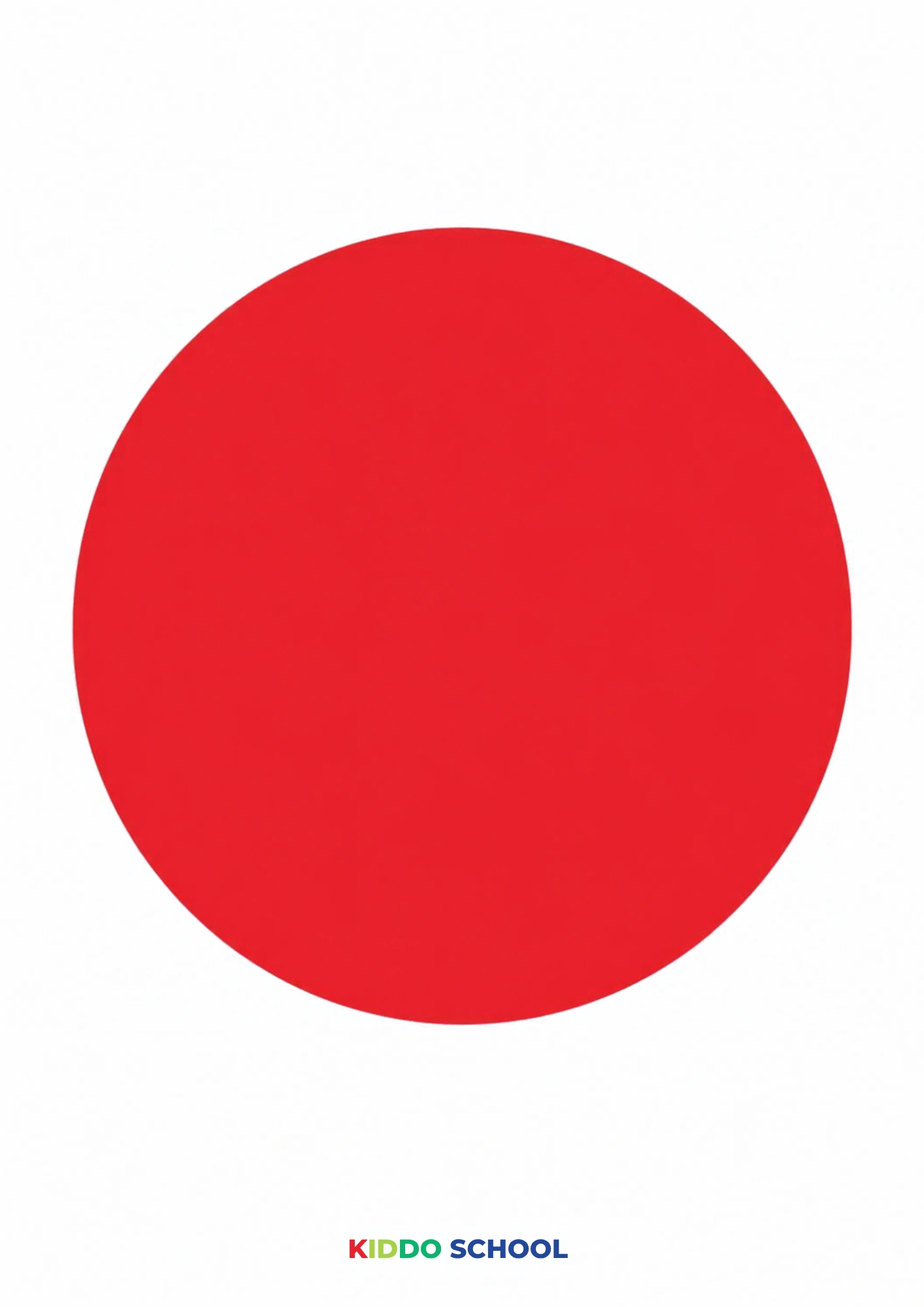
What is this?
Red is a colour, and the card gives it in its simplest costume: one large, bold circle. At 3–4 months your baby’s colour vision is still warming up, and red is the shade that lands earliest — the natural first colour to offer.
What does it mean?
The eye’s colour sensors come online in stages, and the long red wavelengths register before the rest of the spectrum. That physiology is why so many baby sets lead with red: you are showing the colour your baby is best equipped to see.
What does the child need to know?
The plan is deliberately small: this red card today, its yellow twin tomorrow, its blue cousin the day after. One colour at a time gives each shade room to be noticed. And every session gets a real-world twin — one red thing from your home, held up for two seconds.
Why this matters
Colour is a property, not an object, and property-thinking starts here: the baby meets "red" as something a circle can be, a jumper can be, a book can be. That idea — one word stretching across many things — is the seed of all later categories.
What it teaches
Colour discrimination, visual attention on a single bold target, real-world transfer (card to object), and narration listening — your baby hearing one colour word attached to many different things.
Words to learn
redcirclelookcolourroundfound it
Say this to your child
“"Red! Here is a big round circle in red. And look — here is my red sock. Red on the card, red in my hand. Red is out in the world today, and you are finding it."”
Step by step
- Choose an alert window after a feed, settle your baby and show the red circle at close focusing range, filling a good slice of the view.
- Say its name twice, slowly and warmly: "Red. A big red circle." Then hold still and let the looking happen.
- Swatting or batting at the card? Wonderful — bring it a fingertip closer so the swipe can land, with your hand behind it the whole time.
- Now the twin: grab one red thing within arm’s reach — a sock, a book, a toy — and hold it beside the card. The word is the same; the sizes are not.
- Close the session there. One colour, one object, two minutes; tomorrow belongs to yellow.
Look closer at the picture
The artwork is exactly one large red circle and nothing else — say that much. The live noticing is richer: does your baby’s gaze jump between card and real red object? That little trip is transfer, happening in real time.
Ask your child
Watch the pairing: when the real red thing arrives, do the eyes cross to it, or stay loyal to the card? Does a swat come when the object is near? Wonder aloud: "I wonder which red you prefer — the flat one or the fuzzy one."
What your child can say or do
Long stares that flick between card and sock, an arm swing that grazes the card, a fresh kick of interest when the real object lands, or a calm blink and nothing more — all four are normal replies at 3–4 months.
Out in the real world
Red waits all over the house: a mug on the counter, the spine of a book, the tomato in the fruit bowl. Each time you pass one during the day, tap it and say "red" once. The card taught the word; the house repeats it for free.
Try it together
One-colour day: pick red as today’s tiny theme and narrate every red thing you meet out loud — red sock at dressing, red cup at lunch, red leaf at the window. Your baby does nothing but listen and look, which is everything.
Understanding check
Parent self-check: did one real red object actually join the session, and did you manage to keep the whole thing under five minutes? Small and repeatable is the design; long and dutiful is how card time dies.
Parent tips
Resist adding more colours to speed things up — parallel colours cancel each other out at this age. If your baby seems bored, move the card a little, not the plan. Repetition feels dull to you and builds exactly nothing but memory for them.
Staying safe
The adult holds the card for every second of every session — at this age everything that lands in a hand heads for the mouth, and cards are not teethers. Real red props get chosen for size too: bigger than a fist, nothing that can snap or shed.
This lesson pairs with the Red circle flashcard in the library — print it, show it, keep it on the fridge. Back to Colors & First Objects (Infant 1).