

Curved path — a step-by-step lesson for grown-up and child
This card has a beginning, a middle and an end, and this lesson is about travelling all three — slowly, with a small cheer waiting at the finish.
What is this?
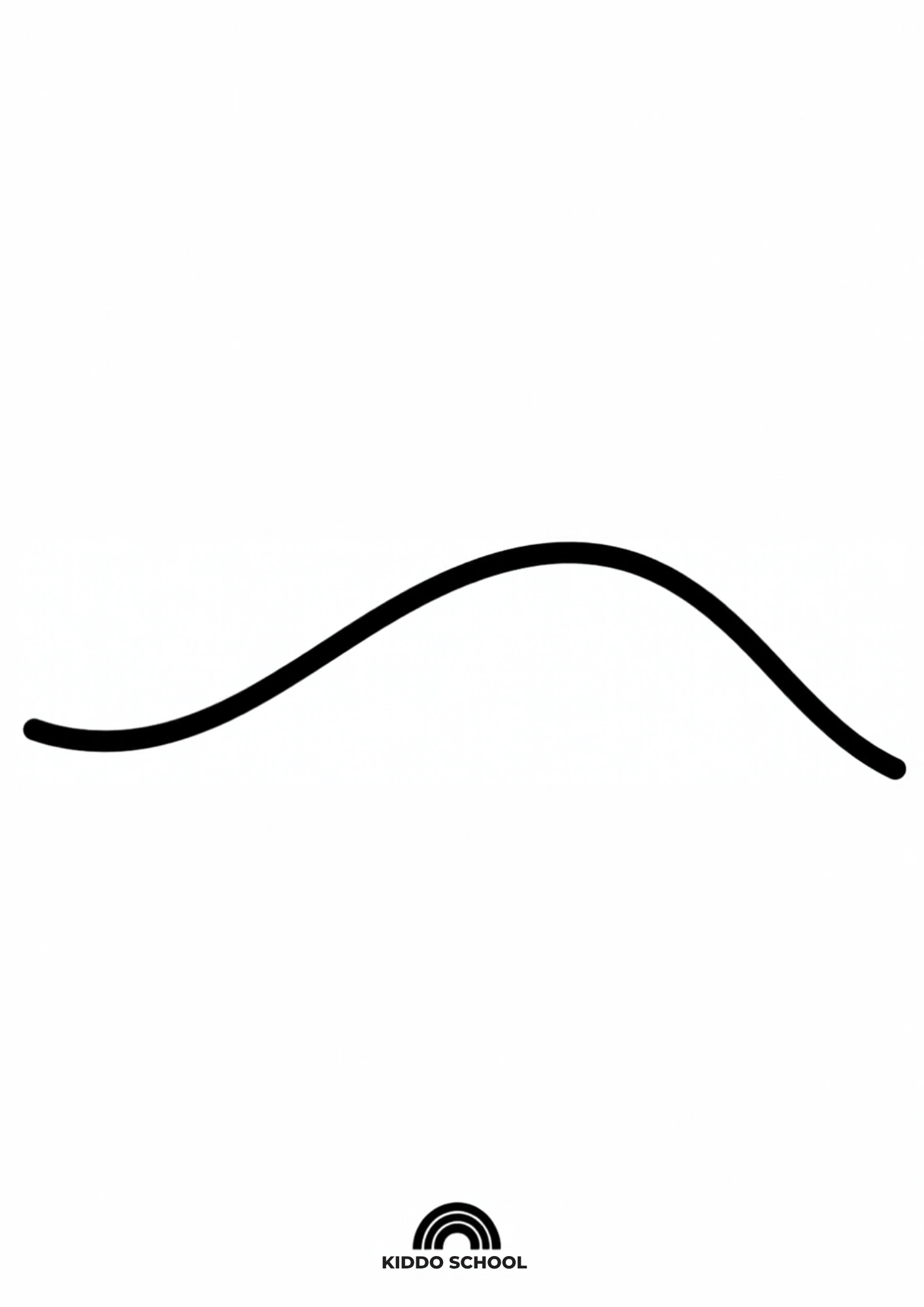
A curved path is a single long line that sweeps across the card from one side to the other. Unlike the waves (many lines) or the rings (in and in), this is one road with one direction — a journey your baby’s eyes can complete.
What does it mean?
Following a line from start to finish is a chain of small visual decisions: stay on, keep going, arrive. Each completed run strengthens the habit of persistence in looking — and line-following is, one day, exactly what reading a sentence is.
What does the child need to know?
Slow matters more than finished. If the gaze drops off halfway, stop there and let the look be complete; a half journey today becomes a full one by next week. The small arrival cheer is for landings, however short the trip.
Why this matters
Every book your child will ever read runs on lines that go left to right and arrive somewhere. This card is that experience in its simplest costume — no letters, no story, just the pure pleasure of getting from here to there by eye.
What it teaches
Sustained line tracking, left-to-right direction, finish-and-celebrate sequencing, and shared attention — two people following the same path together.
Words to learn
pathlongstartendall the wayarrived
Say this to your child
“"One long, curvy path. Here is the start — off we go, slowly, slowly, all the way along... and here is the end! We arrived. What a journey for two small eyes and one patient finger."”
Step by step
- Show the card and announce the journey: "A long curvy path — where does it go?"
- Put your fingertip at the line’s start and name it: "Here is the start." Then travel, slow as syrup, while the eyes ride along.
- If the gaze slips off, pause the finger where it slipped and wait; often the eyes climb back on by themselves.
- At the end, stop, lift your finger and mark the arrival with a small warm cheer — "arrived!" — every single time.
- Run it once more, or not, on your baby’s vote: a second full lap is a bonus, never a requirement.
Look closer at the picture
The artwork is one bold curved line sweeping across a plain card — that is the whole scene, so say that much. The noticing that matters is live: did today’s journey run further than yesterday’s? Progress here is measured in centimetres of attention.
Ask your child
Watch the trip: where does the gaze usually drop off — early, middle, near the end? Is that spot moving further along through the week? Wonder aloud: "I wonder if you will make it all the way by the weekend."
What your child can say or do
Eyes riding the finger for most of the line, a body-lean that follows the curve, a startle-smile at your arrival cheer, or a gaze that quits at the halfway hump — all four are fine, and the last one is simply where training starts.
Out in the real world
Paths are everywhere: the curve of the garden edge, a ribbon lying on the carpet, the S of a river on a map you glance at. Trace any long curve you meet — "long path... arrived" — and the card plays itself in the world.
Try it together
Ribbon run: lay a length of ribbon in a gentle curve on the floor beside your baby during tummy time and trace it with your finger, then let a sibling or partner walk a toy car along it. Same journey, new costume, twice the audience.
Understanding check
Self-check: did the finger actually travel the whole line at least once, and did you cheer the arrival even on a short run? The habit of finishing is built by celebrating finishes — yours to give, freely.
Parent tips
Vary which end you start from across the week, but keep most runs left to right — reading’s direction gets a quiet head start. If your baby always quits at the same spot, end the run there with the cheer anyway; arrival is wherever you stop together.
Staying safe
Tummy-time versions need full supervision, chin up, on a firm surface — a tracing session is no time to step away. Ribbon and string props live in your hand and go away with you; loose lengths near a baby are never left lying around.
This lesson pairs with the Curved path flashcard in the library — print it, show it, keep it on the fridge. Back to Faces & Visual Tracking (Newborn 2).