
Apple — a step-by-step lesson for grown-up and child
The apple opens the fruit class because it is the fruit most children already own: it sits in their fruit bowl, their lunchbox, their stories. This lesson gives the word a home, the fruit a biography — it grows on trees — and your child a crunchy, washed-and-ready tasting job.
What is this?
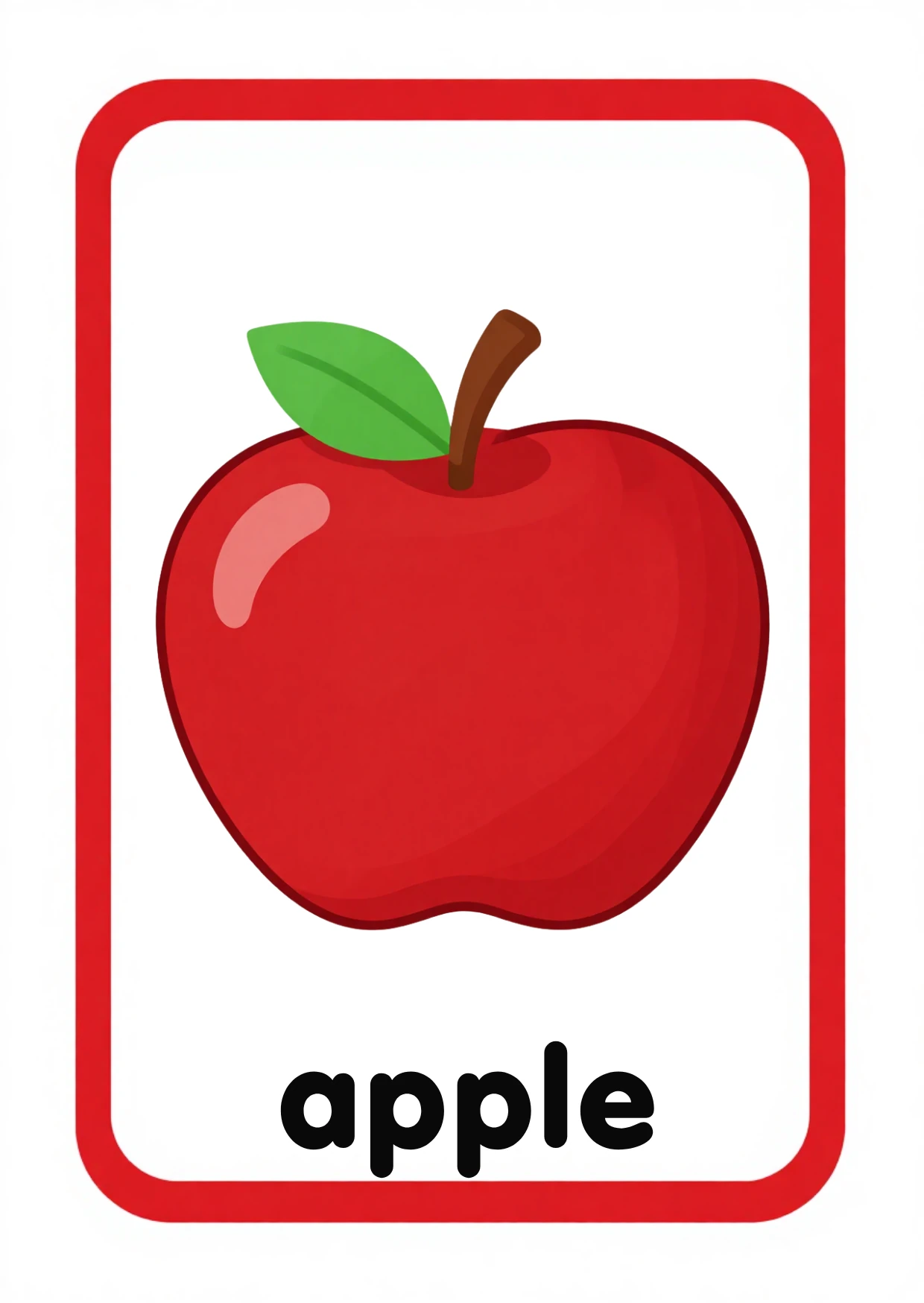
An apple is a round fruit that grows on trees, in orchards and gardens, hanging from branches until picked. On the card it is a shiny red apple with a green leaf. In your kitchen it is heavy and cold in the hand, crunchy between the teeth, and sweet enough to request by name.
What does it mean?
Naming a food your child already eats turns snack time into lesson time: the word apple gets attached to the heaviest, coldest, crunchiest fruit in the bowl, and every future apple repeats it. Food words are the easiest vocabulary a kitchen teaches, because the props show up daily and get eaten on schedule.
What does the child need to know?
Your child needs the word at the card, one real apple held in both hands — heavy, smooth, cold — and one supervised tasting: washed under the tap, cut by a grown-up into slices, then crunched loudly together. The loud crunch is not optional; it is the sound of the lesson working.
Why this matters
Apples are a first lesson in where food comes from: not shelves, but trees, seasons and picking. A child who says “apples grow on trees” has planted the seed of a food story that will grow into gardens, farms and why-we-wash-things — real knowledge with a snack attached.
What it teaches
Word-object mapping with a holdable prop, early food-science (tree to table), sensory vocabulary (heavy, smooth, cold, crunch), counting at the fruit bowl, and the confidence of requesting food by name.
Words to learn
appleredroundcrunchtreeseed
Say this to your child
““Apple! Here is the picture apple, all shiny with its leaf. Can you find the real one? Feel it — heavy! Cold! Now we wash it, a grown-up cuts it, and... CRUNCH! Did you hear that? That is the sound of an apple saying hello.””
Step by step
- Show the card and say apple — then ask your child to find the real thing in the fruit bowl before you lift a finger.
- Hand the apple over: heavy, smooth, cold. Say the word while both hands are full — the grip is the vocabulary lesson.
- Tell the biography: apples grow on trees, hung there by the tree itself, picked when round and ready.
- Tasting job: your child washes the apple under the tap while you cut it into slices, then everyone crunches as loudly as possible.
- Count the apples left in the bowl together — the word got said, the fruit got eaten, and the numbers sneaked in behind both.
Look closer at the picture
Look at the card together: it shows a shiny red apple with a green leaf and the word apple underneath. Ask your child where the leaf sits, what color the apple is, and whether the real apple in your bowl wears a leaf too.
Ask your child
“Where do apples grow — on trees or under the ground?” “Is the apple heavy or light?” “What sound does a crunch make?” “Should we wash it first — why?”
What your child can say or do
Your child might demand “apple slices, please!” at odd hours, report that the apple is cold like the fridge, or march to the tap uninvited to wash the next one — a food word that triggers its own safety routine is a food word fully learned.
Out in the real world
Apples repeat all week: at breakfast, in the lunchbox, at the shop where the pile sits shiny and cold. Each one is a rehearsal of the word — and by the time the bag is empty, it has been crunched into memory.
Try it together
Apple bowl hide-and-seek: hide three apples around the room while your child counts to ten, then send them hunting with the word — “find an apple!” Every discovery gets announced, washed and shared. The hunt is cardio; the naming is the lesson.
Understanding check
Ask: “Where does an apple grow? What do we do before we eat it? Show me a crunch.” Tree, wash and a jaw-breaking demonstration — that is the lesson landed.
Parent tips
If your child rejects the first slice, offer the crunch challenge instead: who can make the loudest sound? Pride reopens more mouths than persuasion ever will, and the second bite is usually the one that counts.
Staying safe
Apples get washed before every tasting, and a grown-up does all the cutting — slices, not chunks, for small mouths. Whole apples are for confident chewers at the table, never for wandering-and-munching, and a wobbly-toothed cruncher gets their slices thinner.
This lesson pairs with the Apple flashcard in the library — print it, show it, keep it on the fridge. Back to Fruits & Vegetables Flashcards.