
Four Cars — a step-by-step lesson for grown-up and child
This lesson takes counting past the glance: four is where pointing and patience start pulling real weight. Your child counts the cars one careful touch at a time, then parks fours all over the house — four wheels, four corners, four crackers.
What is this?
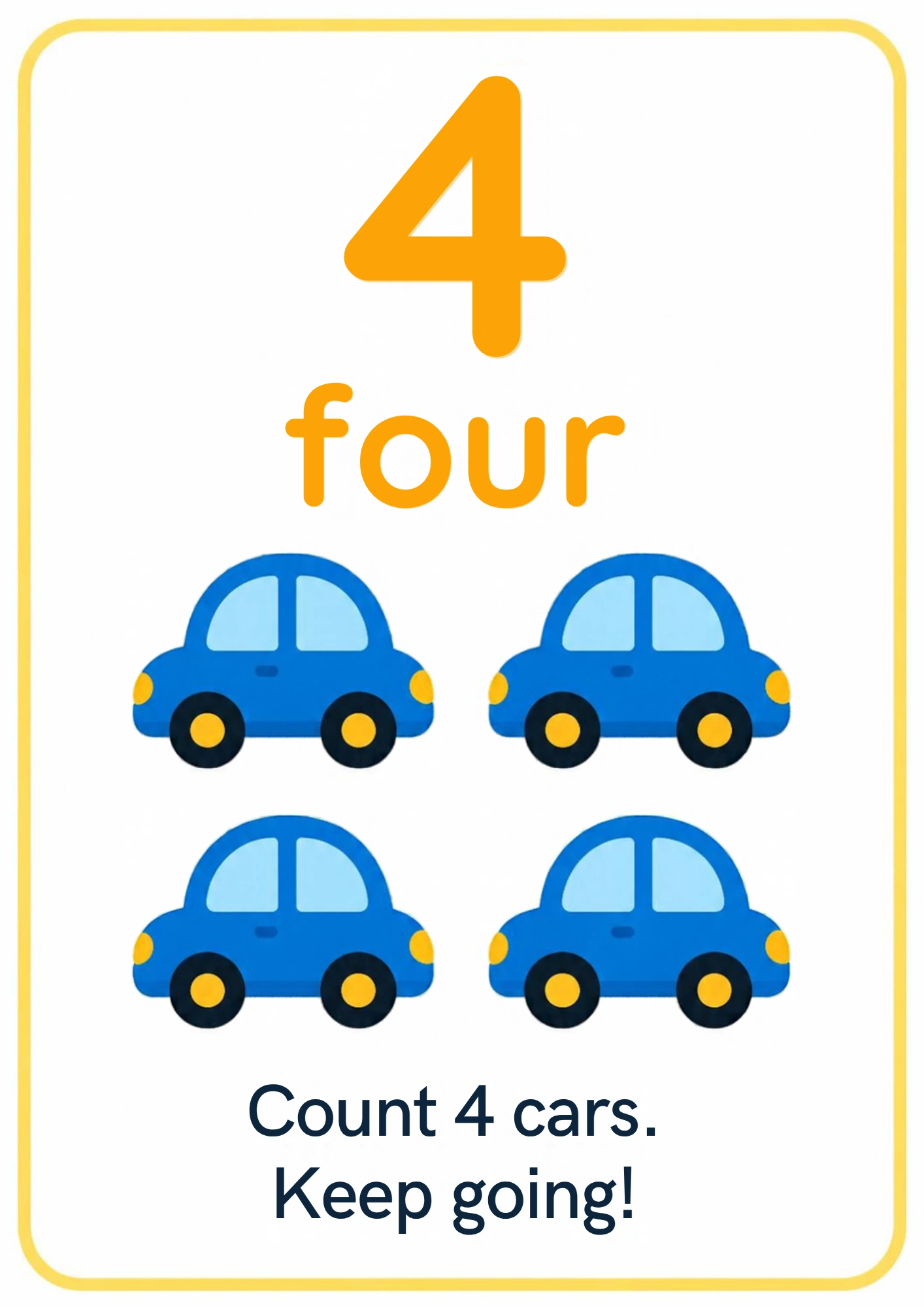
Four is three and one more. On the card: four little blue cars, the word four and a big numeral 4 — a tidy parking lot for a careful count.
What does it mean?
At four, children meet the honest work of counting: the answer no longer arrives by looking, and double-counts happen. That is not failure — noticing the count went wrong IS the number sense developing, and it deserves applause.
What does the child need to know?
Your child needs: four comes after three, each car gets exactly one touch, and four can feel like "just lots" on some days. Parking the cars in rows makes counting kind — tidy beats scattered at every stage of learning to count.
Why this matters
Four sits at the edge of what a three-year-old can see at a glance, which makes it the perfect training number: easy on good days, countable on all days. The square layout quietly introduces rows and corners — early maths furniture.
What it teaches
Touch-counting past the glance zone, working memory (holding the count in mind), arranging objects in rows and squares, and the growing patience that longer counts quietly build.
Words to learn
fourcarssquarecornerrowmore
Say this to your child
“"One, two, three, four — four cars! Let’s touch each one as we count. Beep beep! Now park four cars of your own — count them into their spots. If a count goes wonky, no worries — park them again and start from one. Four careful touches, four cars!"”
Step by step
- Show the card and ask how many cars are parked on it — then count together, one touch per car, taking the corners in order.
- Park your own four: four blocks or four toy cars in a square, touched and counted one by one — then drive one away and count what is left.
- Hunt fours through the house: four chair legs, four wheels on the big car, four corners of the rug. Touch as you count, every time.
- Try the two-and-two trick: count the top two cars, then the bottom two, then all four together — two little counts making one big one.
- Finish with four claps, four stamps and a four-wheeled parade around the rug — counting that arrives from the legs up.
Look closer at the picture
Look at the card together: how many little cars, and what colour are they? Touch each car once as you count from one to four. Where is the big numeral 4, and where is the word four?
Ask your child
"How many cars are on the card?" "Can you touch each one once?" "How many wheels does your favourite car have?" "Is four more than three?" "Can you clap four times?" — answered with touches, claps and engine noises.
What your child can say or do
Your child may count four soup ladles, four stair steps and four everything — with occasional five-and-six answers when enthusiasm outruns the fingers. The four-means-lots phase is genuine progress wearing a messy coat.
Out in the real world
Fours wait in every room: four table legs, four candles on a birthday cake, four socks pegged on the line, four seasons named at bedtime. Each one counted is a repetition of the card.
Try it together
Parking lot: chalk or tape a four-space square on the floor and let your child drive one car into each space, counting as they park. A full lot means four — and every empty space asks the question out loud.
Understanding check
Ask for four of something tomorrow — four blocks into your hand: a counted, touched, correct four means the number has moved in. A miscount means the parking lot needs another week of business, which is fine.
Parent tips
Keep counting pace slower than your child’s enthusiasm — the finger must arrive with the word. Rows and tidy squares help small counters more than any explanation: park the objects neatly, and the numbers behave.
Staying safe
Toy cars with real rolling wheels stay on the floor, not tables where they launch from. Counting snacks get cut small and eaten sitting down — and the parking lot keeps walkways clear, for toddlers and grown-up shins alike.
This lesson pairs with the Four Cars flashcard in the library — print it, show it, keep it on the fridge. Back to Numbers 1–10.