
One Apple — a step-by-step lesson for grown-up and child
This lesson starts counting where counting actually starts: with one. Your child meets the numeral, the word and one shiny apple, then spends the day discovering that everything has a one — one head, one tummy, one favourite chair.
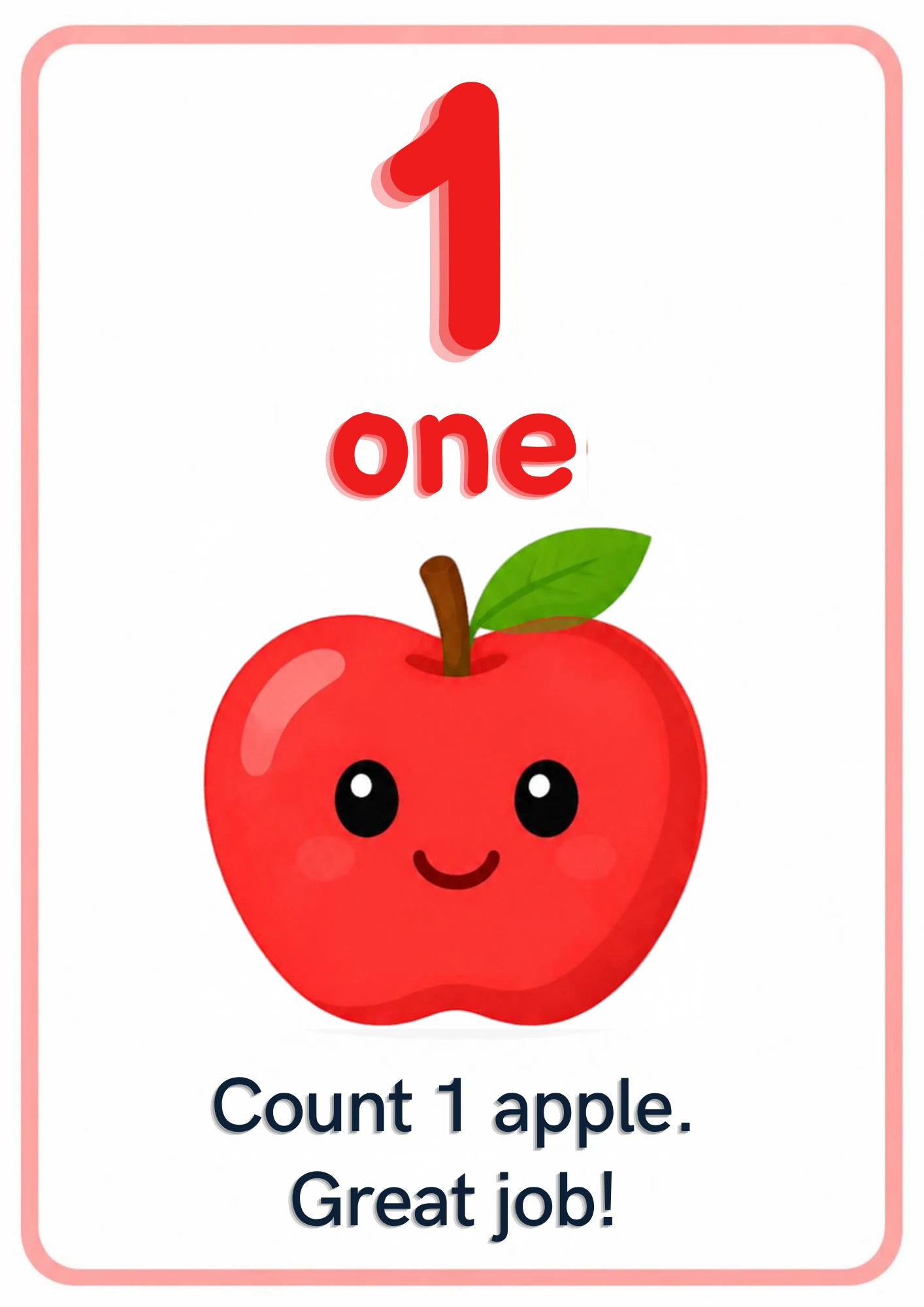
What is this?
One means a single thing — just the one, and no more. On the card it looks like a big red numeral, the word one, and a single smiling apple: the whole idea of one-ness drawn in three pieces your child can point at.
What does it mean?
Before children count groups, they notice singles — and one is the only number a three-year-old can verify by feel: one hand closed, one nose tapped, one apple on the card. That certainty is the confidence every later number borrows.
What does the child need to know?
Your child needs to know: one means a single thing, the numeral 1 is its picture, and singles are everywhere — one spoon, one shoe, one doorbell. Spotting one against many is the milestone; everything past it is repetition.
Why this matters
One is the seed the whole number line grows from: two is one and one more, three is one more again. A child who owns one deeply — not just recites it — has the unit idea installed before the bigger numbers arrive.
What it teaches
One-to-one noticing, numeral recognition, singular-to-plural language (one apple, many apples), pointing precision, and the pride of a first number fully owned.
Words to learn
oneapplesinglefirstpointalone
Say this to your child
“"Look — the number one! And here is one apple, all by itself. Can you touch it once? One tap — one apple! Now find me one thing in this room... one spoon! One! Everything has a one somewhere — can you find another?"”
Step by step
- Show the card and ask what number is hiding on it — then say one together, slowly, while a finger lands on the big numeral.
- Touch the apple once — a single, deliberate tap — and say one apple. The one-touch rule starts here and never changes.
- Sweep the room for ones: one nose, one cup, one door. Touch each find once and whisper the word.
- Hold up one finger, then two, then one again — let your child show you one with their hand until the finger pops up on request.
- Put one block on the table and ask how many. Then add more and ask again — one stays one until a second block arrives, and your child just proved it.
Look closer at the picture
Look at the card together: where is the big red numeral 1? Where is the word one? And how many apples are on the card — count them with one slow touch. The numeral, the word and the single apple all say the same thing.
Ask your child
"How many apples do you see?" "Can you touch it just once?" "Can you show me one finger?" "What else comes in ones — look around?" "Is one more than none?" — real questions with touchable answers.
What your child can say or do
Your child may announce "one!" at every single object for a day — one sock, one biscuit, one extremely plural pile of blocks. Counting errors here go the friendly way: calling things one is the enthusiasm phase, and it passes into precision.
Out in the real world
Ones fill every day: one sun in the sky, one belly button at bath time, one key for the door, one child in the car seat. Name them as you meet them — each one named is the number rehearsed in the wild.
Try it together
One-and-only basket: fill a basket with pairs and singles — two spoons, one cup, two socks, one car — and ask your child to fish out only the ones. Then reverse: hand them the cup and ask how many. The sorting is the game; the answering is the maths.
Understanding check
Hold up the card and ask how many apples, then hold up a finger and ask how many. Two right answers with one-touch pointing — that is the number landed, unit and all.
Parent tips
Accept every "one!" happily, even the wrong ones, then model the count yourself: touch the objects once, slowly. Correction is not needed when demonstration is available — and demonstration always is.
Staying safe
Counting hunts stay floor-level and finger-sized: nothing small enough to swallow joins the game, especially with a baby sibling around. One is a fine number for biscuits, too — but sitting down for eating, always.
This lesson pairs with the One Apple flashcard in the library — print it, show it, keep it on the fridge. Back to Numbers 1–10.