
Forest Animals and Their Habitat — solve it right on the sheet.
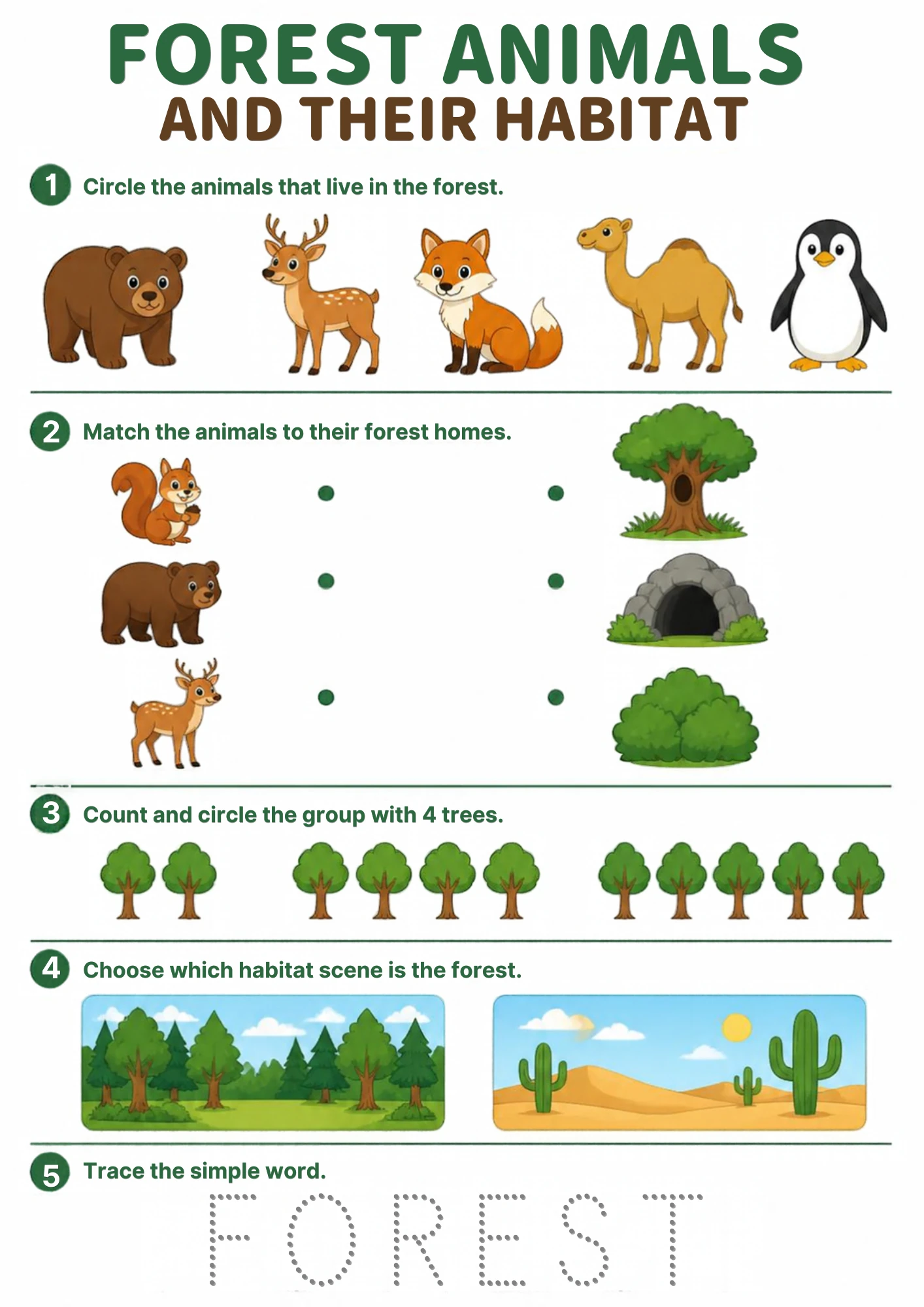
Circle the forest dwellers, match them to hollows, dens and thickets, count the trees and trace FOREST.
Your sheet is ready.
Pick a color or the eraser, then circle, match, count, choose and trace straight on the sheet with your finger, a stylus or the mouse. Press Save my work when you are proud — that is what marks this activity cleared for your child.
What this worksheet teaches.
What the child is learning: The forest is a home you can walk under: tall trees give food, shade and hiding places, and every forest animal uses them its own way.
Knowledge to have ready: The word forest, and three forest neighbors — squirrel, bear and deer — plus the fox who lives there too.
Why this activity matters: Forests are the habitat children meet in storybooks first; naming its residents turns familiar pictures into real knowledge.
- Habitat vocabulary
- Matching animals to homes
- Sorting belong and not belong
- Counting to 5
- Word tracing
What to say before you start: Under the tall trees lives a whole neighborhood — let us meet who hides in the forest.
What to look for on the sheet: For the camel standing in the circle row — sand feet have no business in the woods, and that is the laugh of the sheet.
Questions to ask along the way: Who stores food in a tree? Who sleeps all winter? Where would you hide if you were small and furry?
Helpful hints without giving it away: The tree hollow and the bush are close together in the matching row — slow lines, no guessing.
Parent tips: On the next walk under trees, play spot-the-home: holes, nests, burrows all count.
Understanding check: Point at the deer: what does the forest give it to eat? Leaves and twigs is a right answer.
Real-life practice: Collect one fallen leaf on your next walk and call it forest mail — delivered to the fridge.
This activity belongs to Class 36 — Animals & Their Habitats on the Learning Path. Progress is saved on this device for the child chosen in My Classroom — and only a real save of finished work marks it cleared, never just opening the page.
How did it go?
One tap, no writing, no name. Pick the face that matches how it went — reactions are counted instantly and stay anonymous.
Parent reviews.
A different thing from the quick faces above: a star rating for the grown-ups, plus an optional line about how it went. Every review is read by the school office before it appears.
No parent reviews yet — yours could be the first.
Parent comments.
How did you use this page Share the game, the moment or the trick that worked in your house. Comments are read by the school office before they appear, and they are about your ideas — never about your child.
No parent comments yet — yours could be the first.