
Lifeguard — a step-by-step lesson for grown-up and child
This lesson introduces the lifeguard’s watching job and sets the water rules your child will use at every pool, beach and bath.
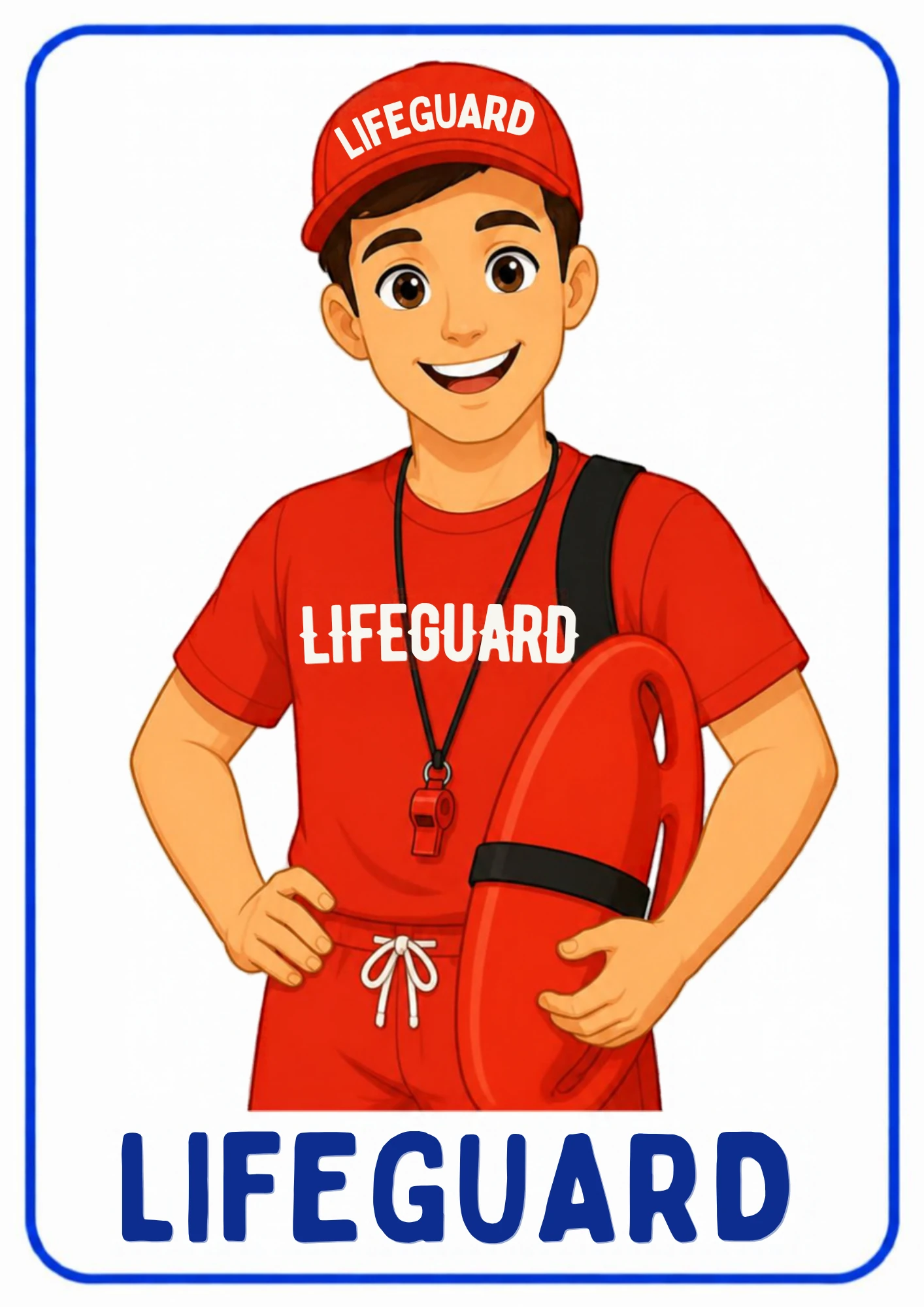
What is this?
A lifeguard is a water-safety helper who watches everyone in the water and helps the moment something goes wrong.
What does it mean?
Lifeguards sit in a tall chair by pools or on beaches, watching all the time. They blow a whistle when something is unsafe, rescue people with a buoy or tube, and know first aid.
What does the child need to know?
Water rules for fours: we ask a grown-up before any water play; a lifeguard’s whistle means freeze and listen; we walk near water, never run; a grown-up is always in the water with non-swimmers.
Why this matters
Rules feel unfair until they have a person and a reason. The lifeguard — watching IS helping — makes pool rules make sense, which is exactly when children follow them.
What it teaches
Listening-and-freezing control (a genuine safety skill), rule reasoning, water vocabulary, and the asking-before-doing habit that generalises to every risky place.
Words to learn
lifeguardwhistlerescuedeepshallowwalk
Say this to your child
“"The lifeguard watches the water all the time. When we hear the whistle, we stop and listen. Near water we walk — and a grown-up is always with us."”
Step by step
- Show the card: "This is a lifeguard. They watch the water and keep swimmers safe."
- Find the tall chair, the whistle, the rescue ring. "Sitting up high lets the lifeguard see EVERYONE."
- Give the whistle meaning: "One whistle means stop and look at the lifeguard. It is not scolding — it is helping."
- Teach the asking habit: any water — pool, bucket, bath, sea — gets a grown-up check first.
- Rehearse the freeze game at bath time so the listening reflex exists before a real pool day.
Look closer at the picture
Ask: where does the lifeguard sit — high or low? Why so high? What is the lifeguard holding? Can you find someone swimming? What colours say "safety" on this card?
Ask your child
"What does the lifeguard’s whistle mean?" "Why does the lifeguard sit so high?" "Do we run or walk near the pool?" "Who do we ask before we go in the water?"
What your child can say or do
Practise the freeze: you whistle softly, your child stops and looks. And the asking line: "May I go in the water?" — said before any water play.
Out in the real world
At the pool, find the lifeguard together: "See how they never stop watching? That is their whole job." Beach flags and pool-depth signs are lifeguard language — decode one.
Try it together
Bath lifeguard: your child is the lifeguard on the "chair" (closed toilet lid, towels for a tower). You wash a doll; lifeguard blows a pretend whistle; doll freezes; lifeguard says "safe!" Swap and let them run the whistle show.
Understanding check
Ask: "What does the whistle mean? Walk or run at the pool? Who goes in the water with you?" Freeze + walk + grown-up = pass.
Parent tips
Never treat the whistle as punishment — it is a helper’s voice. Praise fast freezing; the speed IS the safety. If your child is swim-shy, the lifeguard can be introduced as "the person who helps everyone feel brave".
Staying safe
Never swim without a grown-up actually in the water. No running on wet pool sides. Ponds, buckets and paddling pools count as water — the asking rule covers them all.
This lesson pairs with the Lifeguard flashcard in the library — print it, show it, keep it on the fridge. Back to Community Helpers & Our Neighborhood (Class 33).