
Mail Carrier — a step-by-step lesson for grown-up and child
This lesson follows one letter’s journey and gives your child a real one to send — mail is the most concrete community helper magic there is.
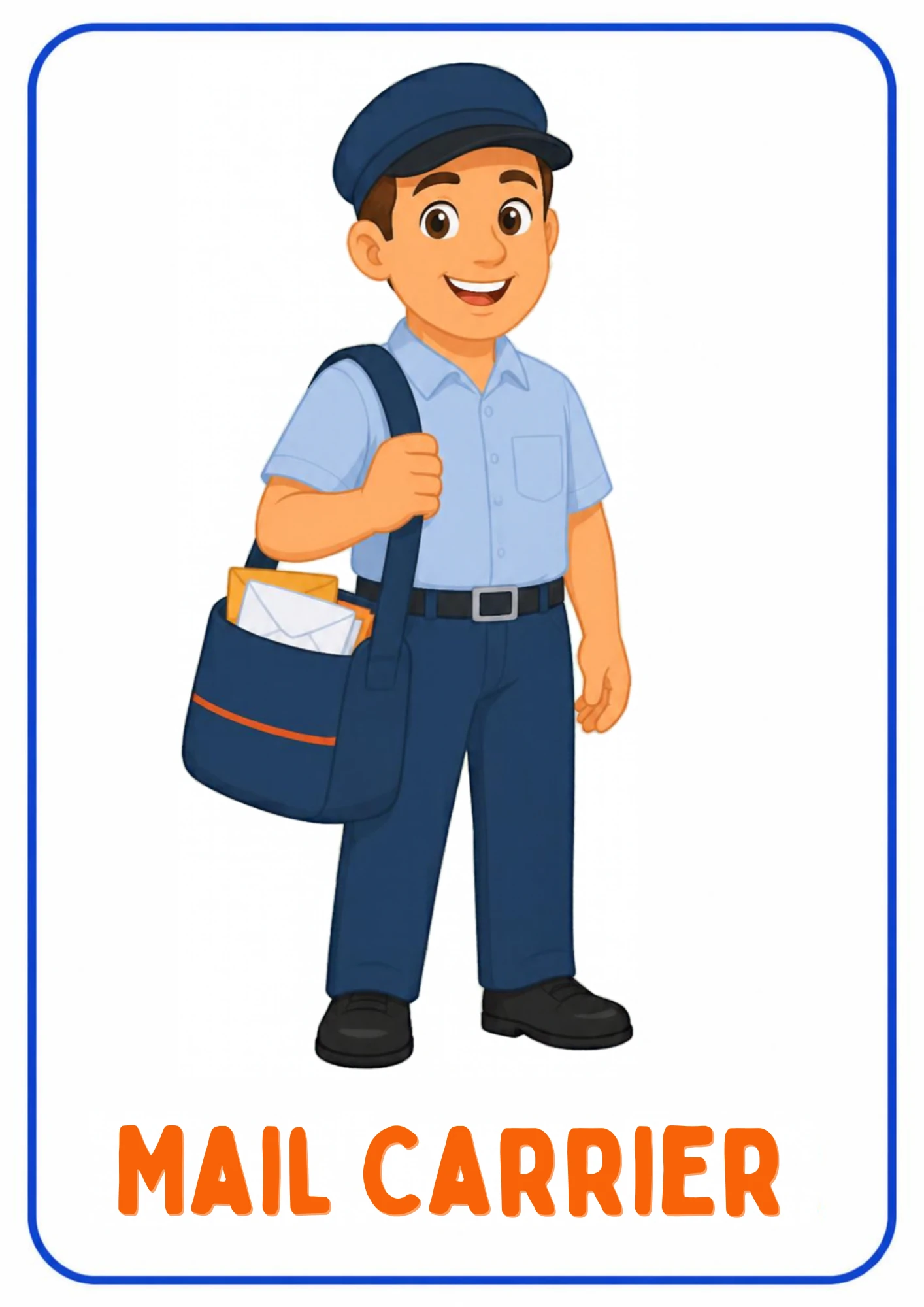
What is this?
A mail carrier is a delivery helper who brings letters, cards and parcels to every home on the street — and carries our post away to the people we love.
What does it mean?
Mail carriers walk or drive a route with a big bag, sorted in address order. Letters travel from post box to sorting office to route — sometimes with a plane or train in between.
What does the child need to know?
The posting loop: write → envelope → stamp → post box → mail carrier → the right letterbox. And the golden rule: our letterbox and mail truck are the carrier’s workplace, not toys.
Why this matters
Posting real mail connects writing to love: your scribble becomes a grandparent’s smile. Address, stamp and delivery stop being abstract words and become a thing your child DID.
What it teaches
Sequencing across days (write today, arrive Thursday — patience!), address awareness, name-writing motivation, community maps, and giver’s joy.
Words to learn
mail carrierletterenvelopestamppost boxdeliver
Say this to your child
“"The mail carrier brings us letters and parcels, and takes ours away to the people we love. A drawing from your hands can travel across the whole town — or the whole world."”
Step by step
- Show the card: "This is a mail carrier. They bring letters to our home and take ours away."
- Find the bag, the letters, the truck. "The bag is heavy — the letters inside are for many different houses!"
- Trace the journey with your finger: our table → post box → sorting office (the letters get sorted like socks!) → the mail carrier’s bag → Grandmother’s letterbox.
- Read an envelope together: name, street, town. "The address is the letter’s home address!"
- Make a real letter today — the lesson only lands when something is actually posted.
Look closer at the picture
Ask: what is the mail carrier carrying? How many letterboxes can you count? What colour is the truck? Is it raining or sunny — do mail carriers still work?
Ask your child
"Who brings our letters? Where does our letter go after the post box? What is on the front of an envelope? Who could we send a picture to?"
What your child can say or do
Practise the send-off: "Dear Grandma, I made this for you!" — your child "writes" their name and tells you whose letter it is and where it is going.
Out in the real world
Walk to a real post box and post something real. Track bin-and-mail days on a family calendar; watch for the carrier on your street and wave.
Try it together
Home post office: shoebox counter, paper stamps, envelopes, a sock "mail bag". Family members write notes; your child sorts by person and delivers to letterboxes made of cereal boxes. Sorting = the real job.
Understanding check
Ask: "Who brings our mail? Where does a letter go after we post it? What do we put on the envelope?" Carrier + sorting + address = pass.
Parent tips
The waiting is the lesson: mark on the calendar when the letter should arrive. If the carrier comes, a wave and "thank you!" from the doorstep beats any worksheet.
Staying safe
Never open other people’s post or mailboxes, and never play behind a parked delivery van — drivers cannot see small people there.
This lesson pairs with the Mail Carrier flashcard in the library — print it, show it, keep it on the fridge. Back to Community Helpers & Our Neighborhood (Class 33).