
Paramedic — a step-by-step lesson for grown-up and child
This lesson turns siren panic into understanding: who is inside the ambulance, what they carry, and what your family does in a real emergency.
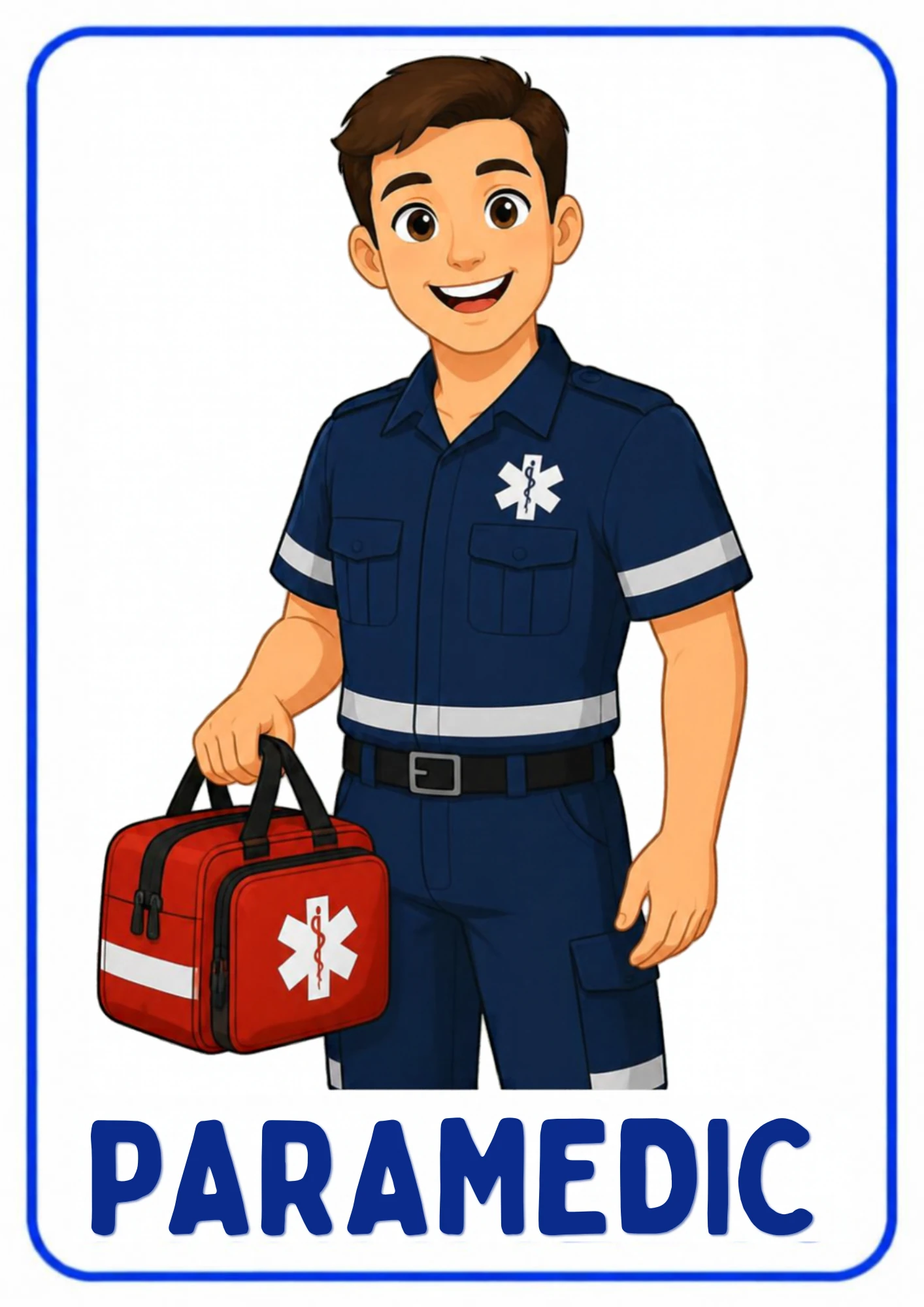
What is this?
A paramedic is a fast health helper. In a big emergency, they come quickly in an ambulance to help the person and take them to hospital.
What does it mean?
An ambulance is a rescue car with lights, a siren and a mini-hospital inside: stretchers, oxygen, bandages, a radio. Paramedics check the patient on the spot and keep helping all the ride to hospital.
What does the child need to know?
Three things your child should carry home: the siren means help is on the way, the emergency number (practise yours), and in an emergency we find a grown-up — fast and loudly.
Why this matters
Emergencies are frightening because they are unknown. Naming the helpers, the vehicle and the family plan gives your child a script — and scripts shrink fear.
What it teaches
Emergency vocabulary, number memory, listening under stress (practised calmly!), community-trust building, and sequencing: call → helpers arrive → check → hospital.
Words to learn
paramedicambulanceemergencysirenstretcherfirst aid
Say this to your child
“"If something bad happens, we tell a grown-up right away — loud and clear. Grown-ups call the emergency number, and the paramedics come fast with their ambulance to help."”
Step by step
- Show the card: "This is a paramedic. When there is a big emergency, paramedics come fast to help."
- Find the ambulance parts: lights, siren, the cross, the wheels that go very fast.
- Explain the noise honestly: "The siren is loud so cars hear it and move — that is how help gets there quickly."
- Learn your family emergency number today: say it, tap it on a toy phone, sing it. Three tiny rehearsals beat one big lecture.
- Rehearse the family rule: big trouble → shout for a grown-up → grown-up calls. Never play-call emergencies for fun.
Look closer at the picture
Ask: what is on top of the ambulance? What colours do you see? What is the paramedic holding? Where do you think the patient rides — can you find the windows?
Ask your child
"Who comes in an ambulance?" "Why is the siren so loud?" "What would you do if someone fell and could not get up?" "What is our emergency number?"
What your child can say or do
Practise the shout: "Grown-up, come quick, help please!" and the number, spoken clearly twice. Then the calm sentence: "The paramedics are coming to help."
Out in the real world
When a siren passes, stop and listen: "Someone needs help — and helpers are coming." Ambulance open days let children sit inside; the radio alone is worth the trip.
Try it together
Teddy rescue: Ted "falls" off the sofa. Your child shouts for a grown-up (you), you "call", the toy ambulance rushes over, paramedic checks Ted on a shoebox stretcher, everyone recovers. Repeat weekly — rehearsal is the point.
Understanding check
Ask: "Who comes to help in a big emergency? What do we do first? Say our emergency number." Loud-and-clear shout + number = pass.
Parent tips
Sensitive children may need the siren named BEFORE it happens. Keep the number learning light — songs and toy phones, never quizzes. Praise every "I told a grown-up", real or pretend.
Staying safe
Emergency numbers are for real emergencies only — never for fun calls. Ambulance bays and moving trucks are out of bounds; children watch from far back with a grown-up.
This lesson pairs with the Paramedic flashcard in the library — print it, show it, keep it on the fridge. Back to Community Helpers & Our Neighborhood (Class 33).