
School Counselor — solve it right on the sheet.
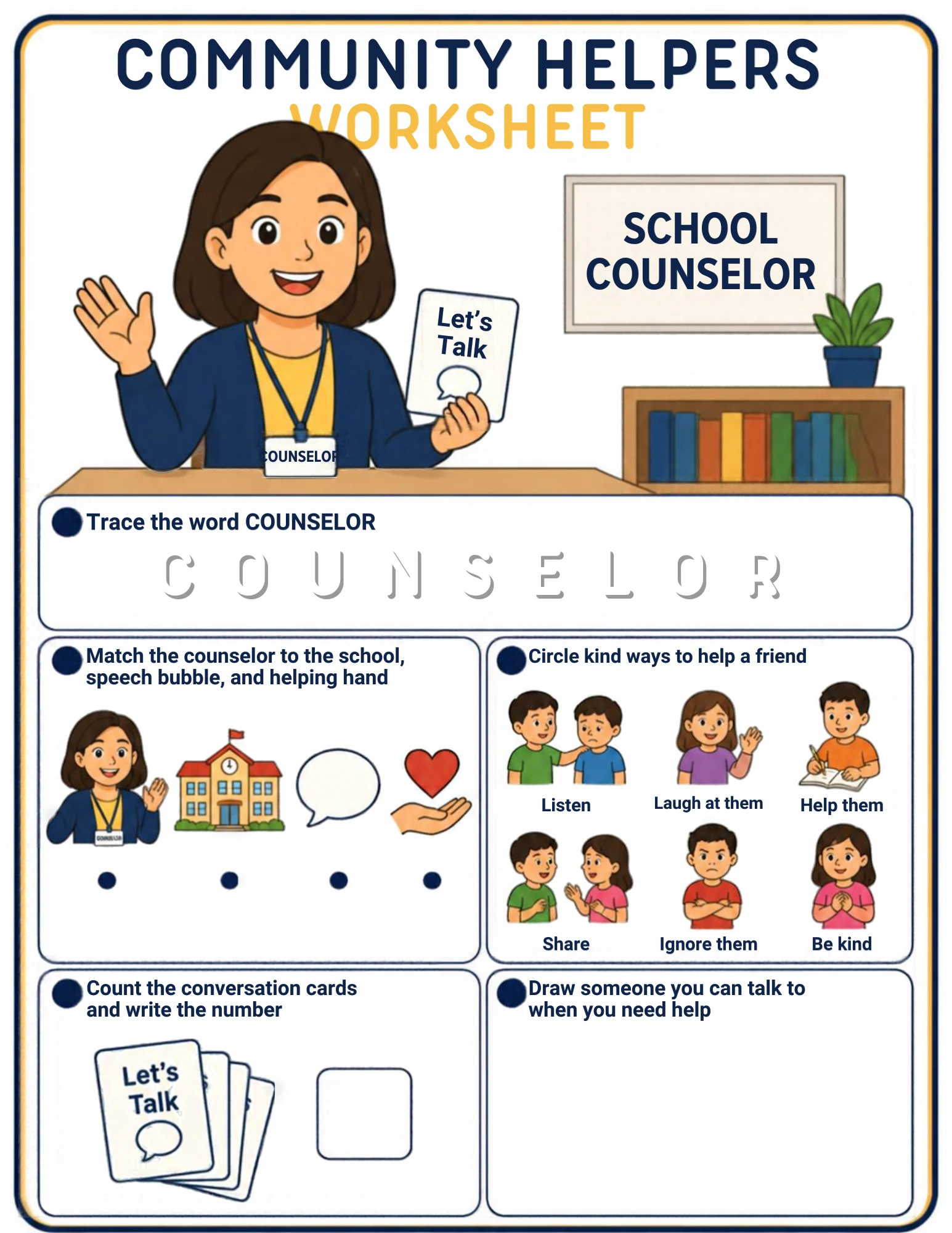
Trace COUNSELOR, match the counselor to the school, the speech bubble and the helping hand, circle the kind ways to help a friend, count the conversation cards and draw someone you can talk to.
Your sheet is ready.
Pick a color or the eraser, then trace, match, circle, count and draw straight on the sheet with your finger, a stylus or the mouse. Press Save my work when you are proud — that is what marks this activity cleared for your child.
What this worksheet teaches.
What the child is learning: Who the school counselor is and how they help, four kind ways to help a friend — and the two unkind ones to catch — plus how to write the word COUNSELOR.
Knowledge to have ready: A school counselor is a feelings helper: the speech bubble means listening and talking, the helping hand means steady support, and their door is open when a day feels too big. Kind friends listen, help, share and are kind — laughing AT someone and ignoring someone are the two tricks to catch.
Why this activity matters: This is the heart sheet of the set: every tile is either a kindness or a trap, and four-year-olds are at exactly the age when friendship habits set. Sorting kind from unkind gives your child the words for the playground, and the draw box names a real person to talk to — a safety net drawn in crayon.
- Feelings vocabulary
- Kind-versus-unkind sorting
- Helper awareness
- Word tracing
- Counting practice
- Trusted-adult drawing
What to say before you start: "This is a school counselor — a helper for feelings and friendships. Trace the name, then connect the school, the speech bubble and the helping hand. Now the six ways to treat a friend: which ones are kind? Two are tricks! Count the conversation cards, and then draw YOUR person to talk to when a day feels big."
What to look for on the sheet: Find the speech bubble and ask what it is full of — words worth listening to. In the grid, read each way aloud and ask your child to make a kind face or a no-thank-you face at each one. Laughing AT someone and ignoring someone get the biggest no faces of all.
Questions to ask along the way: "What does the school counselor do all day?" "Which four ways are kind to a friend?" "What could you say if a friend feels sad?" "Who is YOUR talk-to person — and what would you tell them?"
Helpful hints without giving it away: Kind ways make friends feel bigger; the tricky ones make friends feel small. Ask of each tile: would I like it if someone did this to ME? That one question sorts the whole grid.
Parent tips: Teach the golden test as a daily habit — would I like that done to me? — and let your child hear you use it too. The draw box matters most here: name the real people your child can always talk to, at school and at home, and say it out loud together.
Understanding check: Ask: "Who is the feelings helper at school? Name two kind ways to treat a friend. Which two ways are not kind?" The counselor, two kindnesses, the two tricks = the sheet landed.
Real-life practice: Practise one circled kindness today — listen to a sibling’s whole story, share a snack, help set the table. Then ask your child to name their talk-to people while pointing at the drawing. Safety nets work best when they are spoken out loud.
This activity belongs to Class 33 — Community Helpers & Our Neighborhood on the Learning Path. Progress is saved on this device for the child chosen in My Classroom — and only a real save of finished work marks it cleared, never just opening the page.
How did it go?
One tap, no writing, no name. Pick the face that matches how it went — reactions are counted instantly and stay anonymous.
Parent reviews.
A different thing from the quick faces above: a star rating for the grown-ups, plus an optional line about how it went. Every review is read by the school office before it appears.
No parent reviews yet — yours could be the first.
Parent comments.
How did you use this page Share the game, the moment or the trick that worked in your house. Comments are read by the school office before they appear, and they are about your ideas — never about your child.
No parent comments yet — yours could be the first.