
Clean Up After Eating — a step-by-step lesson for grown-up and child
This lesson ends the meal properly: your child learns that eating is not finished when the belly is full — it is finished when the spot is clear — and that the clear-away is their own three-move job.
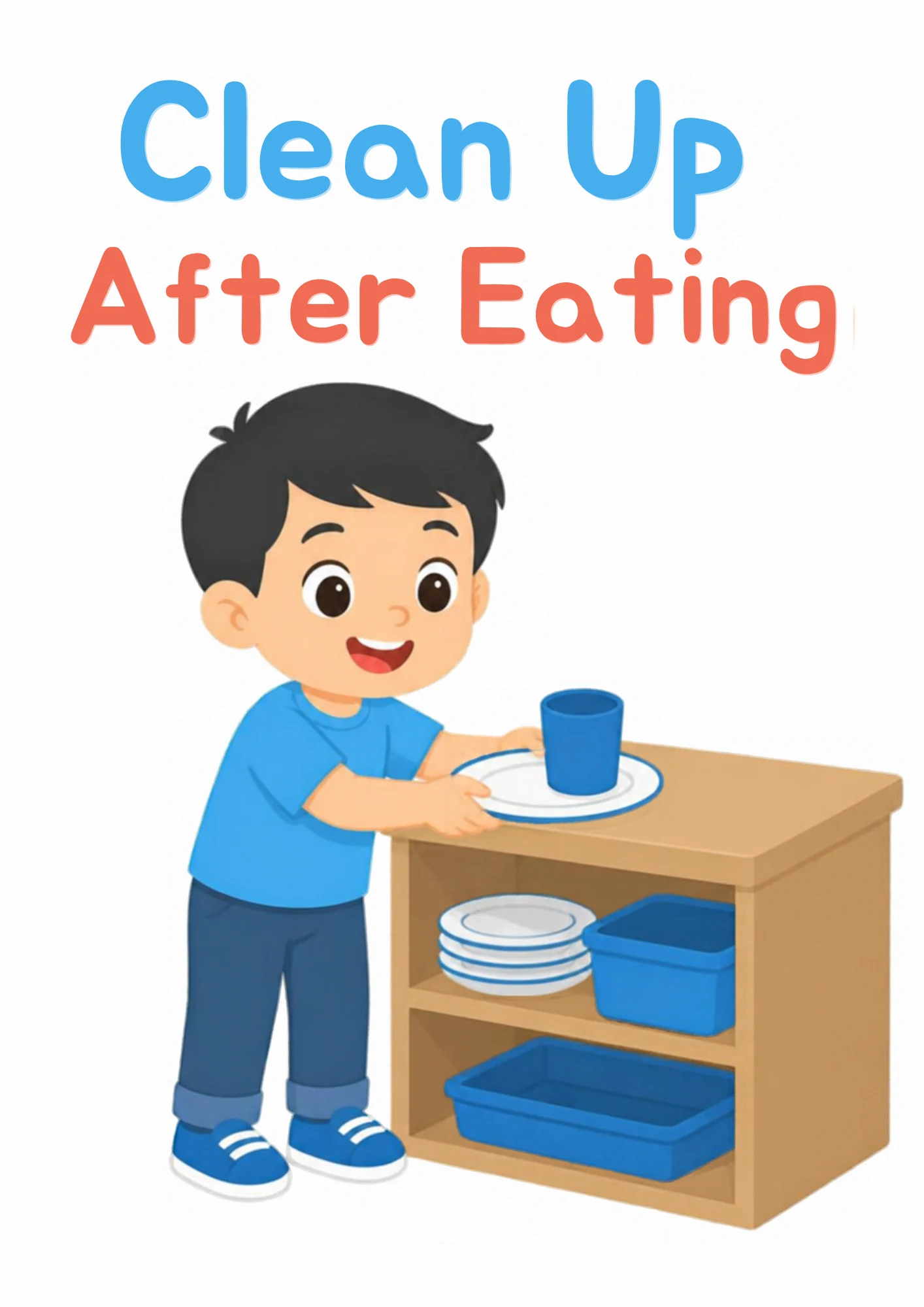
What is this?
Cleaning up after eating means carrying your own plate and cup to where they go, sweeping crumbs into the bin, and pushing the chair back in — the meal’s final chapter.
What does it mean?
In restaurants and preschool canteens, trays go to a rack because meals have an end-to-end shape: eat, clear, done. Learning that shape at home makes every eating place outside it feel familiar instead of confusing.
What does the child need to know?
The three moves: plate and cup to their place, crumbs to the bin, chair pushed in. Where "their place" is depends on the house — deciding YOUR places together is part of the lesson.
Why this matters
Clearing one’s own spot is the first chore that is entirely self-contained — no help needed, no technique required, a finish line visible from the first bite. That is why it sticks: the win is always winnable.
What it teaches
Task completion (seeing a job through to its true end), sequencing, ownership and contribution — "I am someone who helps this family run" — plus careful carrying, an underrated motor skill.
Words to learn
platecupcrumbsbinclearfinished
Say this to your child
“"Belly full? Then the job starts. Plate and cup go to their place, crumbs go in the bin, chair goes back in. Three moves and the meal is truly finished — and everyone in this house clears their own spot, even grown-ups."”
Step by step
- Show the card: what is the boy carrying? Where is he putting it? Name the skill — the meal is not over until the spot is clear.
- Walk YOUR kitchen or table: agree where the plate goes, where the cup goes, where crumbs go. The card names the job; your home names the places.
- Start the routine tonight with the three moves done side by side, then step back one move at a time.
- Add the chair push-in as the ceremonial finish — the small click that says "this meal is complete".
- Let the routine be the boss, not you: "what comes after the last bite?" becomes your whole prompt.
Look closer at the picture
Ask your child: what is the boy carrying? What is sitting on top of the plate? Where is he putting them — the shelf with the stacked plates, or the bins below? What color is his cup?
Ask your child
"What are the three moves?" "Where does your plate live in our kitchen?" "What do we do with crumbs?" "What is the very last move before the meal is done?"
What your child can say or do
"Belly full, plate away!" Your child may quiz YOU at dinner — "Daddy, where does your cup go?" — or narrate the three moves like a game show host.
Out in the real world
The skill travels to every eating place: the tray rack at the food court, the plate scrape at grandma’s, the preschool lunch table. Each one is the same three moves with new locations — name them as you go.
Try it together
Restaurant at home: set a tray, "serve" the meal, then play the return-to-the-rack moment with your child as both waiter and customer. Swap roles — being the waiter who clears is the practice; being the customer who clears is the proof.
Understanding check
Ask: "What are the three moves? Where does your plate go? What tells us the meal is really finished?" Three moves, right place, chair pushed in = landed.
Parent tips
Start small — carry the plate only, you handle scraping and washing. The habit outranks the technique; technique comes with height and years. Never redo their clear-away in front of them; if the cup must move later, move it quietly.
Staying safe
Plates and cups break when dropped — carry one thing at a time, two hands, walking feet. Sharp cutlery and hot pans stay grown-up jobs; your child’s cargo is the safe, unbreakable set.
This lesson pairs with the Clean Up After Eating flashcard in the library — print it, show it, keep it on the fridge. Back to Life Skills & Good Habits (Class 32).