
Get Dressed — a step-by-step lesson for grown-up and child
This lesson breaks dressing into its real steps and gives the mornings back to your child: the order that works, the night-before trick, and the calm voice for the shirt that gets stuck.
What is this?
Getting dressed alone means putting clothes on in a sensible order — underwear, then shirt, then trousers, then socks and shoes — fastening what can be fastened and asking for help only for the tricky bits.
What does it mean?
Clothes have a logic: what sits closest to the body goes on first; tags go at the back; the head hole is stretchy and the sleeves are tunnels for arms. Once the logic clicks, every new garment is the same puzzle in new cloth.
What does the child need to know?
The two supporting skills: choosing (decided the night before, not mid-morning rush) and ordering (top before trousers or trousers before top — either is fine, but it must be a plan). The shirt-over-head moment is the one that traps four-year-olds; the trick is arms first, then head.
Why this matters
Dressing independently is the morning’s first win, and its shadow stretches across the day: a child who dressed themselves arrives at breakfast already capable. It also quietly builds the fine-motor strength that buttons, zips and later pencils demand.
What it teaches
Fine-motor control (pushing arms through, pulling waistbands), sequencing a multi-step routine, spatial thinking (front, back, inside-out) and frustration tolerance — the shirt WILL get stuck, and that is the lesson working.
Words to learn
shirtsleevestagstretchyorderzip
Say this to your child
“"Every piece has a home: underwear first, then the shirt, arms make the tunnels, head walks through, trousers up, socks last. When something sticks, you say ‘help please’ — and when it goes in backwards or inside-out, we just flip it. Clothes always forgive."”
Step by step
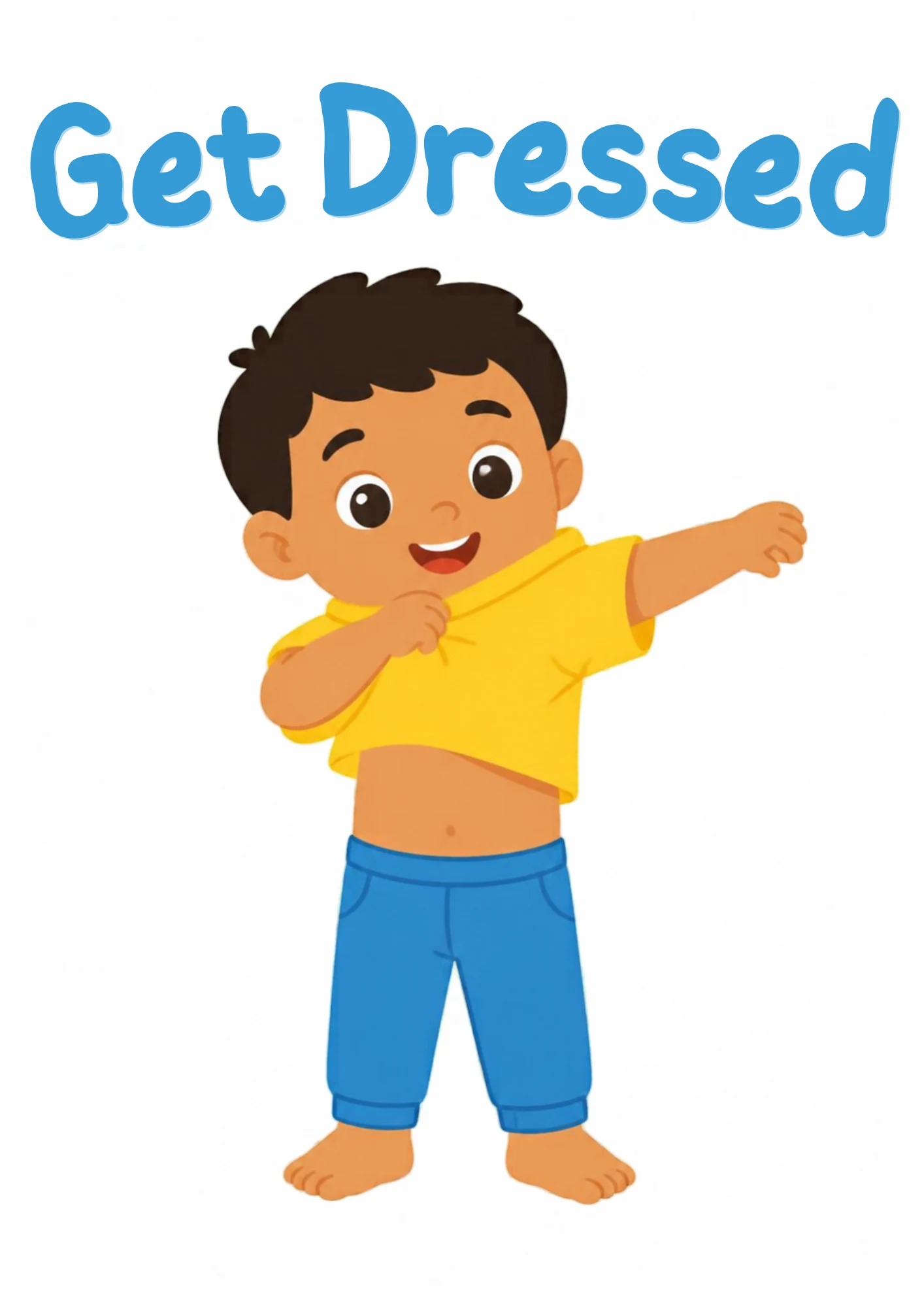
- Show the card: the boy is pulling a yellow shirt over his head with one arm already through — name exactly that moment, because it is the hard one.
- Walk the order with your child’s own clothes: underwear, shirt, trousers, socks. Say the order out loud as a chant.
- Teach the stuck-shirt fix: arms through first, then pull the head hole over — "arms make the tunnel, head walks through."
- Lay out tomorrow’s clothes together at bedtime, in the order they go on, so the morning has no decisions left in it.
- Narrate like a sports commentator while your child dresses — no hands-on help unless the ask comes first.
Look closer at the picture
Ask your child: what color is the boy’s shirt? How many arms can you see — has one gone through yet? Where is his head — in the shirt or still out? What is he wearing on his feet so far?
Ask your child
"Which goes first, the shirt or the socks?" "What do we do when the head gets stuck?" "What could the tag tell us about the front and the back?" "What did we lay out last night?"
What your child can say or do
"Arms make the tunnel!" "I did it — look, look!" Your child may dress a doll in the same order, chanting the steps, or announce the day’s clothing plan at breakfast.
Out in the real world
Dressing happens in many places: bedrooms, swimming-lesson changing rooms, grandma’s house after a sleepover, the beach towel change. The same order works everywhere — and elastic waists travel better than buttons.
Try it together
Dress-the-ted relay: a bear, a child-sized shirt and a timer that nobody checks. Your child dresses the bear, then themselves, then "judges" which outfit has fewer twists. Slow is fine — accuracy is the game.
Understanding check
Ask: "What goes on first? What is the stuck-shirt fix? What did we lay out last night?" Underwear first, arms-then-head, correct clothes = landed.
Parent tips
Choose clothes that forgive: elastic waists, loose necks, velcro shoes. Buttons and zips arrive on their own schedule; struggle is the practice, not a sign it is too hard. Buy the next size with tomorrow in mind — tight sleeves turn winners back into babies.
Staying safe
Drawstrings on hoods and waists get cut off — they catch on slides and playground equipment. Dress for the weather you will meet, not the weather you see from the window, and never let a child stand while wriggling into trousers — sitting prevents the toppling.
This lesson pairs with the Get Dressed flashcard in the library — print it, show it, keep it on the fridge. Back to Life Skills & Good Habits (Class 32).