
Listen Carefully — a step-by-step lesson for grown-up and child
This lesson breaks listening into its three visible parts and builds the skill that school will run on: ears open, eyes on the speaker, body calm — then one two-step instruction at a time.
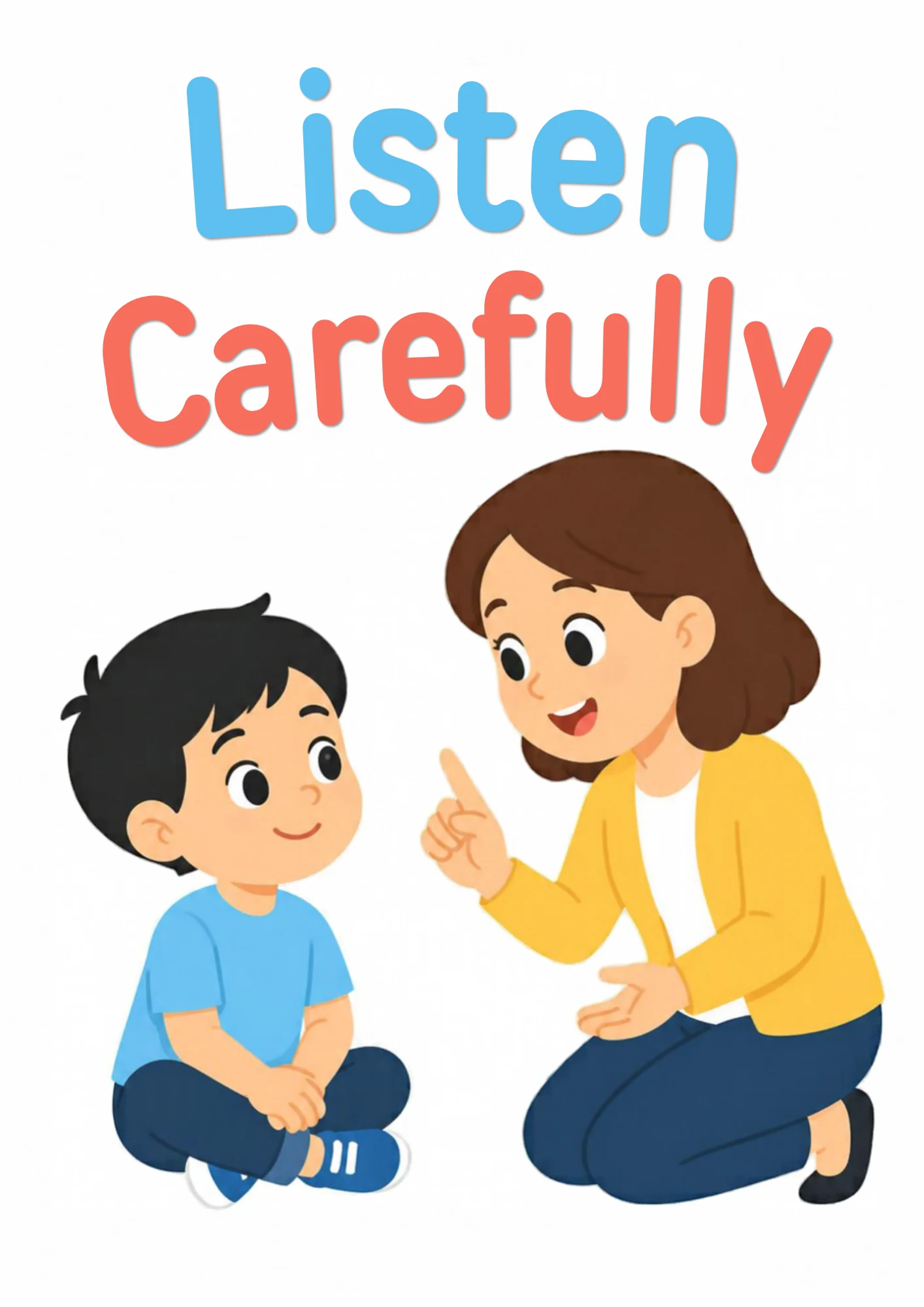
What is this?
Listening carefully means pointing your whole self at the speaker — ears open, eyes looking, body still enough — and holding the words long enough to do what was asked.
What does it mean?
Listening is more than hearing: hearing is the sound arriving, listening is choosing to receive it. The three parts are visible on purpose — a child who cannot yet listen well can still DO ears-on, eyes-on, body-calm, and the mind follows the body.
What does the child need to know?
The practice unit is the two-step instruction: "get your cup, then sit at the table." Two steps is the four-year-old sweet spot; three is a stretch goal. The repeat-back comes BEFORE the doing: "say it to yourself first."
Why this matters
Whole-body listening is the master key of classroom life: instructions, stories, safety rules all arrive through it. A child who listens the first time keeps teachers warm and mornings smooth — the skill pays daily, forever.
What it teaches
Attention control, working memory (holding two steps), sequencing, self-regulation of the body, and communication respect — the listening half of every conversation your child will ever have.
Words to learn
listenearseyescalmstepsrepeat
Say this to your child
“"Listening is three things your body can do: ears open, eyes on me, body calm. Then the words get to land. I will give you a two-step mission — you say it back to yourself first, then do it. Cup first, then table. Say it. Now show me."”
Step by step
- Show the card: the grown-up kneels at the boy’s level with one finger raised, mid-sentence; he sits cross-legged, eyes on her, hands resting. Name all three listening parts on his body.
- Get to eye level and start with their NAME — a child listening across a room is half-listening. Name first, then talk.
- Play "what did I say": give one two-step instruction, have your child repeat it back, then do it. Repeat-back first, action second — every time.
- Stretch slowly: two steps mastered means try a three-step once a week — no more.
- Praise the listening, not just the doing: "you listened with your whole body" names the skill they can reuse.
Look closer at the picture
Ask your child: is the grown-up standing tall or kneeling low? What is her finger doing? Where is the boy sitting? Where are HIS eyes looking? Where are his hands? Can your body sit like that right now?
Ask your child
"What are the three parts of listening?" "What do we do with the mission before we do it?" "Why do I say your name first?" "What was today’s two-step mission?"
What your child can say or do
"Ears on, eyes on, body calm!" "Cup first, then table — done!" Your child may request missions at bedtime, or correct a teddy’s wandering eyes mid-story with the three-parts rule.
Out in the real world
Real listening gets tested daily: the preschool teacher’s morning instructions, the coach’s game rules, the safety words in the car park. Each is a two-step mission in the wild — and the repeat-back works everywhere.
Try it together
Simon-says-lite: you give two-step missions — "touch your nose, then hop once" — and swap roles so your child invents missions for you. Inventing instructions teaches what instructions feel like from the other side.
Understanding check
Ask: "Name the three parts. What comes first, the repeat-back or the doing? What is a two-step mission?" Three parts, repeat-back, one live mission = landed.
Parent tips
Deliver instructions at eye level with the name first — across-the-room shouting trains nobody. One mission at a time; instruction-piles bury the first step. If listening slips, check the basics: hungry, tired, mid-play — the skill needs a fed, calm brain.
Staying safe
Some listening is safety-critical: the word STOP from a trusted grown-up means freeze immediately, even mid-run — no questions first. Practise stop-and-freeze as a game so the real word has a rehearsed body behind it.
This lesson pairs with the Listen Carefully flashcard in the library — print it, show it, keep it on the fridge. Back to Life Skills & Good Habits (Class 32).