
Say Please and Thank You — a step-by-step lesson for grown-up and child
This lesson teaches the two magic words as tools, not tricks: please opens requests gently, thank you closes them warmly — practised through a trading game until they arrive on their own.
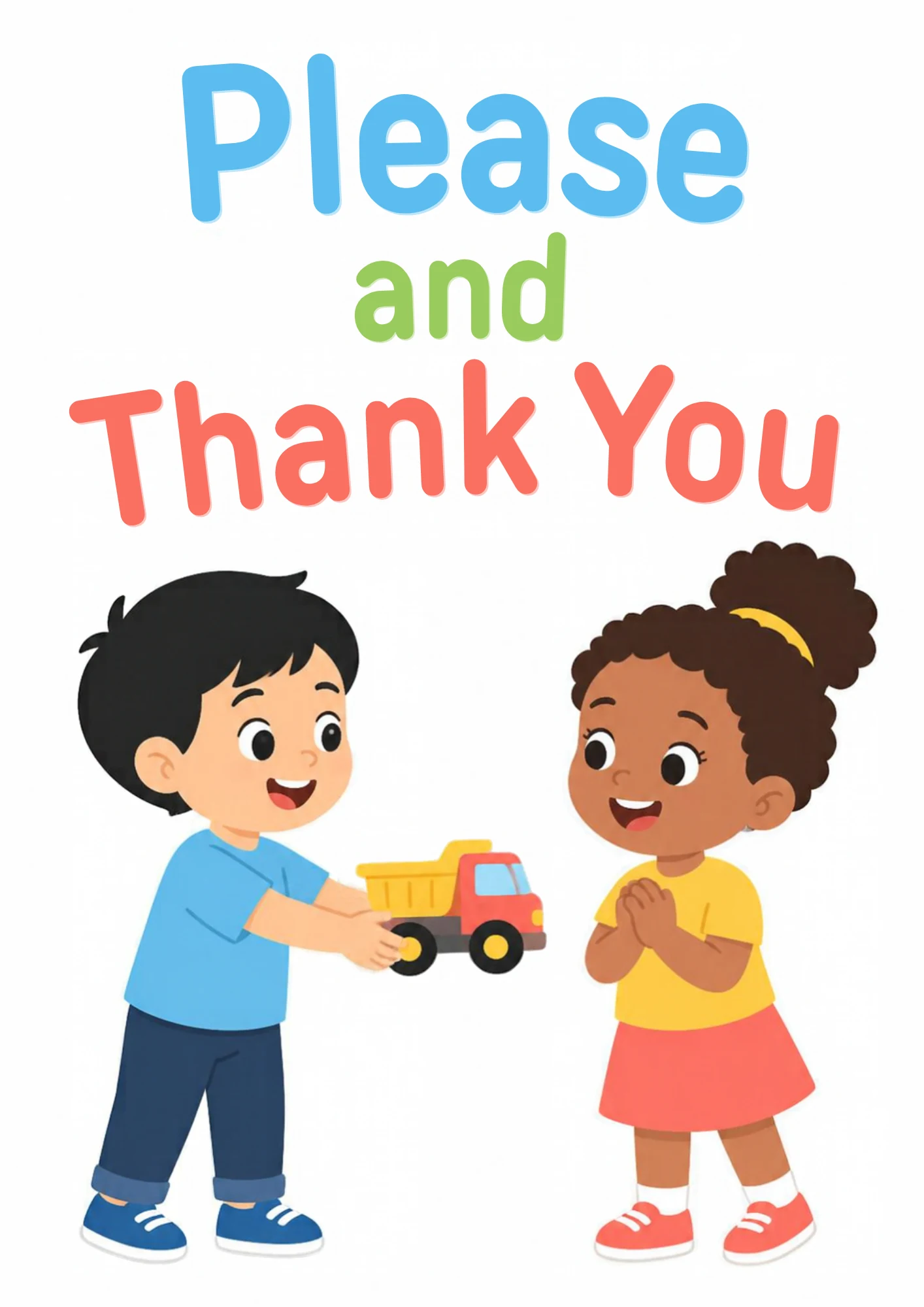
What is this?
Saying please and thank you means asking with a soft word — "please" — and answering kindness with another — "thank you" — so that both sides of every exchange feel good.
What does it mean?
Please tells the other person you are asking, not demanding; thank you tells them their kindness landed. Neither word changes what you get — it changes the relationship around the getting.
What does the child need to know?
The pairing: please goes BEFORE receiving, thank you comes AFTER. Both are practised best in real mini-exchanges — a toy handed over, a cup passed, a door held — not in lectures about manners.
Why this matters
Politeness is social grease that lasts a lifetime: people lean toward children (and adults) who ask kindly and receive warmly. The habit planted at four through play becomes character by ten.
What it teaches
Social scripts (the words that open exchanges), empathy (noticing the giver), turn-taking language, self-control (pausing to add the word), and the confidence of knowing the universal password to every kindness.
Words to learn
pleasethank youaskreceivekindmanners
Say this to your child
“"Please is how we ask, thank you is how we receive. Watch: ‘May I have the truck, please?’ — here it is! — ‘Thank you!’ Two little words, and both of us feel warm. Your turn: ask me for anything you like, with the magic word."”
Step by step
- Show the card: the boy holds the truck OUT, the girl’s hands are clasped with joy — name both halves: the offering and the receiving.
- Act out the trade with a real toy: your child asks with please, you hand it over, they answer with thank you. Repeat until it flows.
- Swap roles so your child is the giver too — hearing "thank you" is half the education.
- Play the fade game: prompt less each week ("what do we say?" becomes a smile, then nothing) so the words learn to travel alone.
- Catch them doing it for real and name it exactly: "you said thank you all by yourself — I heard it."
Look closer at the picture
Ask your child: what is the boy holding out? What are the girl’s hands doing — grabbing, or clasping happily? What do her happy hands tell us? What do you think she is about to say?
Ask your child
"Which word comes before we get something? Which comes after?" "How does it feel when someone says thank you to YOU?" "What do we say when we want a turn?" "Can you ask me for something with the magic word?"
What your child can say or do
"Truck, please!" "Thank you!" Your child may run shop-at-home with please-and-thank-you as the only accepted currency, or catch a grown-up forgetting a thank-you with gleeful justice.
Out in the real world
The magic words work everywhere: asking a shopkeeper for help, receiving a birthday plate, thanking the bus driver on the way off. Each real use is a rep — and every one lands on a real person who visibly warms.
Try it together
Kindness shop: stack toys as "goods", take turns being customer and shopkeeper — every transaction must include both magic words or the shop cannot open. Manners as the engine of the game, not the moral of it.
Understanding check
Ask: "Which word asks and which word receives? Show me a please-and-thank-you trade right now." Before-and-after placed, one live trade = landed.
Parent tips
Prompt with a question, not an accusation — "what do we say?" keeps the child’s dignity while their mouth catches up. Never shame in public; practise in play. Fade prompts slowly: the goal is a habit that appears without you, and it will.
Staying safe
Politeness has a limit that must be taught in the same breath: a child may always say a firm NO to a stranger’s request, an unwanted touch or an unsafe ask — please does not open every door, and safety outranks manners, always.
This lesson pairs with the Say Please and Thank You flashcard in the library — print it, show it, keep it on the fridge. Back to Life Skills & Good Habits (Class 32).