
Share Your Toys — a step-by-step lesson for grown-up and child
This lesson teaches sharing as the child’s own generous act — the held-out toy and its words — with the training wheels that make it real: timer turns, the special basket, and the words of offering.
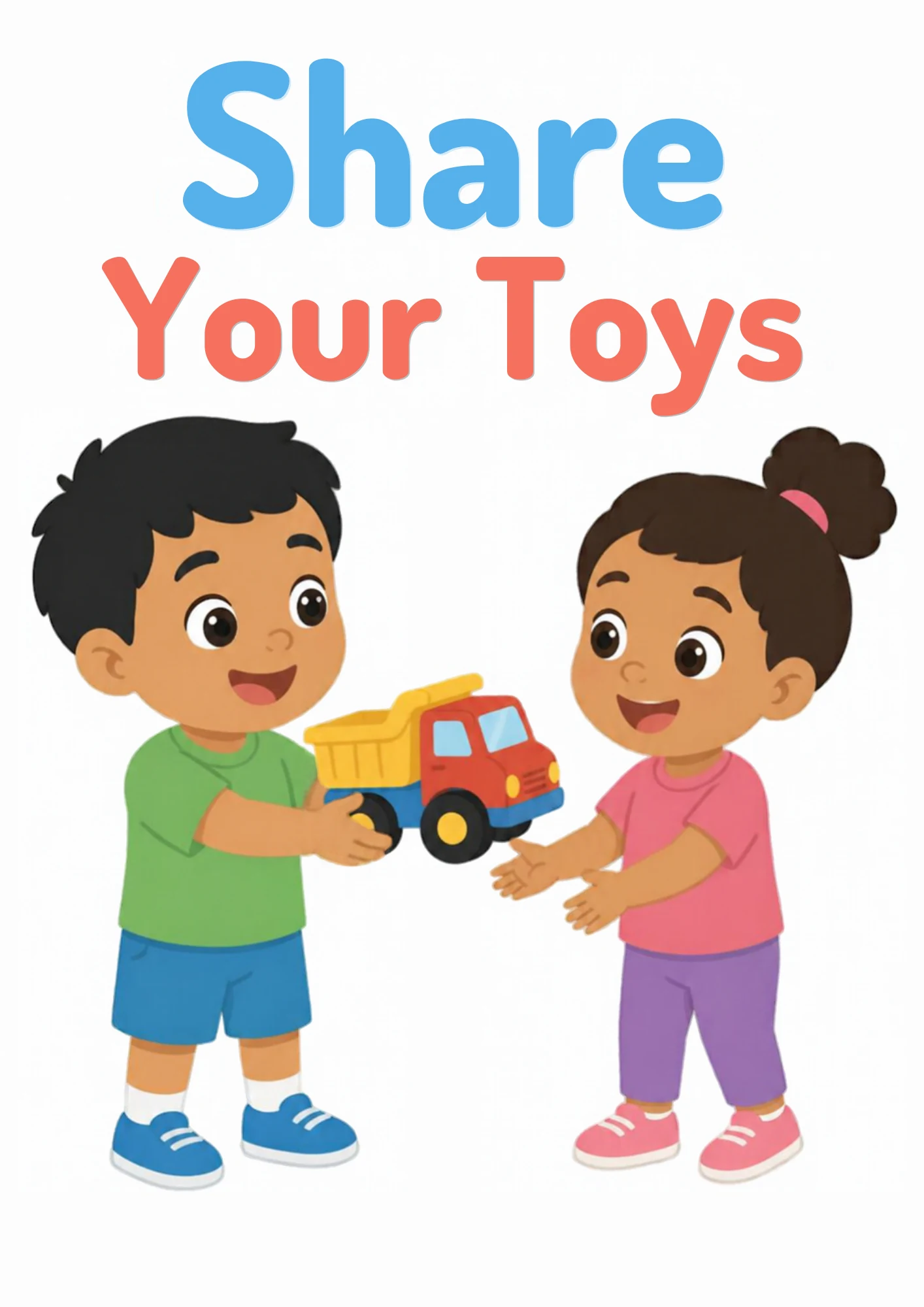
What is this?
Sharing your toys means offering something of yours to someone else — holding it out, saying the words — so two children get more fun than one toy alone can give.
What does it mean?
Sharing is generosity in motion, and it must be chosen to count. Forced sharing teaches resentment, not kindness. Real sharing has a vocabulary: "do you want a turn?", "here, you can go first", "let’s trade."
What does the child need to know?
The tools that make sharing survivable at four: a timer for the wanted toys ("two minutes, then swap"), trades ("truck for crayons?"), and the special basket — toys that NEVER get shared when friends visit, decided before the doorbell rings.
Why this matters
A child whose ownership is respected shares more freely, not less — the special basket is the secret. Sharing is also the entry ticket to cooperative play, the developmental leap that makes real friendships possible at this age.
What it teaches
Generosity and its warm aftermath, negotiation (trades, timers, first-turns), empathy (reading the other child’s want), and ownership security — knowing what is mine so giving can be a gift, not a loss.
Words to learn
shareofferoffer wordstradeturnspecial basket
Say this to your child
“"This is yours, so the offer is yours to make. You can hold it out and say ‘do you want a turn?’ — or trade it, or take turns on the timer. Your special-basket toys never have to be shared; everything else can make two people happy at once. Look at their face when you offer — that smile is what giving does."”
Step by step
- Show the card: the boy holds the dump truck OUT — arms extended, not clutching — and the girl reaches with open hands. Name both: the offer and the welcome.
- Practise the words of offering with a real toy: "do you want a turn?" — the sentence is half the skill.
- Build the special basket before the next playdate: your child picks the never-shared toys; everything else is fair game for offers.
- Introduce the timer for the battle-toys: two minutes each, the swap is the rule, the timer is the referee — not you.
- Notice every offer that happens on its own and name it exactly: "you offered her the truck — look at her face."
Look closer at the picture
Ask your child: whose truck is it — who is holding it out? What are the girl’s hands doing? Are his arms stretched out or tucked in? Who is smiling — one of them or both? What happens next, do you think?
Ask your child
"What are the words of offering?" "Which toys live in your special basket?" "What does the timer do with the battle-toys?" "How does your friend’s face change when you offer?"
What your child can say or do
"Do you want a turn?" "Trade you — truck for crayons!" Your child may pack the special basket with ceremony before every playdate, or report an offer made at preschool with visible pride.
Out in the real world
Offering lives everywhere: the snack bag at the park ("want one?"), the crayons at the restaurant, the swing queue. Each real offer is a rep — and the returned smile is the curriculum’s own certificate.
Try it together
Trade-post: your child runs a "shop" where everything is free but must be asked for with the offer words. You play the customer who always says thank you and always offers something back. Generosity, practised as commerce.
Understanding check
Ask: "What are the words of offering? What is the special basket? What does the timer do?" Offer-words, never-shared toys, referee = landed.
Parent tips
Never force a share — it builds a hoarder, not a giver. Respect the special basket absolutely; security grows generosity. Praise the offer louder than the loan, and let the returned smile do the moralising for you.
Staying safe
Sharing has a safety line: foods are never shared without a grown-up’s check — allergies live in other families’ snack boxes — and small toys that baby siblings could choke on stay out of the reach-and-offer zone.
This lesson pairs with the Share Your Toys flashcard in the library — print it, show it, keep it on the fridge. Back to Life Skills & Good Habits (Class 32).