
Sort the Laundry — a step-by-step lesson for grown-up and child
This lesson turns laundry day into thinking practice: your child learns the dark-and-light categories, holds up each piece to ask "which basket?", and discovers that chores can be matching games in disguise.
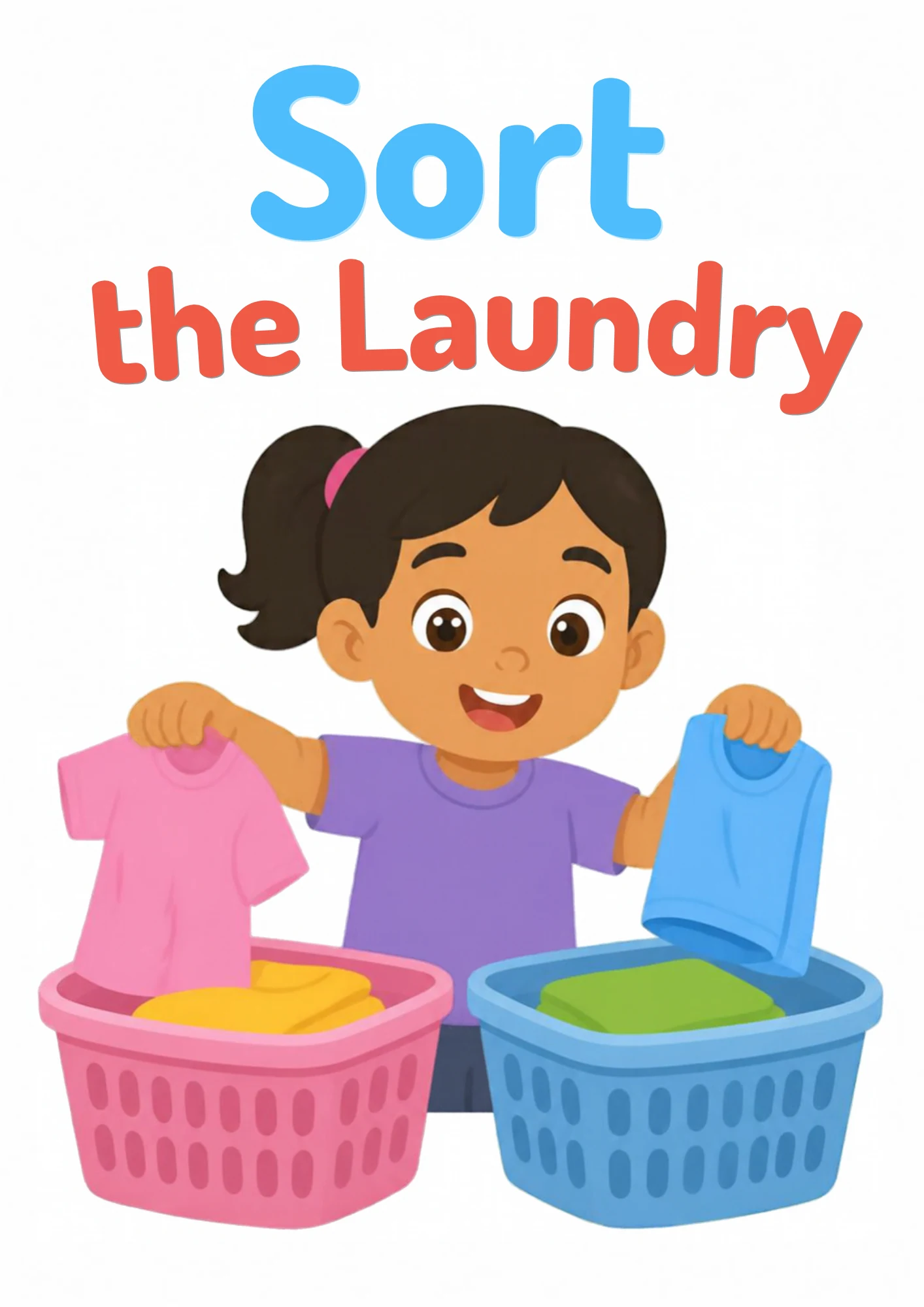
What is this?
Sorting the laundry means putting clothes into groups before they are washed — dark colors in one basket, light colors in the other — and pairing the socks at the end.
What does it mean?
Colors bleed in warm water: a red shirt can turn a whole white load pink. Washing darks with darks and lights with lights keeps every garment the color it was bought as. It is a real reason, not an arbitrary rule.
What does the child need to know?
The method: hold up one piece at a time — "this basket or that one?" — and decide. Socks come off the line in pairs: two that match go together. The categories live in your house: colors and whites, or darks and lights.
Why this matters
Sorting by one attribute (color) is exactly the thinking skill behind maths grouping and science classification — it just happens to also be a job. Chores that feel like play get claimed by children instead of avoided.
What it teaches
Classification by attribute, one-at-a-time decision-making, visual matching (sock pairs), vocabulary of colors and categories, and the work ethic of a real task that really helps the family.
Words to learn
laundrybasketsortdarkslightspair
Say this to your child
“"We sort before we wash: colors with colors, whites with whites — because colors sometimes share a little of their color in the water, and we want every shirt to stay the color it was. You hold each one up and ask: which basket is home for you?"”
Step by step
- Show the card: the girl holds a pink shirt over the pink basket and a blue shirt over the blue basket — name the match she is making.
- Set up YOUR two baskets on laundry day and name the categories out loud: colors and whites, or darks and lights.
- Play the holding-up question: one piece at a time — "this basket or that one?" — and let your child answer and drop.
- Finish with the sock hunt: pull the socks out and find their pairs. Two that match, folded together, into the drawer pile.
- Close the loop: when the machine is running, say why — "the colors stay with their friends so nobody bleeds."
Look closer at the picture
Ask your child: what is the girl holding in each hand — what colors? How many baskets can you see, and what colors are they? What color clothes are already in the pink basket? And in the blue one?
Ask your child
"Why do we wash darks and lights separately?" "How do we choose a basket for one shirt?" "What do we do with the socks?" "What would happen if a red shirt washed with the whites?"
What your child can say or do
"This basket or that one?" Your child may quiz the whole family with the holding-up question, or proudly pair every sock on the sofa — mispairs corrected with the gravity of a detective.
Out in the real world
Sorting travels: the holiday laundry bag, the swimming-towel basket, the donation box for outgrown clothes. Each sort is the same question — which group does this belong to? — with new stakes.
Try it together
Sock memory: five pairs of socks, mixed face-down on the floor — flip two at a time to find pairs. When the game ends, all socks are pre-paired for the real drawer. Laundry, advanced by play.
Understanding check
Ask: "Why do we sort before washing? What is the holding-up question? What do we do with socks?" Colors-bleed reason, one-at-a-time, pairs = landed.
Parent tips
Keep the categories honest — if the baskets get muddled, the pink shirts will explain the rule better than any lecture. Let the child deliver the final sock verdict. Two categories only; sub-sorting can wait years.
Staying safe
Laundry pods and detergents look like sweets and are poison — they live up high, handled by grown-ups only. The washing machine door is a grown-up’s to open and close, and baskets on the stairs are an edge to walk, not a slide to ride.
This lesson pairs with the Sort the Laundry flashcard in the library — print it, show it, keep it on the fridge. Back to Life Skills & Good Habits (Class 32).