
Stay With a Grown-Up — a step-by-step lesson for grown-up and child
This lesson sets the one rule that makes every outing work: stay where the grown-up can see you, hands held at the risky places — agreed before leaving home, rehearsed with kindness, with a calm plan for the rare separation.
What is this?
Staying with a grown-up means keeping where your grown-up can see you, holding hands near roads and in crowds, and knowing exactly what to do if you are ever separated.
What does it mean?
Children wander because the world is interesting, not because rules failed — so the rule needs to be short enough to survive curiosity: "where I can see you." Roads and car parks are the two places hands link, because drivers cannot see small people between cars.
What does the child need to know?
The deal, agreed before every outing: eyes on, hand held at crossings and car parks, stay where the grown-up can see. And the get-found plan, rehearsed at calm times: if we ever lose each other, you stand still and shout my name — then ask a mommy-with-children or a shop worker.
Why this matters
The rule is not about mistrust — it is about visibility. A child within sight is a child a grown-up can shield. And a rehearsed plan turns the scariest "where is Mummy?" moment from panic into a procedure the child can actually run.
What it teaches
Boundary awareness (near/far, seen/unseen), rule memory under excitement, hand-holding as connection rather than capture, self-protection skills, and the trust that grows when rules are kept by BOTH sides — you stay reachable too.
Words to learn
grown-upstayhold handscrossingcar parklost
Say this to your child
“"Here is our deal: you stay where I can see you, and we hold hands near roads and in car parks — that is our agreement, before we leave the house. And if we ever, ever lose each other: you stand still and shout my name. I will come to YOU. A mommy with children or a shop worker can help you shout."”
Step by step
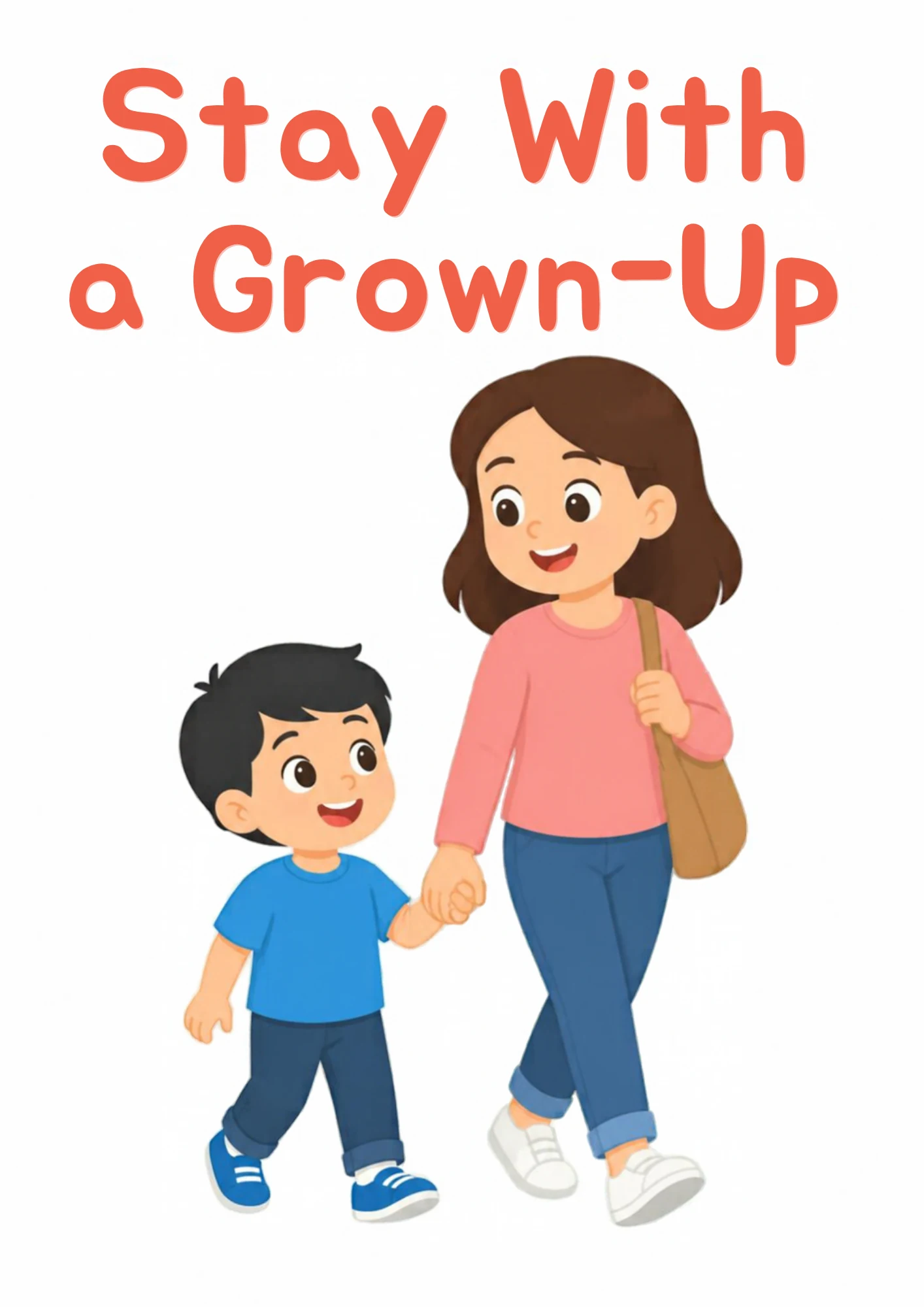
- Show the card: a grown-up and a boy walk hand in hand, both smiling — she carries her bag, he carries nothing but the deal. Name the picture: this is what safe walking looks like.
- Agree the deal before leaving home, every time, in the same words: "eyes on, hand held, where I can see you." The ritual matters more than the words.
- Practise the two hand-holding zones on real walks: crossings and car parks. Same words each time until the hands reach up on their own.
- Rehearse the get-found plan as a game in safe places: "pretend you can’t see me — what do you do?" Stand still, shout, ask a mommy-with-children.
- Close the loop afterwards: "you stayed where I could see you the WHOLE trip — that is how we keep outings easy."
Look closer at the picture
Ask your child: who is holding whose hand? What is the grown-up carrying? Are they walking or standing? Where are both their faces pointing — same way or different ways? Do they look worried or happy?
Ask your child
"What is our outing deal?" "Which two places always mean held hands?" "What do you do if you can’t see me?" "Who can help you shout my name?"
What your child can say or do
"Eyes on, hand held!" "I’d stand still and shout — and you’d come!" Your child may initiate the deal at the front door unprompted, or remind YOU when your eyes drift to a shop window — the rule works both ways.
Out in the real world
The rule is tested daily: the supermarket, the market crowd, the beach, the museum, the school run car park. Each outing is a rehearsal — and the rehearsed child walks taller inside the rule, because the rule makes the world explorable, not smaller.
Try it together
Find-me drill in the park: your child closes their eyes for five seconds, opens them, and points to where you are — the game trains checking-in without a single lecture. At home, stuffed animals get "lost" and the child teaches THEM the stand-still-and-shout plan.
Understanding check
Ask: "What is the deal? Which two places need held hands? What do you do if we lose each other?" Eyes-on-hand-held, crossings-and-car-parks, stand-shout-ask = landed.
Parent tips
Keep the rule short enough to survive excitement — "where I can see you" beats a paragraph. Never use fear as the teacher; rehearsed plans build brave children, frightened ones freeze. Hold hands yourself at roads — the rule visibly binds both of you.
Staying safe
This lesson IS the safety lesson: car parks are the highest-risk minutes of any outing — hands link before the car door opens, every time. Teach that grown-ups HELPFUL in a separation are mommy-with-children or uniformed shop staff, and that any adult who says "keep this secret" or "don’t tell your grown-up" is automatically a tell-your-grown-up event.
This lesson pairs with the Stay With a Grown-Up flashcard in the library — print it, show it, keep it on the fridge. Back to Life Skills & Good Habits (Class 32).