
Eight Watermelons — a step-by-step lesson for grown-up and child
This lesson tames the trickiest counting zone: eight, where fingers run out and pointing races ahead of words. Your child counts eight watermelon slices in two tidy rows, traces the snowman numeral and practices slow, honest counting.
What is this?
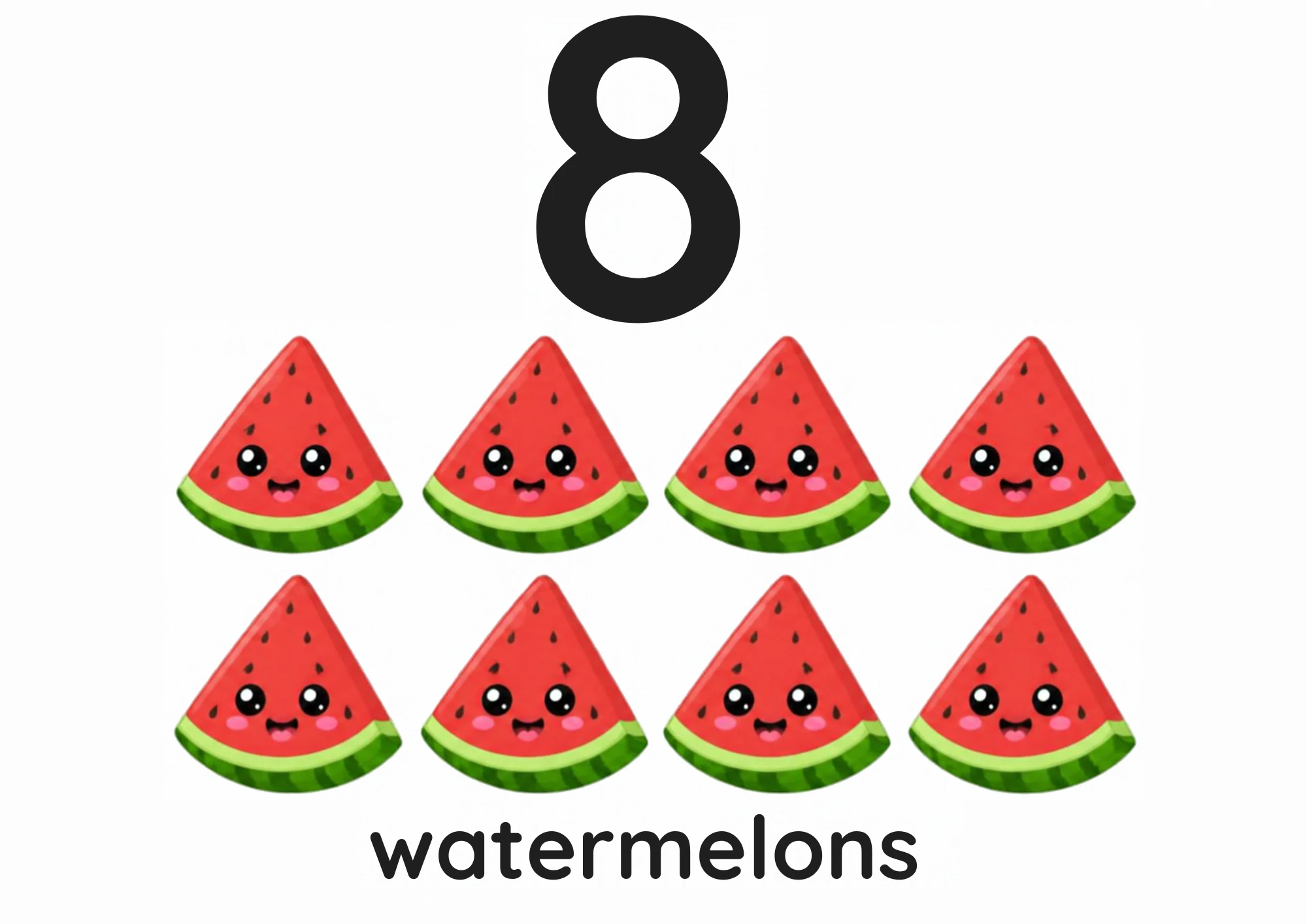
Eight is seven and one more — eight watermelon slices in two rows of four. The numeral 8 looks like two circles stacked into a snowman, and the rows on the card split eight into four and four.
What does it mean?
Eight is where counting most often goes wrong: the voice speeds up, the finger stops, and the number comes out tangled. This lesson's whole job is the slow count — one touch, one word, all the way to eight, every time.
What does the child need to know?
Your child needs three eights: patient touch-counting of eight things in rows; the four-and-four split from the two rows; and the snowman shape — the numeral 8 drawn as one circle balanced on another.
Why this matters
Accurate counting at eight is the gym where counting muscles get strong. The four-and-four split quietly introduces halves and symmetry, and the snowman numeral makes writing eight feel like drawing, which it is.
What it teaches
Row-by-row counting (finish a row, start the next), equal groups as a pre-multiplication idea, numeral formation, and counting stamina — keeping the one-touch-one-word discipline through the longest count so far.
Words to learn
eightsnowmancirclerowsfour and fourslice
Say this to your child
“"Eight slices — four and four, in two neat rows. The 8 looks like a snowman: one circle, then another on top. Let us count slowly, because eight is a long way and slow counting never gets lost."”
Step by step
- Show the card: "Eight watermelon slices, two rows of four. And look at the 8 — it is a snowman made of two circles."
- Count the top row: one to four. Keep going on the bottom row: five, six, seven, eight. Finish a row, then start the next — that is the pro move.
- Draw the snowman in the air: a circle, then a circle on top. Now an 8 lives in the room.
- Count a snack into eights: eight berries, eight cereal pieces, laid out in two rows of four exactly like the card.
- Slow-motion test: count to eight as slowly as possible, one giant touch per word. Racing is easy; slow is the real skill.
Look closer at the picture
On this card a big black numeral 8 stands over eight smiling watermelon slices with green rind, laid out in two rows of four, and the word "watermelons" is printed below.
Ask your child
"How many slices? How many in each row?" "What does the 8 look like to you?" "Can you count to eight slower than a snail?"
What your child can say or do
Your child might say: "Four and four — eight!" "A snowman number!" or the proud slow counter's line: "I did not skip a single one."
Out in the real world
Eights crawl and roll through the day: eight legs on a spider or octopus, eight sides if you find a stop sign, eight pieces when a sandwich gets cut in a grid. Spiders are the favorite — count the legs on a picture, never up close.
Try it together
Snowman eights: draw giant 8s in the air with both arms, then lay eight toys in two rows and count the parade. Then the freeze count: clap and count to eight, freeze on eight, and hold it — wobbly freezes get a rematch.
Understanding check
Ask: "How many slices? What does the 8 look like? How many in each row?" Eight slices, a snowman, four and four — the long count is won.
Parent tips
If the count keeps landing on seven or nine, count together in a whisper-slow voice for a few days — accuracy first, speed is free later. Praise the restart, not just the finish: "you lost count and started over like a real counter."
This lesson pairs with the Eight Watermelons flashcard in the library — print it, show it, keep it on the fridge. Back to Numbers, Counting & Early Math (Class 35).