
Eighteen Bananas — a step-by-step lesson for grown-up and child
This lesson counts eighteen by its rows: three rows of six. Your child counts eighteen bananas the slow way and the row way, feels equal groups doing the work, and stands one step from the last teen.
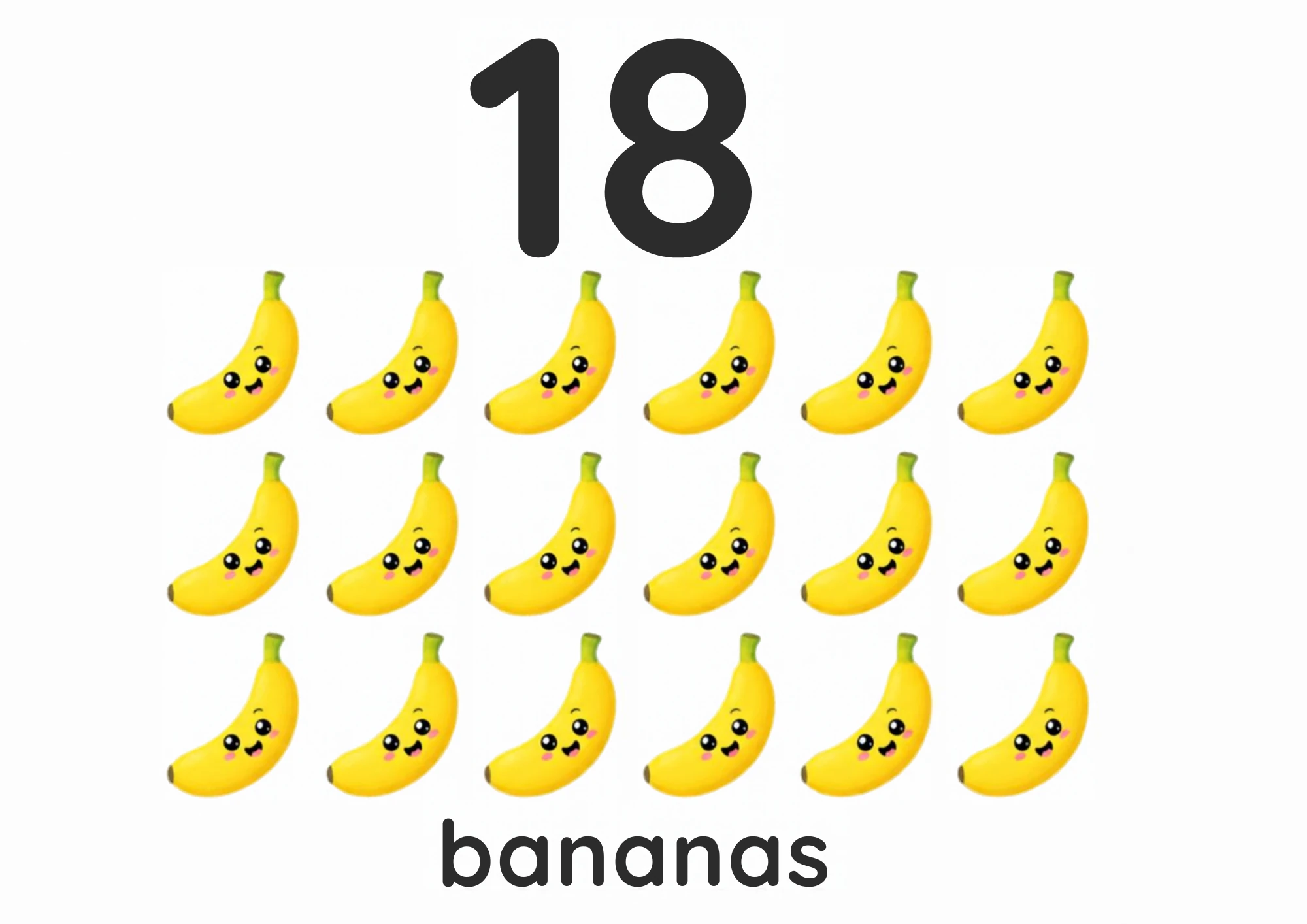
What is this?
Eighteen is ten and eight more — eighteen bananas in three rows of six. The rows are the lesson: six, six and six land exactly on eighteen, the first time equal groups march all the way to a number this big.
What does it mean?
Three sixes making eighteen is equal-group math in plain sight — the great-grandparent of times tables. Reading a number by its rows, instead of one by one, is the fastest counting growth available at this age.
What does the child need to know?
Your child needs three eighteens: the ten-and-eight recipe; the row count — six, six, six; and the neighbor awareness: eighteen is one away from nineteen, two away from twenty.
Why this matters
Equal groups quietly introduce multiplication years before the word appears. And eighteen's place — second-to-last teen — makes it the natural stopping point to look back at ten and ahead to twenty, tying the whole decade together.
Words to learn
eighteenrowssix and six and sixequalgroupsalmost
Say this to your child
“"Eighteen bananas — three rows of six. Six, six, and six again make eighteen. Ten and eight works too. We are one step from the last teen number — listen to how close twenty sounds."”
Step by step
- Show the card: "Eighteen bananas in three rows of six. First the long way, then the clever way."
- Long way: count all eighteen, one touch per banana, steady voice. The long walk earns the shortcut.
- Clever way: count one row — six. Second row — six more, twelve. Third row — six more, eighteen! Six and six and six.
- Recipe check: ten and eight more. Count a full ten, then the remaining eight — same eighteen, two ways, one number.
- Look both ways: "Eighteen is one away from nineteen and two away from twenty." Count those tiny hops — the end of the teens is near.
Look closer at the picture
On this card a big black numeral 18 stands over eighteen smiling yellow bananas arranged in three rows of six, and the word "bananas" is printed below.
Ask your child
"How many bananas? How many rows, how many in each?" "What is ten and eight more?" "How far is eighteen from twenty?"
What your child can say or do
Your child might say: "Six, six, six — eighteen!" "Ten and eight!" or the lookout's call: "Nineteen is next, then twenty!"
Out in the real world
Eighteens sit in grown-up number land: the eighteenth birthday (the biggest one on the calendar horizon), eighteen holes on a golf course, house number eighteen on the walk to school. The birthday is the headline — eighteen years feels impossibly far and hugely exciting.
Try it together
Row dealer: deal eighteen cards or snacks into three rows of six exactly like the card, count by rows, then remove a row and count — twelve! Rebuild and count again. Then the two-hop game: from eighteen, hop to nineteen, hop to twenty — two hops to the summit.
Understanding check
Ask: "How many bananas? What do the rows say? What comes after eighteen?" Eighteen, six and six and six, nineteen next — the rows are counted.
Parent tips
Counting by rows may lose the child on "twelve" as a running total — that is fine; say "six more makes twelve" slowly and tap it out. The point today is the shape of equal groups, not memorizing anything. Eighteen is a happy, almost-done number — let it sound that way.
This lesson pairs with the Eighteen Bananas flashcard in the library — print it, show it, keep it on the fridge. Back to Numbers, Counting & Early Math (Class 35).