
One Apple — a step-by-step lesson for grown-up and child
This lesson starts counting from the true beginning: one. Your child learns that "one" names a single whole thing, practices the slow point-and-say that all counting rides on, and goes hunting for ones around the house.
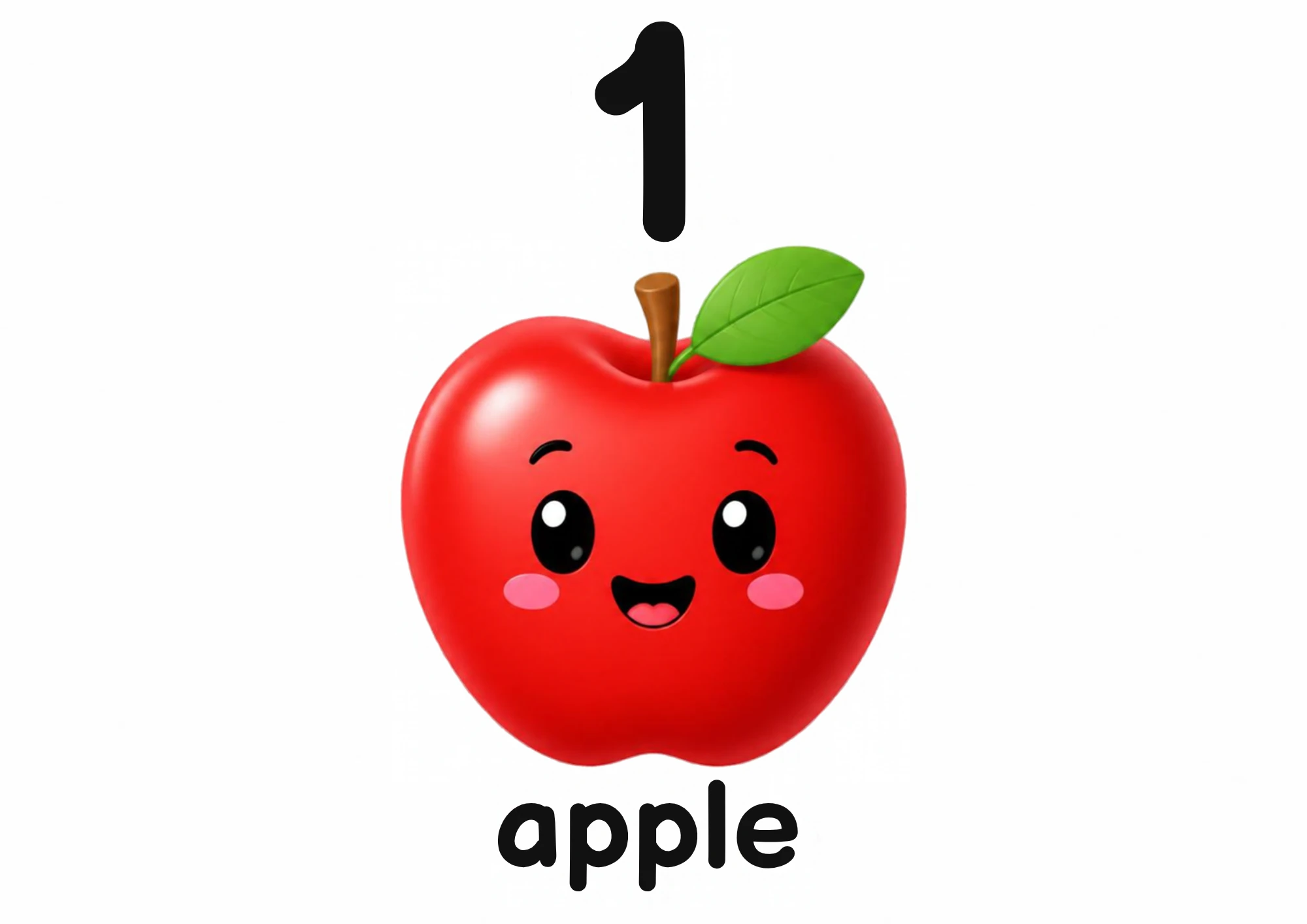
What is this?
One means a single thing, all by itself. One apple, one nose, one you. It is the smallest number we say, and every other number is simply more ones stacked together.
What does it mean?
Before a child can count to five, they need the idea of one: that a single object can be named with a number word. One is also the seed of one-to-one counting — one word for one thing, never two words for the same apple.
What does the child need to know?
Your child needs three ones: the word "one" said while touching a single thing; the numeral 1 spotted on doors, remotes and birthday candles; and the feeling that one is whole and complete — one biscuit is a real, honest amount.
Why this matters
Every later number is built from ones, so a wobbly "one" wobbles all of maths. Naming single things proudly also builds the counting habit itself: touch, say, move on.
What it teaches
One-to-one correspondence (one word, one touch), the idea that numbers name amounts, vocabulary for single and whole, and the confidence to announce a number out loud — the bravest counting move there is.
Words to learn
onesinglealonefirstwholeapple
Say this to your child
“"This is one apple. One is the number for a single, whole thing. Find one of something nearby — touch it and announce it: one!"”
Step by step
- Show the card: "This is one apple. Just one — say it with me: one."
- Touch the apple on the card and say "one" slowly. Then touch the big black 1 at the top. One apple, one numeral — both are one.
- Play find-one: walk the room and place a finger on one thing at a time — one chair, one lamp, one nose. Each time, say "one" like an announcement.
- Hand over one of something real — one cracker, one spoon — and let your child claim it: "One!" Receiving one thing feels like owning the number.
- Finish with the one-body trick: one head, one tummy, one me. One is not lonely; one is complete.
Look closer at the picture
On this card a big black numeral 1 sits at the top, one smiling red apple with a green leaf sits underneath it, and the word "apple" is printed below — one numeral, one apple, one word, three ways to meet the same number.
Ask your child
"How many apples are on this card?" "Can you find one of something near you?" "What is one thing you always have one of?"
What your child can say or do
Your child might say: "One apple!" "One nose — one me!" or the proud collector's line: "I found one. Just one."
Out in the real world
Ones are everywhere once you hunt: one sun, one moon, one front door, one tooth that just arrived. Point out single things on every walk this week and let your child be the one who names them.
Try it together
The one-and-only game: set out a small pile of snacks and ask for "one, please" — then hand exactly one and wait for the announcement. Reverse roles and let your child be the giver who counts out a single prize for you.
Understanding check
Ask: "How many apples? What does one mean? Show me one finger." One apple, a single thing, one finger up — counting has officially begun.
Parent tips
If your child counts "one, two" while touching a single apple, gently restart together — the one-word-one-touch rhythm matters more than being right. And resist giving two when they asked for one; the exactness is the lesson.
This lesson pairs with the One Apple flashcard in the library — print it, show it, keep it on the fridge. Back to Numbers, Counting & Early Math (Class 35).