
Sixteen Coconuts — a step-by-step lesson for grown-up and child
This lesson builds the first square: sixteen, four rows of four. Your child counts sixteen coconuts, lays them into a square block, and learns that some numbers make perfect shapes — and shapes make counting easy.
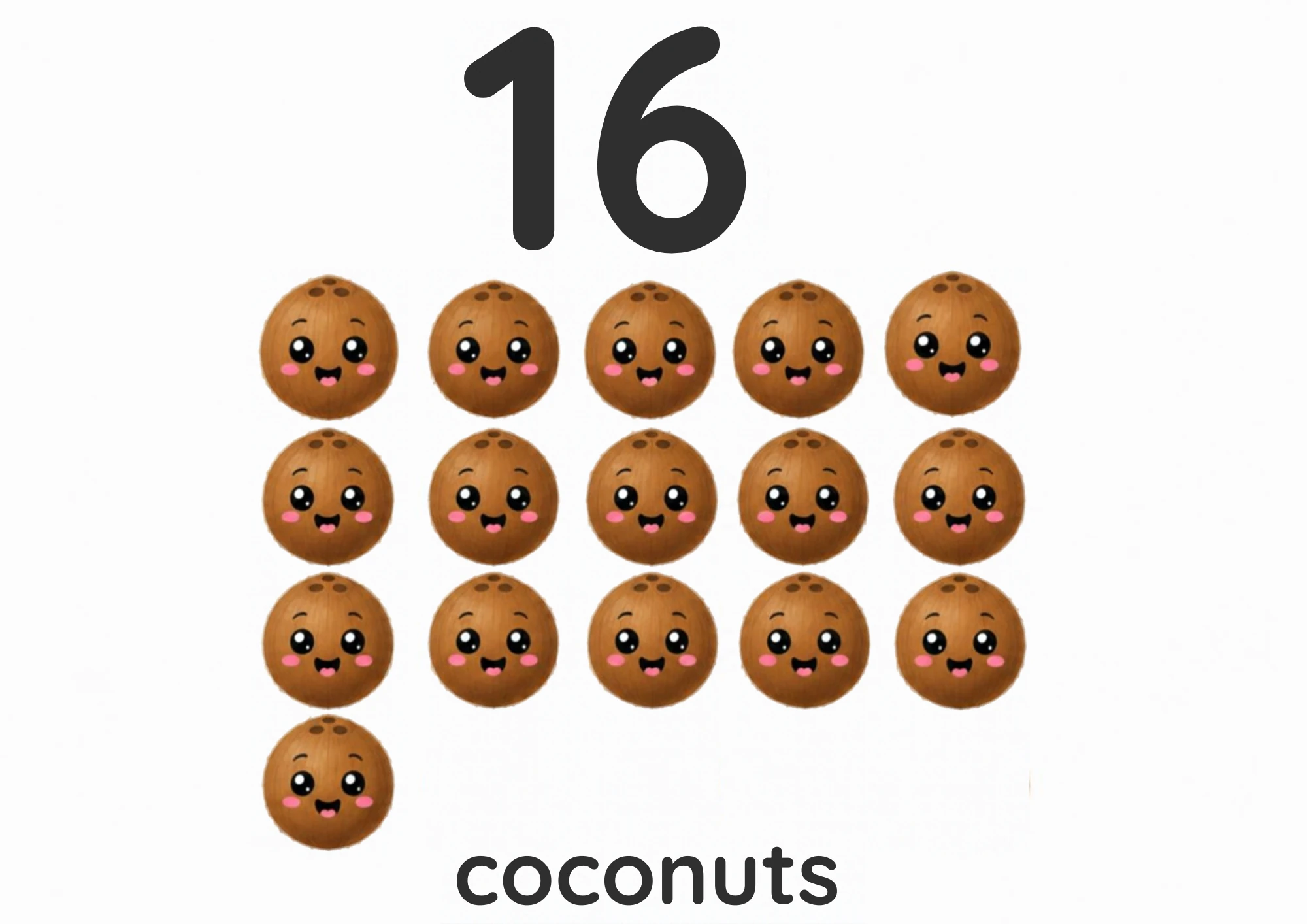
What is this?
Sixteen is ten and six more — sixteen coconuts on the card in three rows of five plus one more. But sixteen has a second, magic shape: four rows of four make a perfect square. Same sixteen, two outfits.
What does it mean?
Sixteen is the first square number a child can actually build. Seeing a number as a shape — not just a heap — is structural math: the same sixteen can be a row of five plus more, or a tidy square, and both are true at once.
What does the child need to know?
Your child needs three sixteens: the ten-and-six recipe; the square build — four rows of four; and the flexible idea that one number can wear different shapes without changing.
Why this matters
Square numbers recur all through school math, and meeting one at coconut scale makes it concrete. Rearranging sixteen from the card's layout into a square also teaches the deepest counting truth: moving things does not change how many there are.
Words to learn
sixteensquareblocksgridcornersrebuild
Say this to your child
“"Sixteen coconuts — ten and six more. Now the magic part: build the same sixteen with blocks, four lines of four, and a square appears. A number that doubles as a shape!"”
Step by step
- Show the card: "Sixteen coconuts. Count them with me — then we will discover the secret shape of sixteen."
- Count all sixteen, ten-and-six style: a full ten, then six more. The recipe never fails.
- Now the magic: gather sixteen blocks or buttons and build four rows of four. Count the rows, count the square — sixteen! Draw around it with one finger: a square.
- Compare shapes: the card's layout and your square. Both are sixteen. Rearranging never changes the count — that is a counting law.
- Walk the square: count four blocks across, four down, four across, four up — sixteen steps around the border of a number.
Look closer at the picture
On this card a big black numeral 16 stands over sixteen smiling brown coconuts, arranged in three rows of five with one more coconut beside them, and the word "coconuts" is printed below.
Ask your child
"How many coconuts? What is ten and six?" "Can you build sixteen as a square?" "Does the count change if we rearrange them?"
What your child can say or do
Your child might say: "Four rows of four!" "It is a square number!" or the law discovery: "It is still sixteen even when we move them."
Out in the real world
Sixteens hold up buildings and games: a four-by-four window grid, sixteen squares on part of a chessboard, sixteen crayons in a small box. Windows are everywhere — four across, four down, sixteen panes, free and daily.
Try it together
Square builder: sixteen blocks, four rows of four — then break one corner and count: fifteen! The broken square proves the count. Then the shape hunt: find anything arranged in four rows of four, count it, and crown it a sixteen.
Understanding check
Ask: "How many coconuts? What shape can sixteen make? Does moving them change the count?" Sixteen, four rows of four, never changes — the square number is built.
Parent tips
Let the rearranging get silly — lines, circles, towers — and count every time: always sixteen. That repetition is the conservation lesson, and it lands better through play than through any explanation. Keep the coconut squishiness in the words: numbers are bendy shapes.
This lesson pairs with the Sixteen Coconuts flashcard in the library — print it, show it, keep it on the fridge. Back to Numbers, Counting & Early Math (Class 35).