
Cold Weather — a step-by-step lesson for grown-up and child
This lesson takes on the serious cold: what freezing air does to bodies and puddles, how layers hold warmth in, the ice rules that keep small feet safe, and the warm-up routine — blanket, cocoa, radiator — that ends every cold-day outing like the mountain experts do.
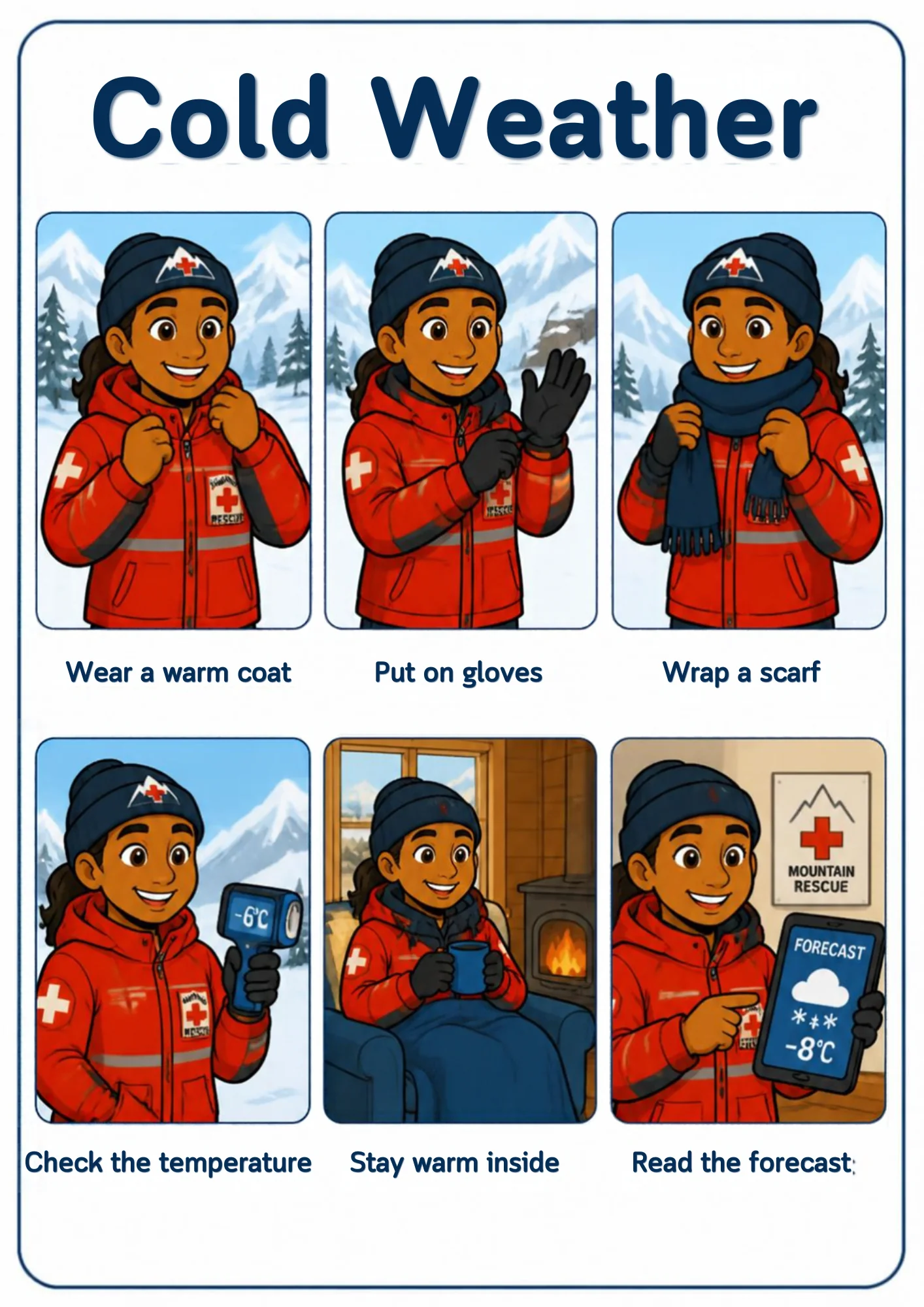
What is this?
Cold weather is when the air drops close to or below freezing: breath turns to mist, puddles grow thin ice lids, fingers and ears feel the bite first, and snow may whiten the hills and rooftops.
What does it mean?
Cold air steals body warmth — fastest from the bits that stick out: fingers, ears, noses, necks. Layers trap warm air close to the body, and each extra layer is another blanket of still air. Ice forms when water freezes: shiny, slippery, beautiful — and strictly for looking.
What does the child need to know?
Your child needs three cold-weather ideas: cold days need many layers — coat, hat, gloves, scarf — because layers hold our warmth; ice is shiny and slippery and never for walking on or touching with tongues; and the routine ends inside — blanket, warm drink, warm-up done.
Why this matters
Cold weather is the deepest self-care lesson in the class: the body signals cold clearly (shivers, clumsy fingers) and the child learns to answer those signals with action — more layers or inside. Reading and answering one’s own body is the skill underneath all health habits.
What it teaches
Layer logic (trapped warm air), body-signal literacy (shivering, numb fingers), ice awareness, dressing sequences under real motivation, and the cosy discipline of the warm-up routine that ends every outing.
Words to learn
coldfrosticelayersshivernumbwarm upthermometer
Say this to your child
“"Cold weather means the air wants to take our warmth, so we wear many layers — coat, hat, gloves, scarf — like blankets we can walk in. Ice is shiny and slippery: we look at it, never stamp it. Then we come in, wrap up and get warm again. That is how cold days work."”
Step by step
- Show the card: "Cold weather means the air can make our bodies chilly fast — so we dress deep and warm up well."
- Read the picture: the mountain-rescue walker in a red jacket fastens it up, pulls on gloves, wraps a scarf, holds a thermometer reading minus 6, sits warm inside under a blanket with a hot drink by a wood stove, and checks a forecast showing minus 8 with snow.
- Build the layer picture with hands: one layer is one blanket of warm air; two layers is two blankets. How many blankets does today need?
- Set the ice rule like a rhyme: shiny means slippery — we look, we never lick, we never stamp. Puddles with lids are museum pieces.
- Drill the warm-up finish: come in, wet things off, blanket on, warm drink in hands. The outing is not done until the warm-up is done.
Look closer at the picture
On this card a mountain-rescue walker wears a red jacket with white cross patches and a dark beanie: fastens the jacket to the chin, pulls on a dark glove, wraps a navy scarf around the neck, holds a white thermometer reading −6°C, sits warm indoors under a blanket holding a mug beside a wood-burning stove, and points at a forecast tablet reading −8°C with snow icons by a mountain-rescue poster.
Ask your child
"Where does our body feel cold first?" "Why do we wear many layers instead of one big one?" "What is the rule about shiny ice?" "How does a cold-day outing end?"
What your child can say or do
Your child might say: "Two layers, two blankets of warm!" "Shiny means slippery — we look, never lick," or announce the finish like the experts: "Blanket, cocoa — warm-up complete!"
Out in the real world
Find the ice on the walk: puddle lids, windscreen frost, the shiny bit of the path the sun has not reached. Watch the layer-workers: builders, posties, dog walkers — all layered deep. Check the thermometer together every morning of the cold snap and let the number pick the number of blankets.
Try it together
Blanket-lab: wrap one teddy in one cloth, another in three — which stays cosiest? That is layers. Ice-look-but-not-touch: find three shiny puddle lids on the walk and rank their shine. Warm-up ritual as a game: wet kit off, blanket burrito, cocoa with two marshmallows — the child who owns the routine owns the season.
Understanding check
Ask: "Why many layers? What do we never do with ice? How does a cold outing end?" Blankets-of-warm, look-never-lick, and blanket-cocoa-warm — the cold now has a system, and the system has your child.
Parent tips
Warm children agree to come inside; cold-stunned ones melt. So set the come-in signals together before the outing: "When your fingers go clumsy or the shivers start, that is your body talking — we listen first time." And keep the warm-up ceremonial: the cocoa is not a snack, it is the finish line.
Staying safe
Cold rules: cover fingers, ears and neck first; come in when shivering starts or fingers go clumsy. Ice is for looking — never for stamping, licking or walking on ponds or frozen water of any kind. Wet clothes get changed the moment we are home. Warm-up is part of the plan, not a treat.
This lesson pairs with the Cold Weather flashcard in the library — print it, show it, keep it on the fridge. Back to Weather, Seasons & What We Wear (Class 34).