
Foggy Day — a step-by-step lesson for grown-up and child
This lesson explains the day the world goes milky: what fog is, how far it lets us see, why bright colours and lights matter, and the walking rules — slow steps, held hands, known paths — that make a foggy day an adventure instead of a worry.
What is this?
Fog is a cloud that forms at ground level — millions of tiny water drops floating in the air right where we walk. It scatters the light so that far-away things fade to grey ghosts and then vanish.
What does it mean?
Fog changes how we use our senses: eyes lose their long range, so ears, memory and bright colours do more work. Everything familiar looks strange, distances are hard to judge, and everyone — walkers, drivers, cyclists — slows down and doubles their looking.
What does the child need to know?
Your child needs three fog ideas: fog is a cloud down at ground level that hides far things; in fog we make ourselves easy to see — bright coats, lights — and walk slowly; and the fog rule of rules: stay close to your grown-up, on paths you know.
Why this matters
Fog is the rare weather that teaches sensory switching — from eyes to ears — plus the deep safety habit of visibility. A child who understands "I must be seen and stay close" in fog carries the same skill into dusk, car parks and crowded places for life.
What it teaches
Sensory adaptation (listening more, looking closer), distance judgement, colour-and-visibility reasoning, self-restraint at crossings, and the comfort of routine — same streets, same holds, slower pace, still safe.
Words to learn
fogmistmilkyvisibilitybrightflashlightslowlyvanish
Say this to your child
“"Fog is a cloud that floats down low, right where we walk. It hides things that are far away, so we wear something bright, walk slowly, hold hands and use our ears as well as our eyes. The crossing guard helps us — in fog, everyone looks after everyone."”
Step by step
- Show the card: "Fog is a cloud that came down to walk the streets with us."
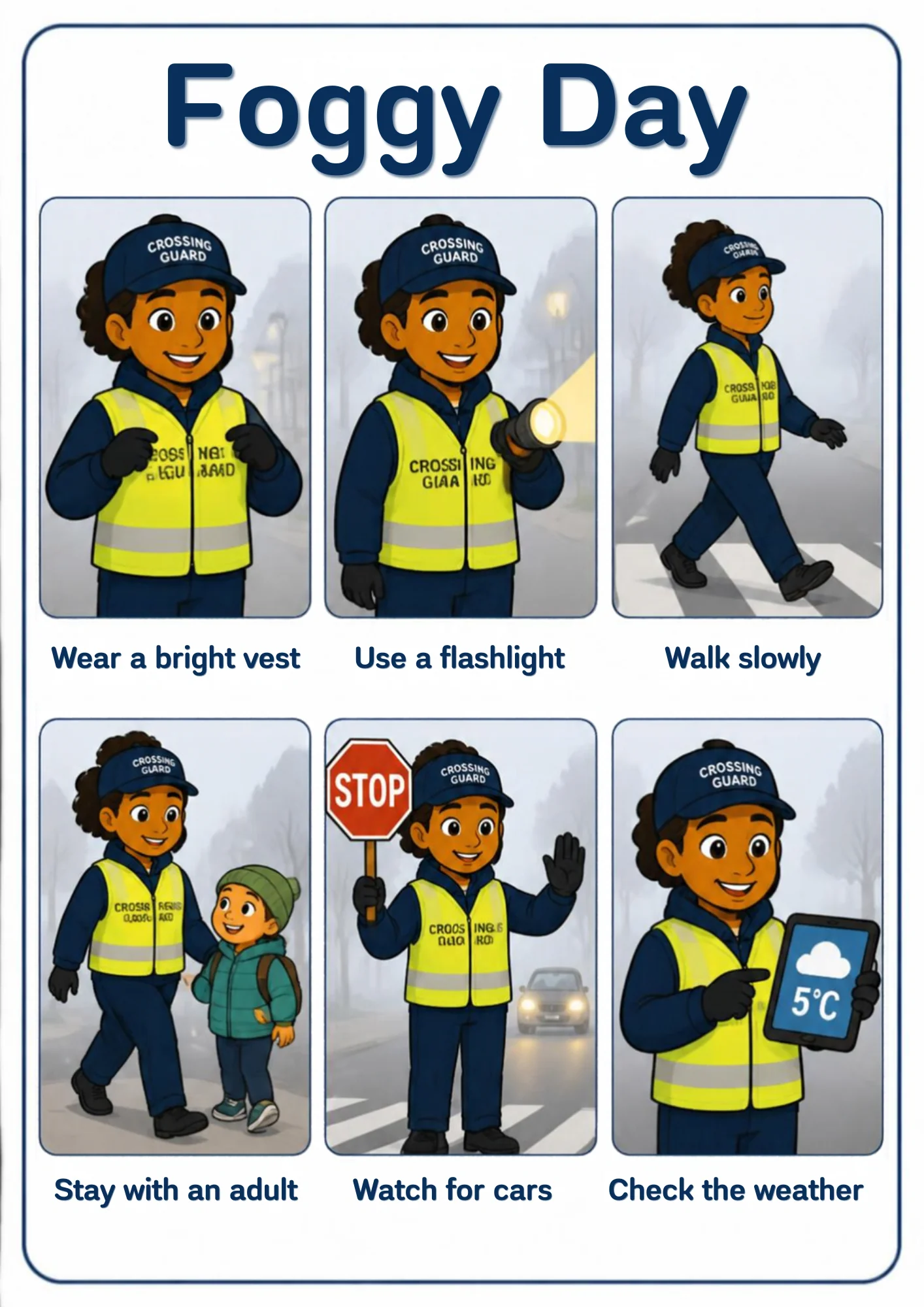
- Read the picture: the crossing guard in a bright yellow high-visibility vest points to it proudly, shines a flashlight into the milky air, walks slowly across a zebra crossing, guides a small child in a green hat by the hand, holds up a stop sign while a car glows faintly behind, and checks a forecast reading 5 degrees.
- Play the disappearing game on the real fog: how far can you see before things fade? Count the steps to the nearest tree. Is it farther than yesterday?
- Do the bright test: stand five steps away. Which is easier to spot — the grey coat or the yellow one? THAT is why foggy-day coats are bright.
- Drill the fog walk: my hand, your hand; small steps; eyes AND ears working; cross only at the crossing where the guard helps.
Look closer at the picture
On this card a crossing guard in a navy cap and a bright yellow high-visibility vest: points at the words on the vest, shines a lit flashlight that glows in the milky air, walks slowly across a zebra crossing, holds the hand of a small child in a green bobble hat and teal coat, lifts a red stop sign while a car’s headlights glow softly through the fog behind, and points at a tablet showing a cloud icon and 5°C.
Ask your child
"What is fog made of?" "Why do we wear bright colours in fog?" "What do our ears do on a foggy walk?" "What is the most important fog rule of all?"
What your child can say or do
Your child might say: "We are walking inside a cloud!" "Bright coats so cars can see us," or the rule, word perfect: "Stay close, hold hands, known paths."
Out in the real world
Watch the fog change your own street: the house you can see, the one you cannot, the bus that arrives like a ghost. Spot the fog workers — guards in bright vests, cars with lights on, ferries and trains sounding their horns. Fog dissolves by mid-morning: check the same view at lunch and celebrate the returning rooftops.
Try it together
Fog-game at home: greaseproof paper over a toy binoculars’ ends — how much can you spot now? Bright-survey in the wardrobe: which jackets would a foggy day love? Listening-walk with eyes closed (safely, sitting): what do your ears catch that your eyes missed? Then the torch test at dusk: one light on, one light off — which grown-up gets spotted first?
Understanding check
Ask: "What is fog? Why bright coats? What do we never do in fog?" A ground cloud, to be seen, and run-off-or-wander-off — the fog rules are now family rules.
Parent tips
Keep fog explanations matter-of-fact and slightly magical — "walking inside a cloud" beats "limited visibility" every time. And if fog feels spooky, rehearse the route in sunshine first: the child who knows the three trees and the red door walks fog with confidence, because memory holds the map the mist hides.
Staying safe
Fog rules: stay together — hand in hand on known paths; wear or carry something bright; listen for cars you cannot see and cross only where a guard or clear view helps; never wander off to explore the greyness. Flashlights and reflective bits come out at dawn-and-dusk fog.
This lesson pairs with the Foggy Day flashcard in the library — print it, show it, keep it on the fridge. Back to Weather, Seasons & What We Wear (Class 34).