
Snow — a step-by-step lesson for grown-up and child
This lesson explains what snow actually is — frozen water falling in tiny crystals — and turns the first snowfall into a full science morning: catch, measure, melt, then warm up properly.
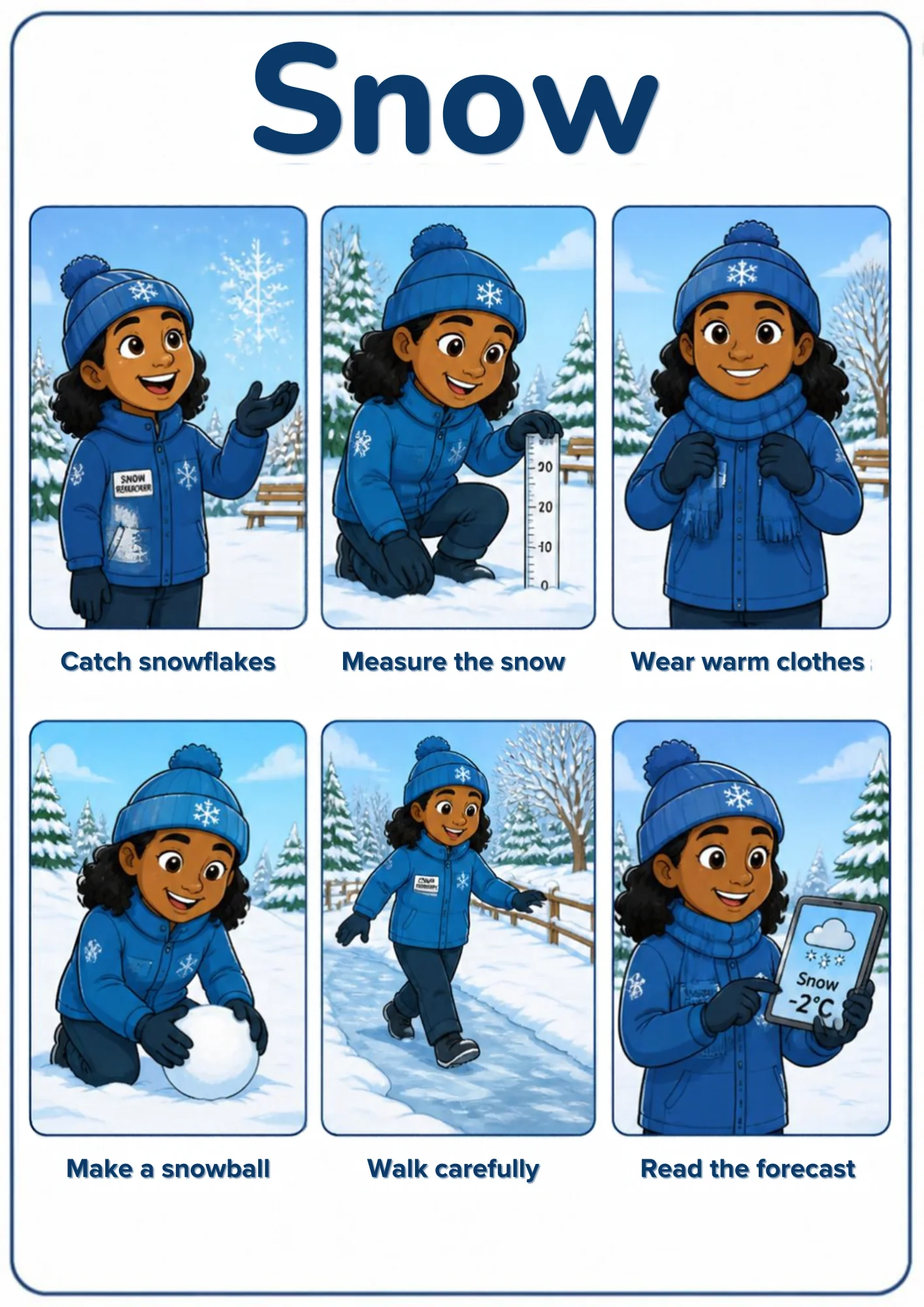
What is this?
Snow is water that froze into tiny ice crystals high in the clouds and fell as soft white flakes. Each flake is a little six-sided star of ice, and each one melts back into a drop of water when it lands on something warm.
What does it mean?
Snow needs cold all the way down — the whole air column must be chilly or the flakes arrive as rain or sleet. Fresh snow covers the ground in a white blanket, muffles sounds, records every footprint and melts back into water that feeds the spring.
What does the child need to know?
Your child needs three snow ideas: snow is frozen water in crystal flakes; flakes melt on warm hands because our bodies are warm; and snow play asks for the full warm kit — coat, hat, gloves and boots — with warm-up breaks inside.
Why this matters
Snow is the most touchable science in childhood: children hold crystals, watch them vanish, pack them, stack them and measure them. Melting is their first change-of-state experiment, and the ruler in the snow is their first measuring instrument used for a real question.
What it teaches
Change-of-state understanding (ice ⇄ water), measurement skills with real stakes, cold-body awareness and self-advocacy ("my gloves are wet"), shape observation on sleeves, and the sequencing of a full dressing routine.
Words to learn
snowsnowflakemeltfreezeicefrostsnowballslippery
Say this to your child
“"Snow is frozen water falling in tiny star-shaped flakes. Catch one on your sleeve and look quick — then watch it melt on your hand, because our hands are warm. In the snow we wear all our warm kit and walk like penguins on the slippery bits."”
Step by step
- Show the card: "Snow is rain that froze into tiny ice stars on the way down."
- Read the picture: the girl in a blue pom-pom hat catches a falling snowflake on her hand, kneels to measure the snow with a big ruler, fastens her warm coat, rolls a snowball, walks carefully on an icy path and reads a forecast that says Snow, minus 2 degrees.
- Teach the melt: catch one flake on a dark sleeve and watch it closely; then one on a warm palm — gone! Our hands are warm enough to turn snow back into water.
- Measure together: stand a ruler in the snow, read the number, check again after an hour. Snow grows and shrinks — like a science pet.
- Drill the kit in order: coat, hat, gloves, boots — then the penguin walk on icy paths, tiny steps, knees soft.
Look closer at the picture
On this card a girl in a blue pom-pom beanie with a snowflake pattern and a blue winter jacket: holds her hand out to catch one big six-pointed snowflake, kneels beside a numbered ruler standing in the snow to measure its depth, zips her coat up to her chin, rolls a big round snowball, walks with careful steps along a snowy path between fences and snowy pines, and points at a tablet reading "Snow −2°C" with little flakes on the screen.
Ask your child
"What is snow made of?" "Why did the flake melt on your hand?" "How deep is the snow on our ruler?" "What do we wear before snow play?"
What your child can say or do
Your child might say: "Snowflakes are little ice stars!" "It melted because my hand is warm," or the kit chant: "Coat, hat, gloves, boots — ready for snow!"
Out in the real world
Watch snow line rooftops, hide the grass and outline every branch after a night of steady fall. Find where snow melts first (sunny edges, warm car roofs) and where it lingers (shady corners). Track a snowman through its slow, sagging goodbye.
Try it together
Snow-kitchen: bowls, spoons and cupcake trays turn fresh snow into the year’s best sensory table. Melt-race: one cup of snow indoors, one outside — which melts faster, and why? Then the snowball school: pack, roll, stop — and the family rule about where snowballs may never fly.
Understanding check
Ask: "What is snow? Why do flakes melt in your hand? Name your snow-day kit." Frozen water, warm hands, and any full run of coat-hat-gloves-boots — the lesson has landed.
Parent tips
Keep spare gloves drying by the radiator — the wet-glove swap keeps the outing alive twice as long. And capture the melting question every time: "Where did the snow go?" is a genuine science prompt, and "it turned to water!" is a genuinely correct answer.
Staying safe
Wet plus cold chills bodies fast — full kit with waterproof boots, and dry gloves the moment they soak through. Penguin steps on icy paths, never eat snow, snowballs never at faces or cars, and inside when shivers start. Snow that has been played in is for playing, not for tasting.
This lesson pairs with the Snow flashcard in the library — print it, show it, keep it on the fridge. Back to Weather, Seasons & What We Wear (Class 34).