
Ant — a step-by-step lesson for grown-up and child
This lesson finds the smallest card in the set and makes it the busiest: your toddler marches like an ant, follows a real line with their eyes, and learns that ants are always on their way somewhere important.
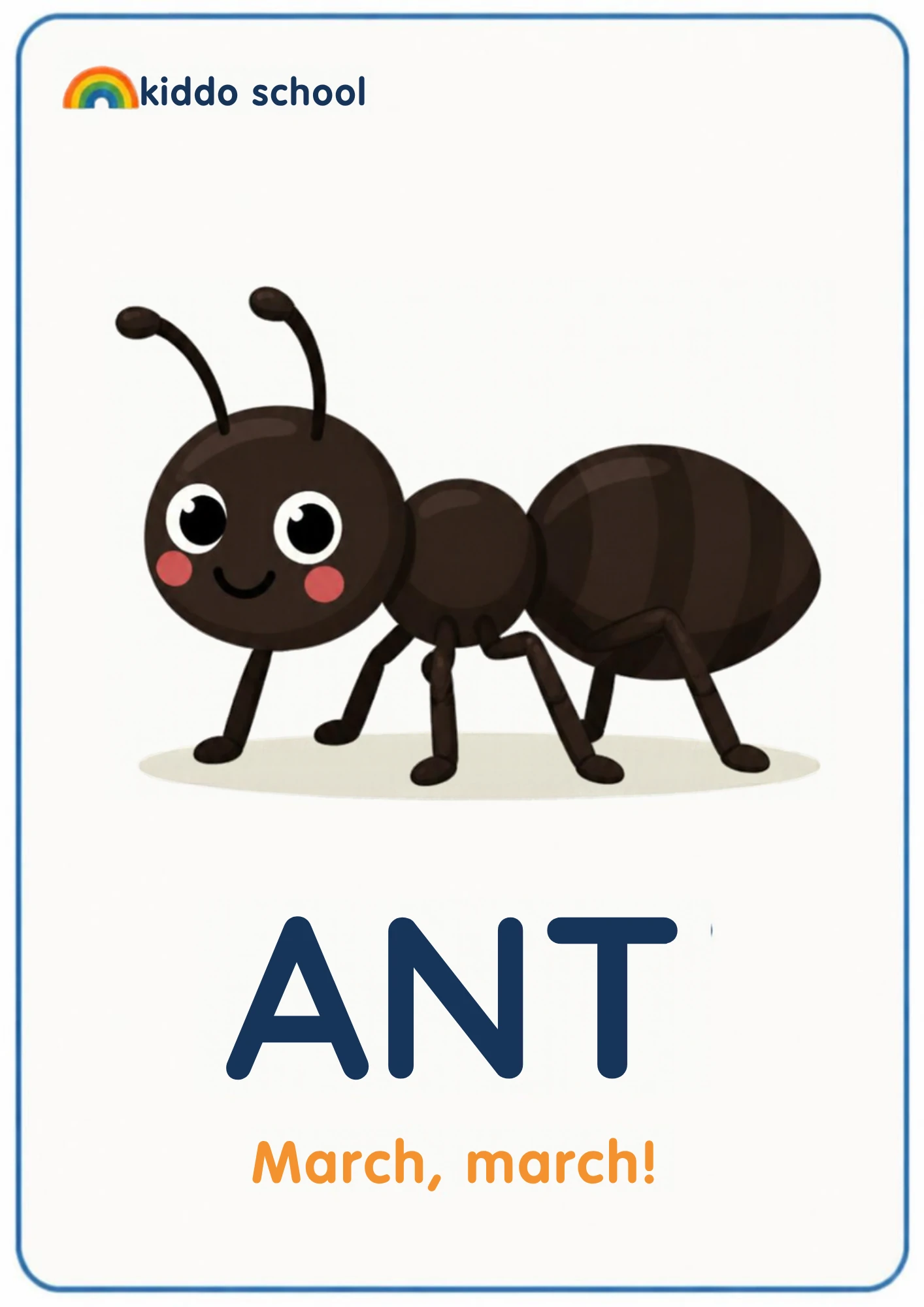
What is this?
An ant is a very small insect with six legs that walks in long lines with its many friends, carrying crumbs and seeds far bigger than itself. Ants are always going somewhere — usually home.
What does it mean?
Ants are the first teamwork a toddler can actually see: a whole line of tiny workers, all heading the same way. The marching game puts your child inside that line, and the watching rule keeps the real workers unbothered.
What does the child need to know?
Ants are tiny and march in long lines, and they are heading home with food. We follow a line with our eyes — never fingers — because a bothered ant can nip, and busy workers deserve to get home.
Why this matters
Following an ant line with the eyes is real focus training: the line moves, turns and disappears, and your toddler’s attention follows it. The picnic rule teaches the boundary kindly — food is for people, ants have their own plan.
What it teaches
Visual tracking of a moving line, marching and carrying (real heavy-work play), the concept of many-and-small, and early respect for creatures with their own business.
Words to learn
antmarchlinetinyhomewatch
Say this to your child
“"Look — tiny ants, all in a line! They are carrying their food home, just like you carry your cup. March, march, little ant! When we see real ants, we stand still and watch with our eyes. Busy ants go home; our hands stay up here."”
Step by step
- Show the card and say ant — then hold it low and ask where the tiny ant might be going today.
- March like an ant together: small quick steps, arms swinging, maybe carrying a toy crumb — a line of one is still a line.
- Lay a trail of toy ants (or buttons) across the rug and follow it, narrating left, right, over, around — the trail is the game.
- At a real picnic or on the pavement, find an ant line and watch it with still bodies: where do they all lead? Home, always home.
- End with the rule, kindly: ants have their own work, so we watch with our eyes and our snacks stay on our plate.
Look closer at the picture
Find the small ant on this card together and say ant. Ask where it might be heading, then march on the spot like a tiny worker — the picture study at ant scale is all in the pointing.
Ask your child
"Where are the ants marching?" "Can you march like an ant?" "Are ants big or tiny?" "Do our fingers chase the ants, or do our eyes?" — answered with marching, the word tiny and pointing fingers.
What your child can say or do
"Ants going home!" narrated at every pavement crack, marching lines through the kitchen with teddy crumbs, and ants located on every walk within seconds — the small world now officially open for business.
Out in the real world
Ant lines cross pavements, garden paths and picnic blankets all summer. Each one is a rerun: crouch, follow with the eyes, whisper where-are-they-going, and leave the line to its work.
Try it together
Ant crumb relay: your toddler carries one small toy crumb from the rug to a basket, over and over, like a worker on the line. Repetitive hauling is exactly what ant bodies do — and exactly what toddler bodies love.
Understanding check
Watch the next real ant line: if your toddler crouches to watch instead of stomping, the lesson landed — the eyes took over from the feet, which was always the plan.
Parent tips
Follow one line as far as it goes; the destination matters more than the count. Keep picnic boundaries warm and firm — ants are not chased off, they are simply watched from the blanket.
Staying safe
An ant nips when it is bothered, so the watching is strictly eyes-only with hands folded or held. Food stays with people and gets cleared up after eating — a tidy picnic is the kindest thing anyone can do for ants and toddlers alike.
This lesson pairs with the Ant flashcard in the library — print it, show it, keep it on the fridge. Back to Garden Bugs & Friends (Toddler 8).