
Animals Together — a step-by-step lesson for grown-up and child
This lesson points the grouping skill at living things: two animals sit among two everyday objects, and your toddler’s job is to gather the creatures home.
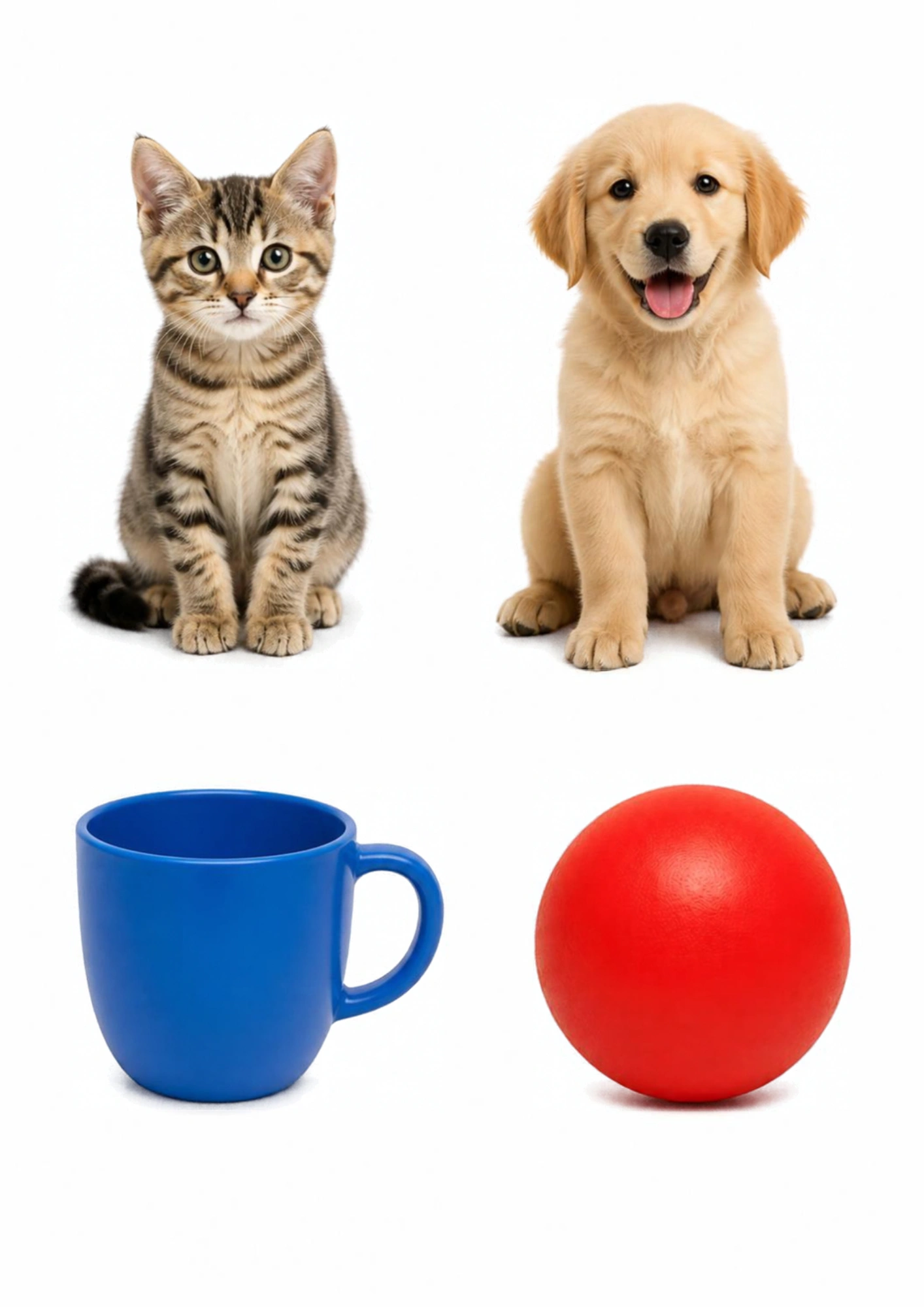
What is this?
Animals are the things that move, eat and make noise — a cat and a dog are both animals, and a cup and a ball are both not. The category is big, old and full of friends.
What does it mean?
Living versus not-living is one of the deepest sorts there is, and toddlers begin it with the animals they already love. Every pet, bird and book creature feeds the same growing group.
What does the child need to know?
Accept group logic in all its toddler forms: if the ball joins the animals because it is round and bouncy, say the thinking back, then ask what the cat can do that the ball cannot.
Why this matters
Animals fill the day — pets, parks, pages, puddle birds. A group this crowded gets rehearsed from every direction without the card ever leaving the shelf.
What it teaches
Category building with living things, the belongs and does-not-belong contrast, and sound-and-motion proof — animals move and make noise, and cups do neither.
Words to learn
animalscatdogtogethergroupalive
Say this to your child
“"Who is on this card? A cat, a dog, a cup, a ball. Which two are the animals? The cat and the dog! Animals together — because animals move and make sounds. Does a cup say woof? Nooo!"”
Step by step
- Show the card and roll-call all four: a cat, a dog, a cup, a ball. One name, one point, no rushing.
- Ask the big question: which two are the animals? Give the looking all the time it needs.
- Gather the animals with your finger and name the group: cat and dog — animals! Animals go together.
- Prove the category with what animals do: the cat moves, the dog says woof. Does the cup say woof? Does the ball walk? The outsiders stay funny while the inside gets firm.
- Rerun on the rug: sort real toys into animals and everything else, two corners of the rug, and let the animal corner grow loud with all its sounds.
Look closer at the picture
The card shows a cat, a dog, a cup and a ball for a grouping activity — two animals and two things that are not animals. Ask your toddler to point at the animals, then at each thing that cannot move by itself.
Ask your child
"Which ones are the animals?" "What does the dog say?" "Does the cup move?" "Where are your toy animals?"
What your child can say or do
The animal corner tends to get loud: woofs and meows are the group being celebrated. A toddler who herds the cup in with the cat is testing the border — the border conversation is the lesson.
Out in the real world
Every dog on a lead, pigeon on the path and cat on a wall keeps the group growing. Point, name, and add the magic word: animal — the category collects them all.
Try it together
Animal corner: two sides of the rug, toys sorted by alive and not. Then visit the animal side with all the sounds and movements — the corner that moves and speaks wins the game every time.
Understanding check
Ask for the animals from a mixed row of four toys. Animals gathered to one side passes outright. A ball gathered too, with woof sounds attached, passes as thinking-in-progress — say what the ball cannot do and let it re-home.
Parent tips
Keep the category loose and lively: animals move, eat and make sounds is enough definition for two. The fine print of biology can wait for school — the warm certainty that animals are their own kind cannot.
Staying safe
Toy animal sorts stay off the stairs and away from radiators; the two-corners game needs floor space, not furniture. Real animals stay behind owner rules — the sorting is for toys and pictures only.
This lesson pairs with the Animals Together flashcard in the library — print it, show it, keep it on the fridge. Back to Matching & Sorting (Toddler 4).