
Marigold — a step-by-step lesson for grown-up and child
This lesson rolls along: your toddler winds invisible wool into a marigold ball, collects orange from every corner, and hears about the flower that stands guard next to the vegetables.
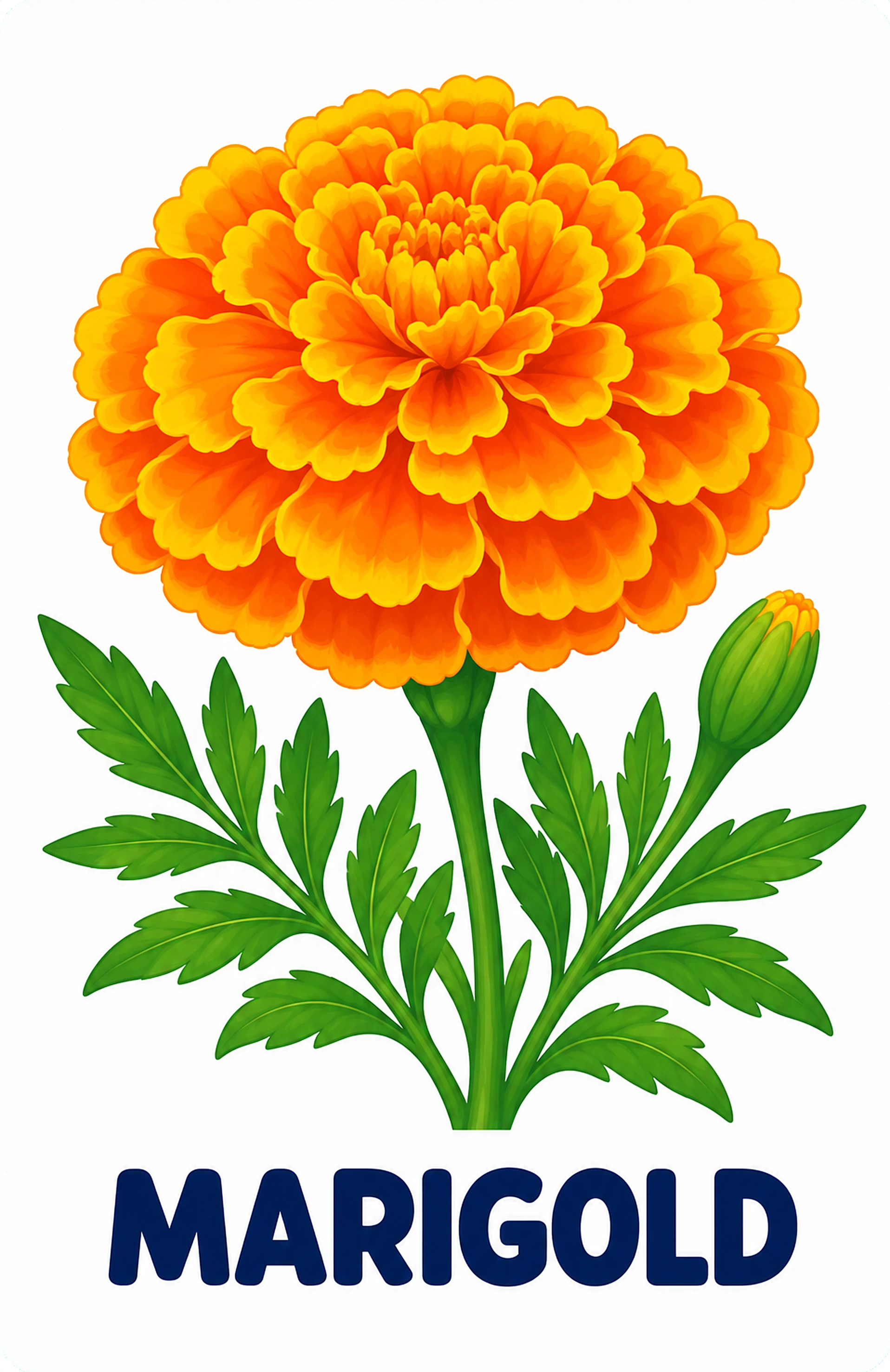
What is this?
A marigold is a rounded, ruffly flower, often orange, like a tiny pom-pom on a stem. Marigolds bloom for a long time and gardeners set them beside the vegetables — their smell sends some nibbling pests packing.
What does it mean?
The marigold is the round card in a set of shapes — a ball, a pom-pom, a winding. And it carries the set’s best job story: a flower with work to do, guarding the vegetable patch with its smell.
What does the child need to know?
Marigolds are the orange ball-flowers of the bed, ruffled all over. They have a job: planted beside vegetables, their smell keeps some nibbling pests away — a flower that works for the garden.
Why this matters
Round-and-round hand motions are fine-motor practice wrapped in pretend play, and orange needs its champion — the set’s least-practised colour. A working flower rounds out the idea that every plant has a story.
What it teaches
Rotating hand movements (winding, rolling), the colour orange in the wild, round-versus-flat shape sorting, and a first helper-story — flowers can have jobs, just like people.
Words to learn
marigoldorangeroundruffleballwind
Say this to your child
“"A marigold! A whole ball of orange — round and ruffly, like a pom-pom. Can you wind your wool? Round and round... and there is your marigold ball! This flower has a job too: it stands beside the vegetables and its smell keeps the pests away. A working flower!"”
Step by step
- Show the card, say marigold, and roll your hands around each other like winding wool — round and round and round, faster and faster.
- Wind an invisible ball together, then hold it up: that is a marigold — a flower shaped like a ball, ruffled from top to bottom.
- Ask your toddler to find the round flower on the card and feel the roundness in the air with both hands cupped.
- Tell the job story: plant marigolds beside the carrots and their smell keeps the nibblers away — this flower is the garden’s guard.
- Take orange hunting on the next outing — leaves, balls, doors, wheelie bins — and cheer every find like the marigold’s own fan club.
Look closer at the picture
Circle your hands around each other like winding wool and say marigold into the middle. Ask your toddler to find the round flower on the card, then cup both hands around an invisible ball — the marigold’s shape, held in the air.
Ask your child
"Is the marigold round or flat?" "What colour is it?" "Can you wind the wool?" "What job does the marigold do in the garden?" — answered with rolling hands, an "orange!" and a proud guard-story retelling.
What your child can say or do
"Ball flower!" Expect hand-winding at every stop, orange collected from pavements to breakfast plates, and marigolds appointed guards of the toy vegetables. The working-flower story will be retold with additions.
Out in the real world
Marigolds blaze orange in beds, borders and tubs from spring to autumn, and stand sentry in vegetable patches everywhere. Every pom-pom bloom is a rerun — wind the ball, name the orange, thank the guard.
Try it together
Marigold wind-up: wind real wool or ribbon around your toddler’s hands loosely, then unwind into a ball — round, round, round. Finish by coiling it into a bowl: a marigold nest for a toy bee.
Understanding check
Ask which flower guards the vegetables: "marigold!" with a winding motion means the story took root. An unprompted "orange!" at the next pumpkin or carrot seals the colour too.
Parent tips
Orange is the quietest colour in most homes, so stage a few finds — an orange lid on the table, an orange sock on the line. Keep the winding slow at first; speed comes with the giggles.
Staying safe
Garden marigolds are look-and-smell flowers, not snacks — and the soil around vegetable beds is for plants, not fingers. Winding play uses soft ribbon or wool, never string long enough to tangle, and hands stay unwound at the end.
This lesson pairs with the Marigold flashcard in the library — print it, show it, keep it on the fridge. Back to Garden Flowers (School Garden).