
Kite — a step-by-step lesson for grown-up and child
This lesson runs: your child taps the k sound at the back of their mouth, sprints with arms raised like kite string, and meets the letter that shares its sound with C.
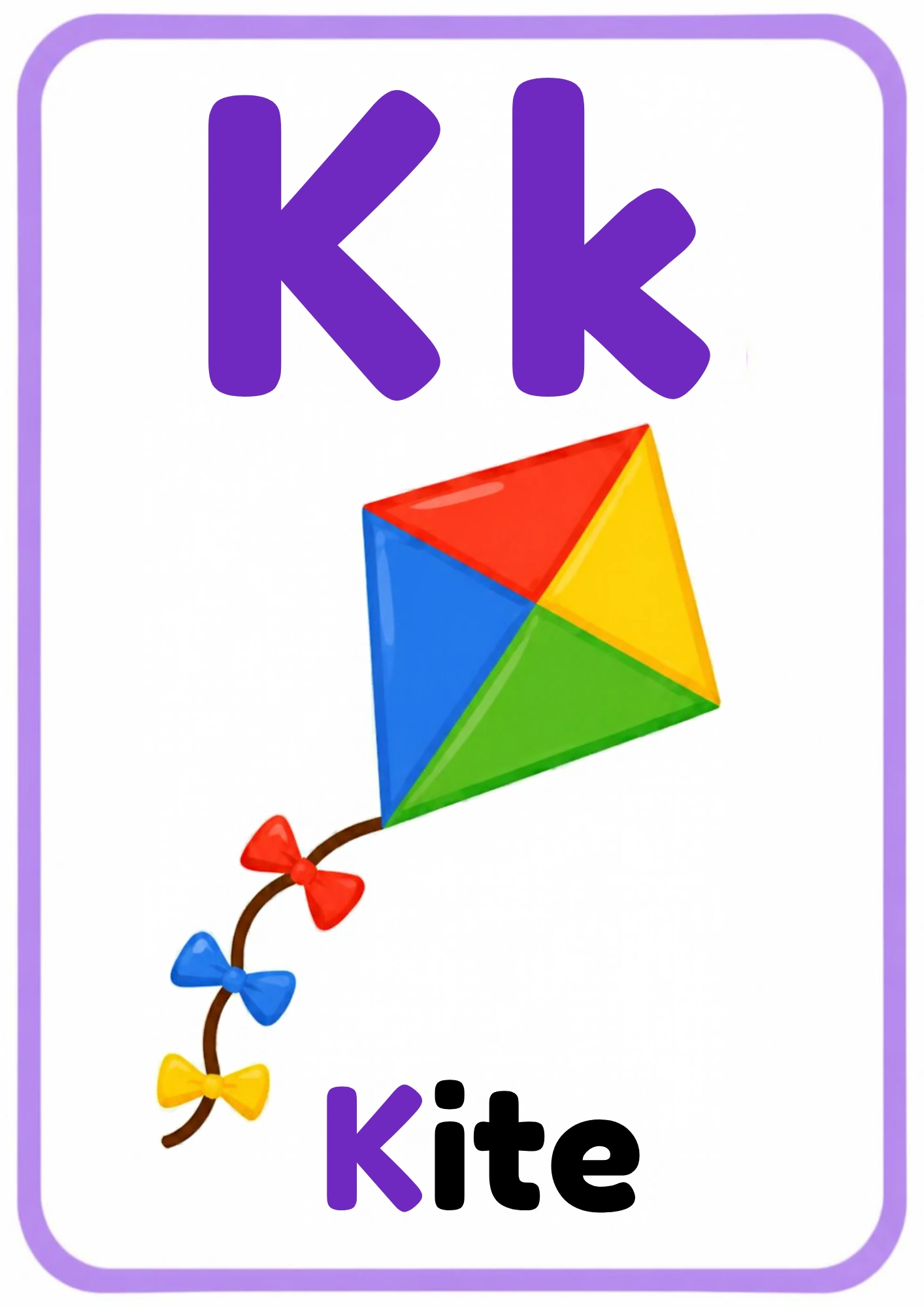
What is this?
K is the eleventh letter of the alphabet. It makes the k sound — the same quick click at the back of the mouth that C makes in cat. Two letters, one sound; English shares them around.
What does it mean?
K is the second letter to arrive with a sound your child already owns. Meeting that as a game of twins — C and K sharing one sound like friends sharing a bike — keeps it friendly for life.
What does the child need to know?
The letter is called K; the sound is kuh, the clean back-of-mouth click. Silent-k words like knife and know are strictly off the menu today — today K flies a kite and that is all.
Why this matters
Kites mean wind, running and a grown-up holding the string, so this card unlocks an outing, not just a lesson. And hearing cat’s sound come out of kite plants the sharing idea early and painlessly.
What it teaches
Back-of-mouth click production, sound-sharing awareness, letter recognition in two cases, whole-body sprinting with quick direction changes, and arm-up postural play that doubles as kite pretending.
Words to learn
Kkitekuhwindrunstring
Say this to your child
“"This is the letter K — hello, K! K says kuh — the click at the back of your mouth, the very same one C uses in cat. Try it: kuh, kuh, kite! Now be a kite: arms up, string tight, and run! When the wind drops, we trace the big K — tall line, then kick, kick."”
Step by step
- Show the card and look up: this is the letter K, and this is a kite — high up, holding on to its string.
- Make the click: tongue taps the back of the mouth — kuh! The same sound cat’s C uses. Try kuh three times, then kuh-kite.
- Trace big K — one tall line, then a small arm reaching out and a leg kicking away — and little k: a tall line with a small arm and a tucked leg.
- Run like a kite: arms up holding invisible string, dashing across the garden or hallway, one kuh for every burst of speed.
- End with a k-hunt: find three things that start with the k sound — the toy cat from the C lesson, a key, a picture of a king — and click the sound at each.
Look closer at the picture
Find the big uppercase K and the little lowercase k on the card, then the kite and the word Kite. Ask which letters look ready to move — both Ks reach away from their tall line with arms and a leg.
Ask your child
"What is this letter called?" "What sound does K make?" "Which other letter makes this exact sound?" "Can you run like a kite for three kuh-steps?" — answered with a name, a click, a proud C and a dash across the grass.
What your child can say or do
"Kuh! Kuh-kite!" Expect arm-up sprinting in open spaces, k-sounds offered to keys and kicks, and C-K friendships declared over breakfast. The toy cat may be promoted to honorary K. The sharing idea has landed.
Out in the real world
K clicks quietly through the day: key, kick, kitchen, ketchup, kites at the park. Every click is a rerun — and every shared kuh with a cat or a car seat is the twins idea still working.
Try it together
Kite string dash: tie a light ribbon to a stick and run with it streaming behind, one shouted kuh per straight stretch. When you call wind down, the kite lands in a crouch — then relaunches on the next kuh.
Understanding check
Ask what K says: a clean back-of-mouth click means the sound landed — bonus points if your child names C as the sound-sharer. A little k traced in the air completes the pair.
Parent tips
Resist explaining silent-k words — knife and know can wait years. If the C-K question comes up, "letters share sounds like friends share toys" said once, cheerfully, is the whole curriculum for today.
Staying safe
Kite-running needs open space, clear of furniture corners and garden hazards, with shoes on and eyes on the ground rather than the sky. Ribbon games stay far from necks, and real kite string is a grown-up’s job.
This lesson pairs with the Kite flashcard in the library — print it, show it, keep it on the fridge. Back to Alphabet A–Z (Preschool).