
Moon — a step-by-step lesson for grown-up and child
This lesson hums: your child closes their lips and holds the mmm for as long as breath allows, hunts the real moon out of the window, and traces a letter full of mountain peaks.
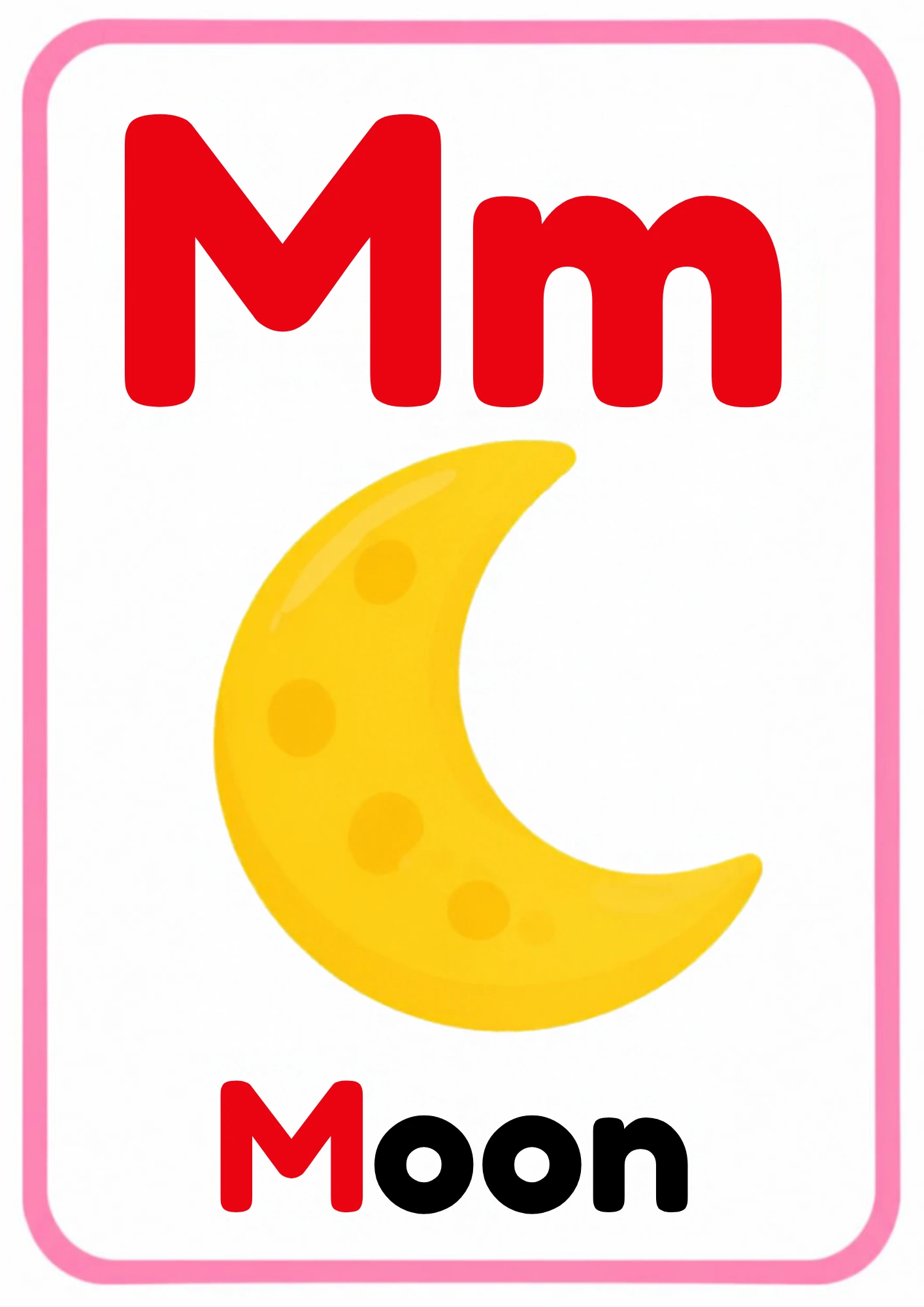
What is this?
M is the thirteenth letter of the alphabet. Big M and little m make the m sound — mmm, a hum made with lips together and the voice switched on. It lasts exactly as long as your breath does.
What does it mean?
M is the easiest sound in the set to feel and the hardest to miss: lips closed, hum out. Attach it to the moon and the practice renews itself every clear night, right at the calmest hour.
What does the child need to know?
The letter is called M; the sound is mmm — closed lips, humming voice, no burst of air. Hold it long, hold it short, taste something delicious with it: the hum stays the same throughout.
Why this matters
A bedtime word means bedtime practice, and no other card lands at a calmer hour. The mmm contest turns breath control into a game, and the moon turns the sky into a flashcard that comes out nightly.
What it teaches
Humming with closed lips, breath-length control, letter recognition in two cases, sky observation and pointing, and the evening-routine attachment that lets this card teach itself after dark.
Words to learn
Mmoonmmmhumlipsnight
Say this to your child
“"This is the letter M — hello, M! M says mmm — lips together, and hum like you have tasted something wonderful. Feel your lips buzz? Hold it — mmmm. Now look up: that is the moon. Say it with me — mmm-moon! Good night, moon. Good night, M."”
Step by step
- Show the card in the evening if you can: this is the letter M, and this is the moon — the letter’s favourite address in the sky.
- Make the sound with lips closed: hum — mmm. Feel the tickle behind your lips. Try one long mmm, then three short ones.
- Trace big M — down, peak up, valley down, peak up, down — and little m: one short stick followed by two small humps.
- Play the mmm contest: everyone hums with lips closed and the longest hum wins. Then hum through some words — mmm-moon, mmm-mummy, mmm-milk.
- End at the window: hunt the moon out of the sky together and greet it with mmm-moon! If there is a crescent up there, trace its curve with one finger.
Look closer at the picture
Find the big uppercase M and the little lowercase m on the card, then the moon and the word Moon. Ask which letter has more peaks — big M climbs two mountain peaks, little m rolls two gentle humps.
Ask your child
"What is this letter called?" "What sound does M make?" "How long can you hold your mmm?" "Can you find the moon from here?" — answered with a name, a closed-lip hum, a breath-length record and a pointing finger.
What your child can say or do
"Mmm! Mmm-moon!" Expect humming at every delicious meal, m-sounds offered to mummies and milkshakes, and moon-inspection at every bedtime from now on. The mmm contest may crown a permanent family champion.
Out in the real world
M hums through the whole day: milk, mummy, more, moon at bedtime. Every closed-lip hum is the card rehearsing itself — and the real moon keeps the appointment every clear night for free.
Try it together
mmm contest: faces together, lips closed, one long hum each — longest breath wins and chooses tonight’s bedtime story. Then hum the word moon together as the lights go down: the calmest phonics game ever devised.
Understanding check
Ask what M says: a closed-lip hum that holds and stretches means the sound landed perfectly. A little m traced in the air — stick, hump, hump — completes the evening.
Parent tips
This is the gentlest card in the set — save it for tired evenings. If the hum escapes into a muh with lips apart, close your own lips pointedly and hum; copying your face does the rest without a word of correction.
Staying safe
Moon-spotting happens from a window, balcony or doorway with a grown-up present — never leaning out. Keep the mmm contest to calm volumes after bedtime, and save crescent-drawing for indoors paper.
This lesson pairs with the Moon flashcard in the library — print it, show it, keep it on the fridge. Back to Alphabet A–Z (Preschool).