
Turtle — a step-by-step lesson for grown-up and child
This lesson slows down: your child taps a quick tuh behind their teeth, walks the world’s slowest laps of the living room and traces a letter made of two clean lines.
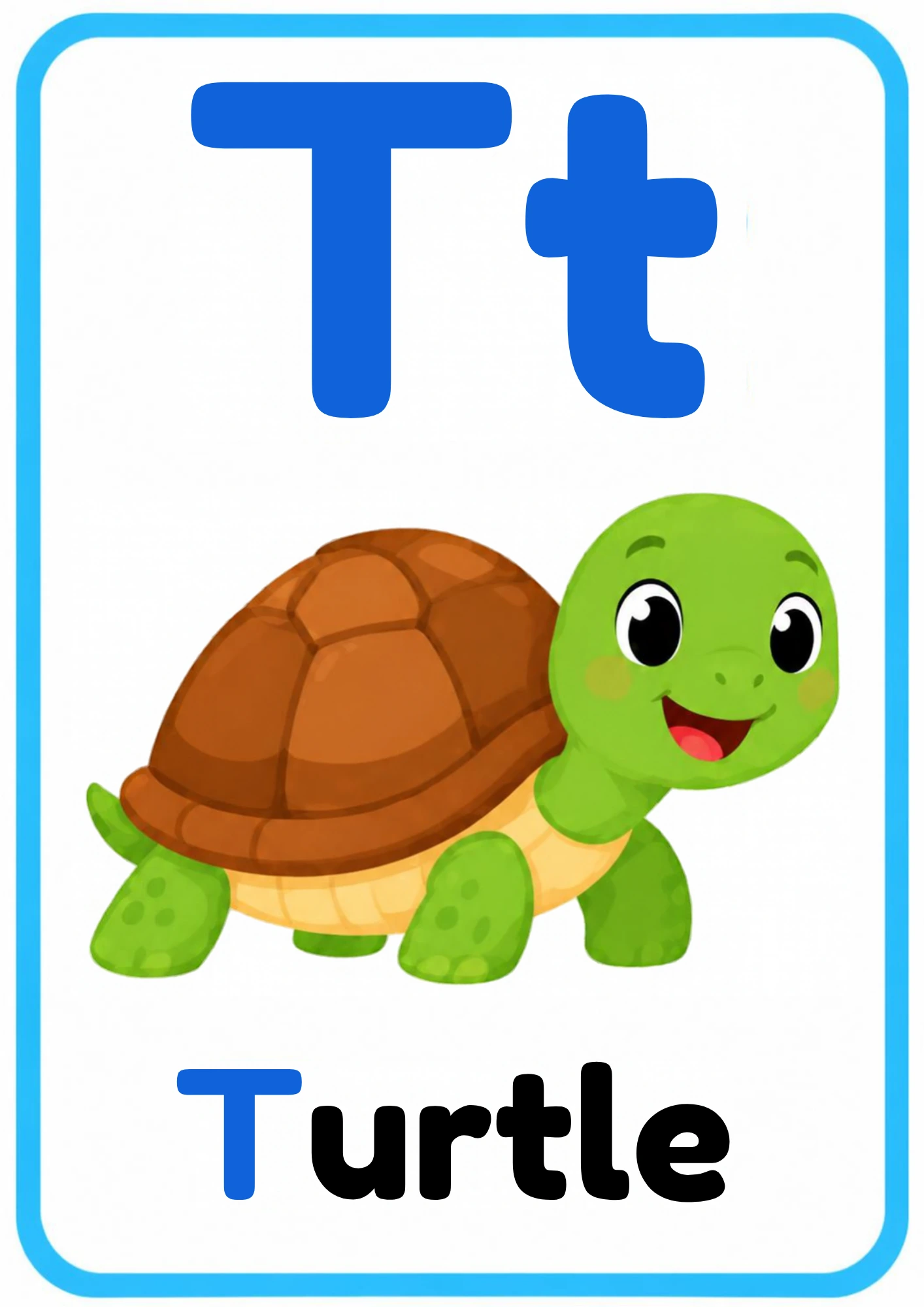
What is this?
T is the twentieth letter of the alphabet. Big T and little t make the t sound — tuh, a quick tap of the tongue on the ridge behind the top teeth. Tap once and the word is away.
What does it mean?
T is a speed lesson disguised as a slow one: the sound is a single fast tap, but the turtle insists on walking pace. Fast sound, slow feet — the contrast keeps both facts memorable.
What does the child need to know?
The letter is called T; the sound is a short clean tap — tuh, tongue on the ridge, no buzzing. Tap it twice — tuh-tuh — and you can feel the letter working. D is its cousin: same spot, voice on.
Why this matters
Slow-motion games are comedy gold at three, and the turtle is their patron saint. A letter that arrives with permission to be extremely slow gets practised far longer than a rushed one ever does.
What it teaches
Tongue-tap precision, voiced-versus-voiceless discrimination, letter recognition in two cases, balance and slow-motion body control, and the patience to finish a full lap without bursting into a trot.
Words to learn
Tturtletuhtapslowsteady
Say this to your child
“"This is the letter T — hello, T! T says tuh — the tongue taps behind the top teeth, quick as this: tuh! Feel the tap? Now be a turtle with me: one slow step... tuh... another slow step... tuh. Slow and steady wins the alphabet. Then trace the big T: tall line, arms out straight."”
Step by step
- Show the card and admire the pace: this is the letter T, and this is a turtle — the slowest teacher in the alphabet.
- Make the tap: tongue taps the ridge behind your top teeth — tuh. Quick! Tap twice: tuh-tuh. Find the spot with one slow tap first.
- Trace big T — one tall line down and one straight arm across the top — and little t: a shorter stick with a crossbar and a small curve at its foot.
- Walk like turtles: very slow steps around the room, one tuh per step. Slow-motion races are allowed; real hurrying breaks turtle law.
- End with a t-hunt: find three things that start with the tap — a toe, a tooth, a teddy — and tap the sound onto each.
Look closer at the picture
Find the big uppercase T and the little lowercase t on the card, then the turtle and the word Turtle. Ask which letter holds its arms higher — big T spreads a straight line across its very top, little t wears its crossbar lower down.
Ask your child
"What is this letter called?" "What sound does T make?" "Where does your tongue tap?" "Can you take one genuinely slow turtle step?" — answered with a name, a crisp tuh, a pointed tongue and a heroic crawl.
What your child can say or do
"Tuh! Tuh-turtle!" Expect slow-motion walks everywhere, t-sounds offered to toes and toothbrushes, and turtle law invoked at bedtime. The tap is quick; everything else about this lesson stays slow. That is precisely the charm.
Out in the real world
T taps through the day: toast, teeth, time for bed, tickle — some of the busiest words in a toddler’s vocabulary. Every tap is the card again, and a real turtle met at a pond is the lesson walking off at its own pace.
Try it together
Turtle race: pick a finish line three metres away and cross it in the slowest steps anyone can manage — first to finish last wins. One tuh per step, wobbling encouraged, trotting disqualifies the whole species.
Understanding check
Ask what T says: a quick tongue-tap with no buzz behind it means the sound landed clean. A big-armed T traced in the air — line down, arms across — completes the slow parade.
Parent tips
Keep the tap crisp: tuh, not tuuuh — the turtle is slow, the sound is not. If D and T get confused, tap both slowly and let your child feel which one buzzes; the tongue already knows the spot.
Staying safe
Turtle racing happens on open floor with room to wobble — bare feet or grippy socks on smooth floors. Slow-motion is not hands-free climbing: shells stay on the ground, and laps end before legs do.
This lesson pairs with the Turtle flashcard in the library — print it, show it, keep it on the fridge. Back to Alphabet A–Z (Preschool).