
Cow — a step-by-step lesson for grown-up and child
This lesson takes the biggest voice in the barnyard and gives it room. Moo is long, low and lazy — and while your child is enjoying it, the sound is quietly teaching slow, controlled breathing that speech and singing will use for years.
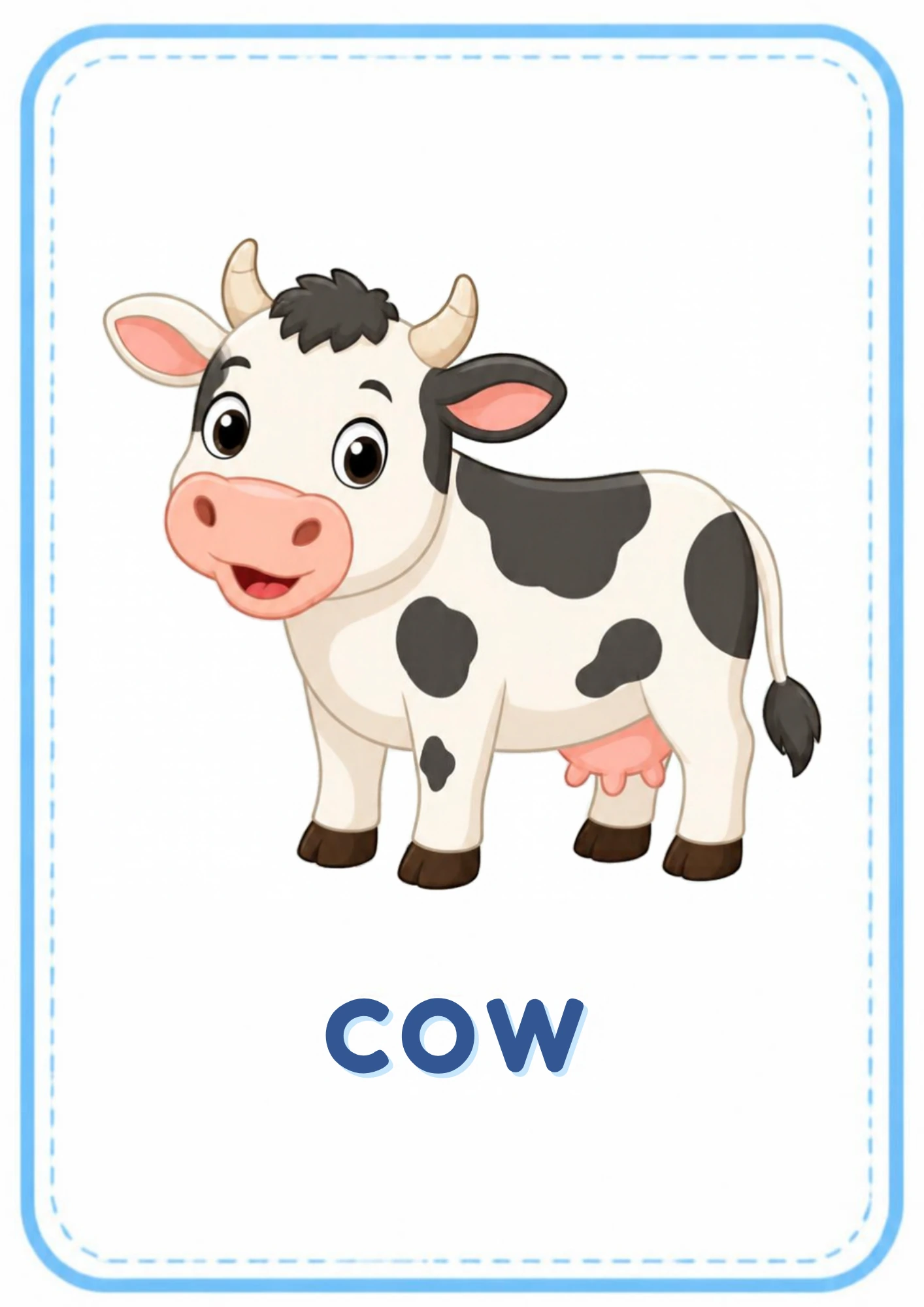
What is this?
A cow is a big farm animal with kind eyes, a spotted coat and a voice to match its size. The call goes out slow and rumbly, and people copied it as moo — one of the oldest animal words there is, and one of the easiest to say big.
What does it mean?
A cow says moo because that is how people hear it. The real call is a long, low rumble from deep in the chest; moo is our mouth’s best copy of that rumble. Say moo slowly and you can feel the shape of the true sound: wide open, low, in no hurry at all.
What does the child need to know?
Your child needs to know: the cow’s sound is written moo in English, cows give us milk, and cows call to their calves and to the farmer with that big slow voice. Moo is made with a wide-open mouth and a long breath — the body knows it before the word does.
Why this matters
Moo is the best breath exercise disguised as a game. Holding a long, low sound takes controlled air — the same control behind singing, long sentences and calm-down breathing. Every giant moo is oral-motor training that feels like pure silliness.
What it teaches
Breath control and sustained voicing, pitch play (high moos, deep moos), animal and farm vocabulary, the cause-and-effect of milk coming from cows, and confident loudness — a safe place to be huge.
Words to learn
cowmoofarmmilklowherd
Say this to your child
“"The cow says moo! Mooooo — open wide, start low, and let it rumble all the way out. Moo is our word for the cow’s big slow call. Can you make the longest moo in the house? And guess what — the milk in our fridge came from a cow just like this one."”
Step by step
- Show the card and ask who this big spotted animal might be. Then ask the question the farm answers: what does it say? Take any guess, then give the real one.
- Say the pair — the cow says moo — and make your best long, low moo together. Slow is the rule: a moo that lasts the whole breath.
- Look at the picture: a farm cow, spotted black and white. Run a finger over the spots and name the colors — black, white, black, white.
- Form a kitchen barnyard choir: everyone moos at their own pitch — squeaky moos, deep moos, slow moos — and votes on the most cow-ish one.
- Connect the milk: we drink milk at breakfast, and milk comes from cows. The carton in the fridge is the proof your child can hold.
Look closer at the picture
Look at the picture together: what colors are the spots? Where is the cow looking? What word sits with the cow? Does the cow look big or little?
Ask your child
"What does the cow say?" "Where does our milk come from?" "Can you make a deep, slow moo — the biggest one you have?" "What sound would a baby cow make?"
What your child can say or do
Your child may fill entire car journeys with moos, answer the milk-carton question with pride, or line up the animal cards and give the cow the deepest voice of all — the big animal, the big sound, correctly matched.
Out in the real world
Cows graze in fields on the drive out of town, appear at farms and county fairs, and stand on every milk carton in the fridge. Each sighting earns its moo — and each carton at breakfast is a quiet repeat of where milk really comes from.
Try it together
The barnyard choir: assign everyone an animal — you the sheep, your child the cow, a teddy the duck — and sing a verse of a familiar tune, but each singer may only make their animal’s sound. The cow carries the low part. It is a concert, a matching game and a breath workout in one.
Understanding check
Ask: "What does the cow say? Where does milk come from? Make your longest moo." The long, low rumble, the answer and the wide-open mouth — that is the lesson landed.
Parent tips
Judge the moo contest generously and often — longest, deepest, slowest — because every round is another slow-breath exercise. And when the moos migrate to the supermarket, let them: a cow sound in public is a small price for a word this well loved.
Staying safe
If you visit real cows at a farm or a field, admire them from the fence — big animals get big space, and feeding happens only when the farmer hands out the job.
This lesson pairs with the Cow flashcard in the library — print it, show it, keep it on the fridge. Back to Animals & Their Sounds.