
Ears — a step-by-step lesson for grown-up and child
This lesson tunes in to the hearing pair. Ears never sleep, never blink and never switch off — they catch the world all night and all day — and naming them opens up a whole set of listening games your house is already full of.
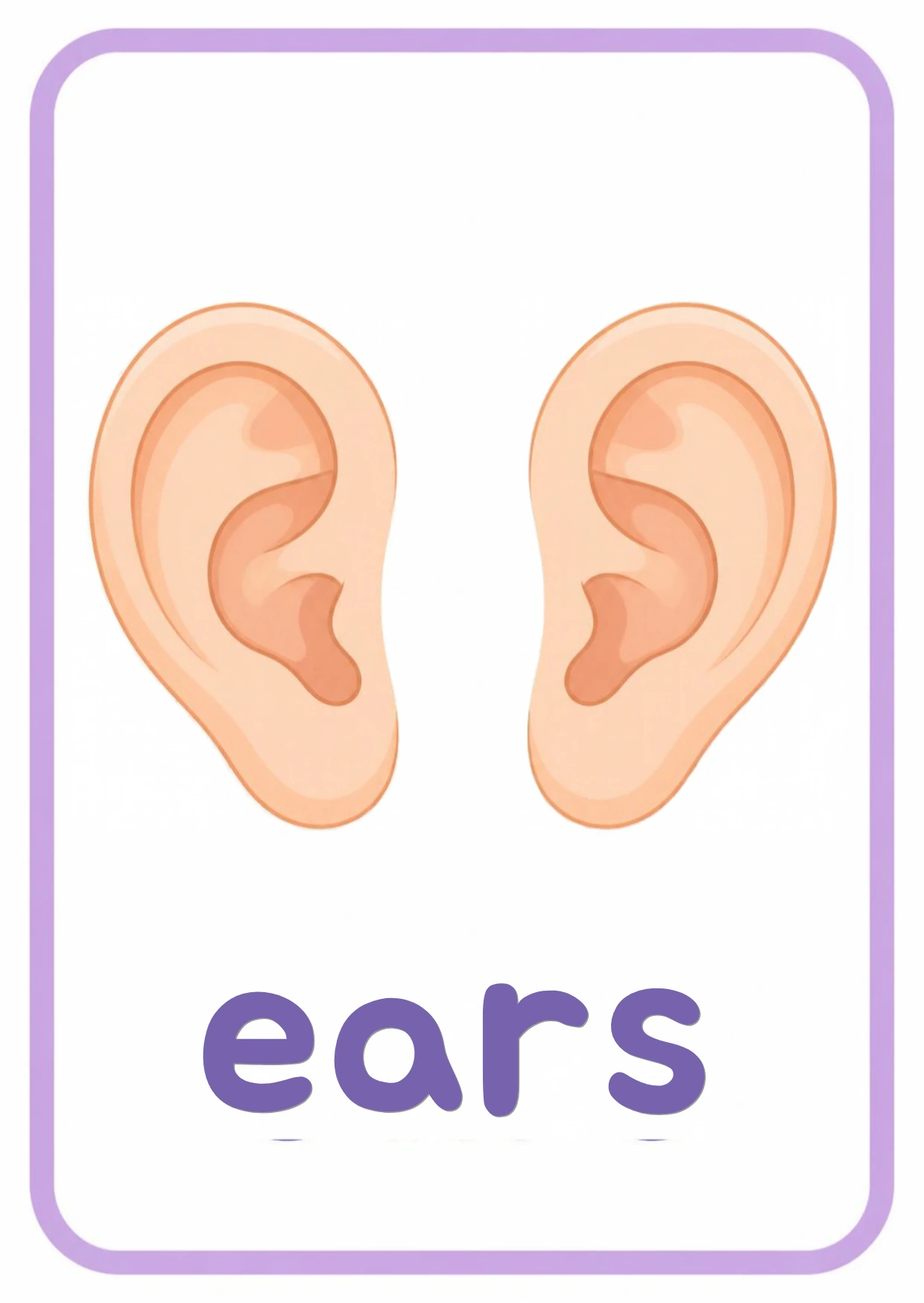
What is this?
Ears are the two hearing parts of the body, one on each side of the head. They catch sounds — voices, dogs, doorbells, songs, thunder — and pass them to the brain, which works out what each one is. Even asleep, ears stay on duty.
What does it mean?
Hearing is the one sense that never closes: eyes shut for sleep, but ears keep listening, which is why a familiar voice can wake a child and a lullaby can settle one. Sound arrives from every direction — front, back, through walls — making ears the body’s surround-sound system.
What does the child need to know?
Your child needs to know: ears are for hearing, they come as a pair on the sides of the head, they work even when eyes are shut, and they are delicate — nothing ever goes inside an ear, and very loud noise right up close is too much for them.
Why this matters
Listening is half of every conversation and all of every song, story and instruction. A child who knows their ears can also train them: the quiet games in this lesson build the attention that circle time, music class and safety — hearing a warning call — all depend on.
What it teaches
Auditory attention and discrimination (telling sounds apart), body-part vocabulary, volume awareness, the quiet-stillness skill that group learning needs, and the sensory delight of a world heard with intent.
Words to learn
earshearlistensoundloudquiet
Say this to your child
“"These are your ears — one here, one here, a pair! They catch everything: my voice, the dog next door, the kettle, the song on the radio. They even listen while you sleep! And they are delicate — nothing ever goes inside an ear. Ears are for listening, from outside only."”
Step by step
- Show the card and point: what are these, and what are they for? Name them — ears — and count: one on each side.
- Find your child’s ears: trace the curve, tug gently, then wiggle your own and admit how hard it is. Some people can, most cannot — trying is the fun.
- Play cover-and-listen: cup your hands over your ears and hear the world go quiet — then let go and name every sound that rushes back in.
- Prove the all-directions trick: your child shuts their eyes while you hide and call their name — the ears find you without any looking at all.
- Set the care rules: nothing goes in an ear, not even a finger, and ears need a break from very loud noise right up close. Ears are on duty for life.
Look closer at the picture
Look at the picture together: how many ears are in the picture? Where do they sit — on the sides? What word sits under them? Can you see a hole or a curve in each one?
Ask your child
"What do your ears do?" "What was the first sound you heard this morning?" "Do ears sleep when you sleep?" "What do we never put inside our ears?"
What your child can say or do
Your child may narrate the household soundscape — fridge humming, door creaking, daddy coughing — point out the ears of every animal they meet, or cup their hands behind their own ears and announce that the world got louder.
Out in the real world
Ears earn their keep everywhere: hearing the doorbell, the timer, the bath running, a sibling crying two rooms away, a warning shout at the road. Name the ears’ catches as they happen — "your ears heard that first!" — and the pair becomes a celebrated instrument.
Try it together
The sound detective: your child closes their eyes while you make a mystery sound — keys, a spoon in a cup, a page turning, a zipper — and they name it. Six sounds, six guesses, endless replays. It is listening, memory and deduction with objects from every drawer.
Understanding check
Ask: "What do your ears do? How many and where? What do we never put in them?" The hearing, the pair and the nothing-inside rule — that is the lesson landed.
Parent tips
The hide-and-call game doubles as separation reassurance — ears prove that a hidden parent is still findable. And keep music and screens at conversation volume as the household default: little ears do their best growing at that level, and the rule is easiest when it is everyone’s.
Staying safe
Nothing ever goes inside an ear — not fingers, not cotton buds, not toys; ears clean themselves, and anything stuck gets a doctor, not a dig. Loud sound close to the ear — shouts, speakers, headphones at full — can harm hearing, so keep volume at talking level and step back from the very loud.
This lesson pairs with the Ears flashcard in the library — print it, show it, keep it on the fridge. Back to Body Parts & Five Senses Flashcards.