
Look — a step-by-step lesson for grown-up and child
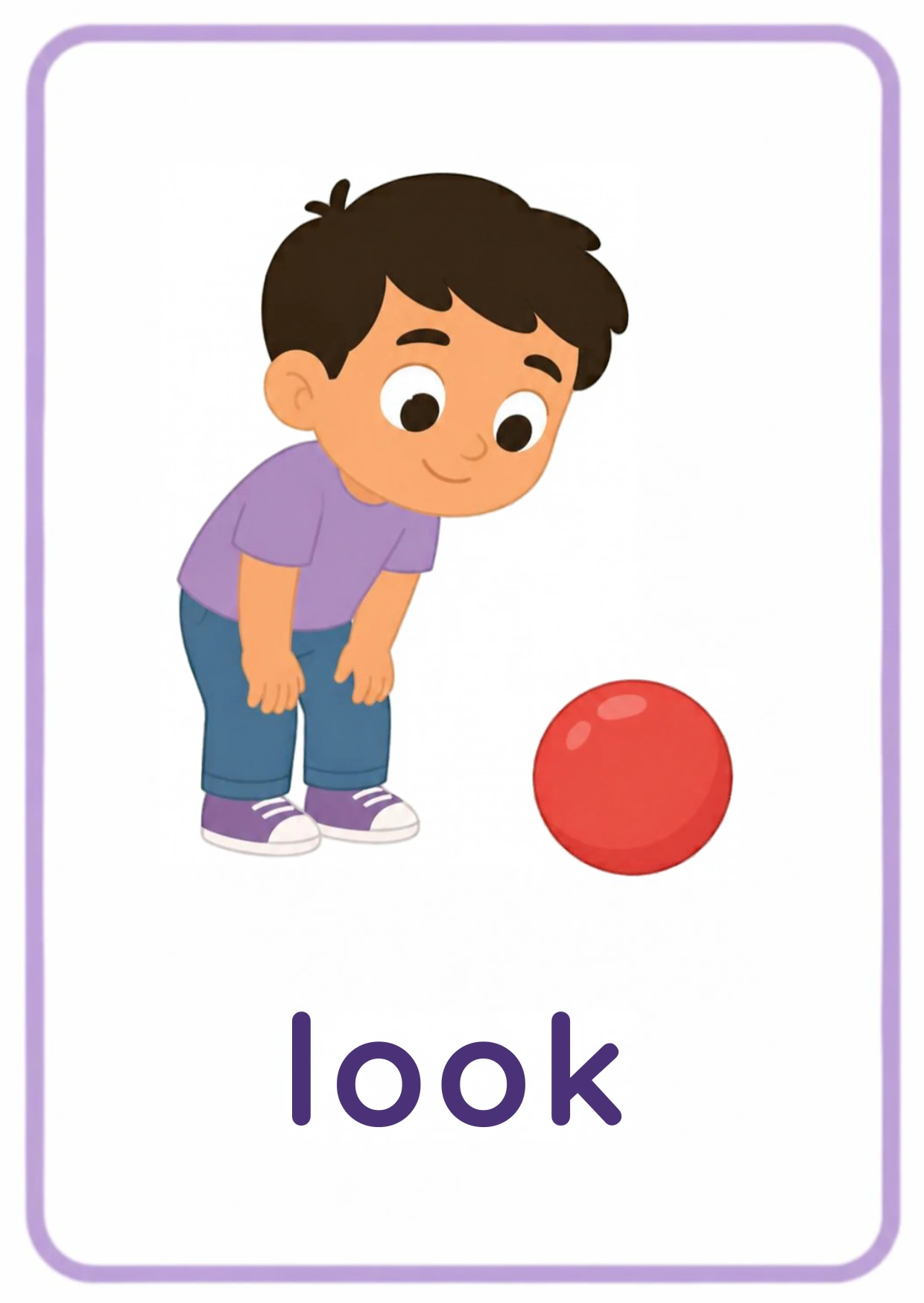
This lesson puts the eyes to work. See is the sense; look is the job — bending down, getting close, taking your time. The card shows it exactly: a boy folded low over a red ball, close enough to study every inch of it.
What is this?
Look is what eyes do on purpose: point them at something and study it. Looking is slower than seeing — the whole body helps, bending down, holding still, getting close. It is the eyes’ doing-word, and it is the difference between a glance and a real investigation.
What does it mean?
See happens whether you choose it or not; look is the chosen version — attention aimed on purpose. That aiming is the first scientific skill your child owns: freeze, focus, study, report. The card’s bent knees say it plainly: looking closely is body work, and it takes practise.
What does the child need to know?
Your child needs to know: we look with our eyes, looking means slowing down and getting close — bend, freeze, study — it is the doing-word for the seeing sense, and moving feet get eyes up: eyes study best when the body is still, so feet stop first, then eyes work.
Why this matters
Look is one of the most-used words in a preschool day — look at this, look where you are going, look at me! — and a child who owns the word owns the game of noticing. Looking closely feeds every later skill: puzzles, books, patterns, science, and the find-your-shoes speed run at the door.
What it teaches
Visual attention and deliberate focus, body-stillness as a condition for looking, action-word (verb) vocabulary, near-and-far looking ranges, and observation as the first step of the science habit.
Words to learn
lookeyesclosestudyspotfreeze
Say this to your child
“"Look! Your eyes have a doing-word, and this is it: look. Bend down slow, hold still, and really study something — a red ball, a bug, a pattern. What did the long look find that the quick one missed? And remember: feet stop first, then eyes work. Show me your best freeze-and-look!"”
Step by step
- Show the card: what is the boy doing — bending down, low and slow, to look at something? And at what? A red ball, worth studying.
- Copy the pose: bend down low together and pick one thing to study — a toy, a shell, a pattern on the rug. Ten slow seconds, then report: what did the close look find?
- Play look-up-look-down: look up high, look down low, look behind you, look between your knees. Freeze after each one — looking bodies are still bodies.
- Try near and far: hold a toy at nose distance and study it, then set it across the room and study it again. Same toy, two reports — looking has ranges.
- Set the feet rule: when feet are moving, eyes go up; when eyes want to study, feet stop first. Look while still, walk while watching — that is the safe way round.
Look closer at the picture
Look at the picture together: what is the boy doing — bending down? What is he studying — a red ball? Is he up close or far off? What word sits with the picture? What was the last thing you bent down to look at?
Ask your child
"What do we look with?" "How is looking different from just seeing?" "Show me a freeze-and-look — what did you find?" "What is the rule for feet and eyes when we walk?"
What your child can say or do
Your child may drop into the freeze-and-look pose mid-pavement — ladybug under study, feet already stopped — issue look! commands at every window, or explain the feet rule to a running friend: stop first, then eyes.
Out in the real world
Look runs the whole day: look both ways at the kerb, look for the missing shoe, look at this drawing, look how tall the tower got. Each command lands better on a child who knows that looking is a skill — and that feet stop before eyes start.
Try it together
The close-study gallery: collect three small treasures — a pinecone, a shell, a big leaf — and give each a full slow look, ten seconds minimum, then a report of three findings. Line them up on a shelf as the gallery. Fresh treasures weekly; the study habit grows with the collection.
Understanding check
Ask: "What do we look with? Show me a freeze-and-look. What do feet do first?" The eyes, the pose and the stop answer — that is the lesson landed.
Parent tips
Give the study time room to be slow — the whole point is the long look, and three-year-olds need seconds to find the details. And join in: study one thing yourself and report out loud, because a child who watches a grown-up look closely learns what close looking looks like.
Staying safe
Looking has a moving-feet rule: no studying while walking — feet stop, then eyes work — or kerbs and table corners collect their toll. And the sun rule holds here too: eyes never study the sun, whatever the game — hats and shade do the guarding on bright days.
This lesson pairs with the Look flashcard in the library — print it, show it, keep it on the fridge. Back to Body Parts & Five Senses Flashcards.