
Taste — a step-by-step lesson for grown-up and child
This lesson is the snack-time sense. Taste lives on the tongue, and the card catches it in action: mouth open, tongue out, a lollipop mid-test. Of all the five senses this is the one with a menu — and the best snacks for practising it.
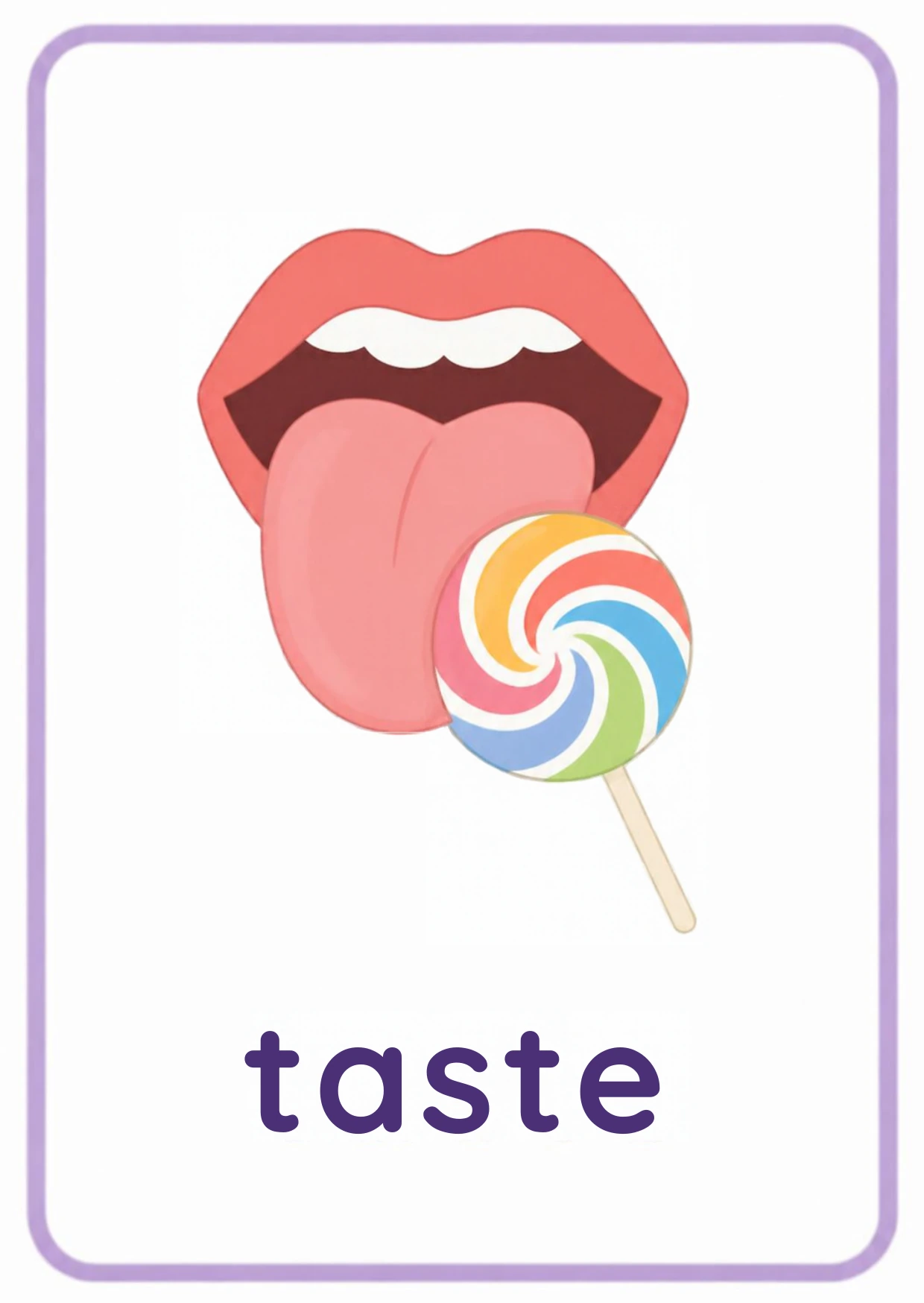
What is this?
Taste is what the tongue does: it checks every bite and reports the flavour — sweet, salty, sour, bitter and yummy-all-over. It is the fourth of the five senses, and it never works alone: the nose smells every bite too, which is why food goes quiet when a blocked nose arrives.
What does it mean?
Taste is the safest sense to train, because the laboratory is the kitchen and the equipment is lunch. The tongue carries thousands of taste-spotters, and the nose does the fine detail — hold your nose mid-bite and everything goes mysterious. Together they turn eating into science, three times a day.
What does the child need to know?
Your child needs to know: we taste with our tongue, tasting is the fourth sense, flavours have names — sweet, salty, sour — and taste has rules: only food, only with a grown-up’s okay; hot things wait until a grown-up has checked them.
Why this matters
A named sense gets used on purpose. Children who can say sweet and sour describe their world, try new foods as a game instead of a battle, and carry the rule that keeps the sense safe: the tongue tastes food — and only food — when a grown-up has said yes.
What it teaches
Flavour vocabulary (sweet, salty, sour, yum), the five-senses framework (taste as the fourth), taste-and-smell teamwork awareness, trying new foods through game framing, and the food-only rule that keeps little mouths safe.
Words to learn
tastetonguesweetsaltysouryum
Say this to your child
“"Taste! Your tongue knows flavours — sweet like banana, salty like crackers, sour like apple, yum like everything. Tasting is one of your five senses, number four! And it has rules: food only, grown-up first, and hot things get checked and blown before the tongue says hello. Ready to be a taste scientist?"”
Step by step
- Show the card and ask what is going on — a lollipop test, tongue out, mid-taste! Name it: taste, the fourth of the five senses.
- Find the taste-spotters: the tongue lives in the mouth and checks every bite. Say ahh and spot it in a mirror — the pink floor where flavour lands.
- Play the three-flavour game at snack time: a slice of banana (sweet), a cracker (salty), a squeeze of apple (sour). One small bite each, one word each.
- Show the teamwork: hold your nose while tasting — suddenly everything is mysterious. Nose and tongue are a team, and food tastes bigger when both report.
- Set the rules with a smile: the tongue tastes food and only food, a grown-up says when it is tasting time, and hot things wait until a grown-up has checked them. Blow first, then taste.
Look closer at the picture
Look at the picture together: what is being tasted — a lollipop? Is the tongue out or in? What word sits with the picture? Has your child ever given a lollipop the full taste test?
Ask your child
"What do we taste with?" "Which sense is taste — the fourth of how many?" "What did you taste today that was sweet? Sour?" "What is the rule for hot food?"
What your child can say or do
Your child may grade every meal by flavour — sweet winner, sour surprise — hold a nose closed mid-dinner to prove the teamwork, or announce the rules at the table: food only, grown-up first, blow before taste.
Out in the real world
Taste runs through every day: the sweet bite of porridge with honey, salty lips after the pool, the sour pucker at a lemon, the yum at the end of a birthday cake. Give each flavour its word at the table and the sense becomes family vocabulary.
Try it together
The taste-test station: three tiny cups with a drop or crumb in each — sweet, salty, sour — eyes shut, one taste each, guess which is which. Then swap roles: your child sets the cups and quizzes you. Being the scientist is half the learning.
Understanding check
Ask: "What do we taste with? Name the flavours. What is the rule for hot things?" The tongue, the three words and the blow-first answer — that is the lesson landed.
Parent tips
Keep the tastes tiny — one crumb, one drop — and let your child spit out anything they dislike without a fuss; brave tasting grows where there is no pressure. Sour is the crowd-pleaser: one lemon face earns a whole week of requests.
Staying safe
Taste is the one sense that comes with a grown-up on duty: grown-ups wash the food and cut it into safe pieces, only food goes on the tongue, and hot things — soup, toast, cocoa — wait until a grown-up checks the temperature and says blow-then-taste. Anything off the floor, out of a pocket or off a plant is not food, whatever it looks like.
This lesson pairs with the Taste flashcard in the library — print it, show it, keep it on the fridge. Back to Body Parts & Five Senses Flashcards.