
Broccoli — a step-by-step lesson for grown-up and child
Broccoli is the vegetable class’s imagination magnet: hold it upside down and it is a tree, point it at the sky and it is a forest, eat a branch and it is dinner. This lesson teaches the word at the card, the real secret — those lumpy bits are hundreds of flower buds — and the tree game that makes the tasting an adventure.
What is this?
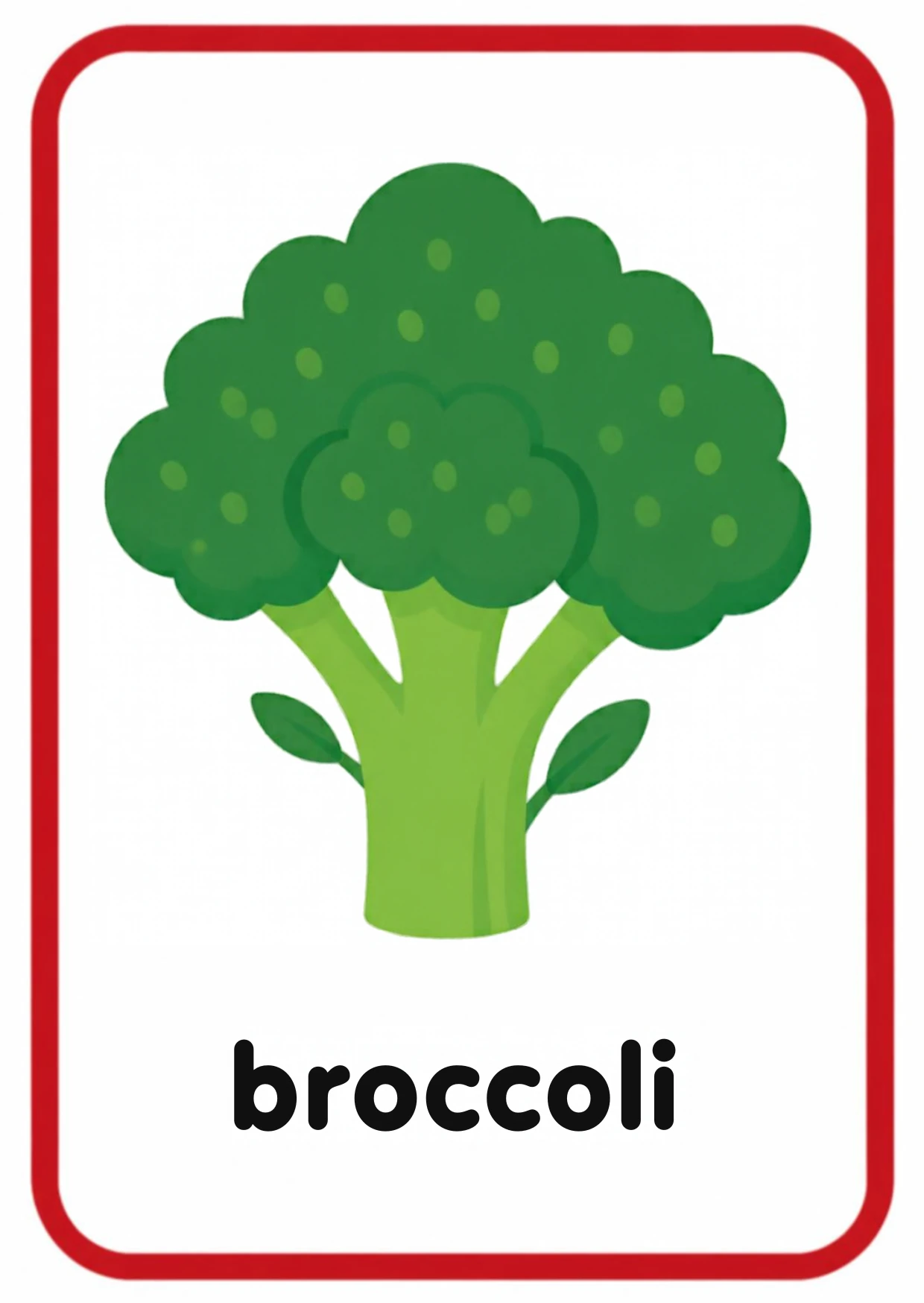
Broccoli is a green vegetable with a thick stalk and a lumpy, bushy top made of hundreds of tiny buds — it grows above the ground in cool gardens, standing up like a small shrub. The card shows a green broccoli that looks like a little tree. It is a flower your child is allowed to eat.
What does it mean?
The tree pretence is not a detour from learning — it is the learning: a child who plays at being a giant eating a forest is doing symbolic play, the engine of language. The word broccoli rides on every branch, every chomp and every roar, and pretend-loaded words get more rehearsals than plain ones.
What does the child need to know?
Your child needs the word at the card, the flower secret — the lumpy top is hundreds of tiny buds, which is why it feels like a forest floor — and the upside-down game: hold it by the stalk, trunk to the sky, and take bites off the branches. Then the tasting: washed by your child, cut by a grown-up, trees for dinner.
Why this matters
Pretend play is the cheapest motivator in the parenting toolkit, and broccoli supplies the prop for free: tree, forest, tiny clouds, a green microphone. A child who eats a tree for dinner is eating a vegetable they refused last week — the costume changed, and so did the vote.
What it teaches
Symbolic and pretend play, botanical secret knowledge (flower buds), part vocabulary (stalk, branches, buds), confident chewing of a challenging texture, and the storytelling that turns dinner into a nature documentary.
Words to learn
broccoligreentreeflowerbudscrunch
Say this to your child
““Broccoli! A little tree — and you can EAT it! Look at the bumpy top: those are hundreds of tiny flower buds, all packed together. Hold it upside down — trunk at the top! Now be a giant: chomp a branch, chomp a branch... the forest never stood a chance. Trees have never been this delicious.””
Step by step
- Show the card and say broccoli — then ask what it looks like. A tree! Agree enthusiastically; the resemblance is the lesson’s engine.
- Tell the secret: the lumpy top is made of hundreds of tiny flower buds — broccoli is a flower your child is allowed to eat, and the bumpy bits are the proof.
- The tree game: hold a real floret upside down by the stalk — trunk up, branches down — and be a giant taking bites off the forest. Roar between bites.
- The washing job: your child rinses the florets in the colander, leaf-forest to tap, while a grown-up stands by for the cutting.
- Tasting: cut florets, raw crunch first, then the soft steamed version — same tree, two weathers. Which forest does the giant prefer?
Look closer at the picture
Study the card together: it shows a green broccoli with a lumpy top and the word broccoli underneath. Ask your child what the top looks like, whether the card’s broccoli has a trunk at the bottom, and what color the whole vegetable is.
Ask your child
“What does broccoli look like?” “What are the lumpy bits really — leaves, buds or stones?” “Where does it grow — up in the air or under the ground?” “Which is your giant roar — loud or louder?”
What your child can say or do
Your child might demand “tree pieces” by name at dinner, stage forests on the plate with mashed-potato ground, or take enormous giant-bites with sound effects — the pretence is the point, and the vegetable is the beneficiary.
Out in the real world
Broccoli repeats weekly: florets in pasta, trees on the dinner plate, the tiny ones in stir-fries. Each appearance is another chance to play giant — and a vegetable that comes with a game built in gets eaten on a different schedule than one that does not.
Try it together
The broccoli forest: hold it upside down — trunk to the sky — and walk a finger along the branches, naming the florets like trees, then take one bite per branch until the forest shrinks. Washed by your child first, cut by a grown-up after: a tree you are allowed to eat is a tree worth meeting twice.
Understanding check
Ask: “What does broccoli look like? What are the bumpy bits? Who is brave enough to be the giant?” A tree, flower buds, and a volunteering mouth — that is the lesson landed.
Parent tips
If the tree game converts a refuser, retire it slowly rather than banning it: from giant-bites to forest-bites to just-broccoli, over weeks. The pretence is scaffolding, and scaffolding comes down a piece at a time when the wall stands.
Staying safe
The stalk skin is tough, so a grown-up peels and cuts the florets into tree-sized pieces — raw for confident crunchers, steamed for the rest. The washing is your child’s proud job; the knife work stays firmly in the grown-up camp.
This lesson pairs with the Broccoli flashcard in the library — print it, show it, keep it on the fridge. Back to Fruits & Vegetables Flashcards.