
Cucumber — a step-by-step lesson for grown-up and child
The cucumber is the vegetable class’s quiet science kit: cool to the touch, mostly water inside, and wearing the same bumpy green skin as its famous cousin the watermelon. This lesson teaches the word at the card, the trailing-vine growing, and the cool-slice trick that turns snack time into a temperature experiment.
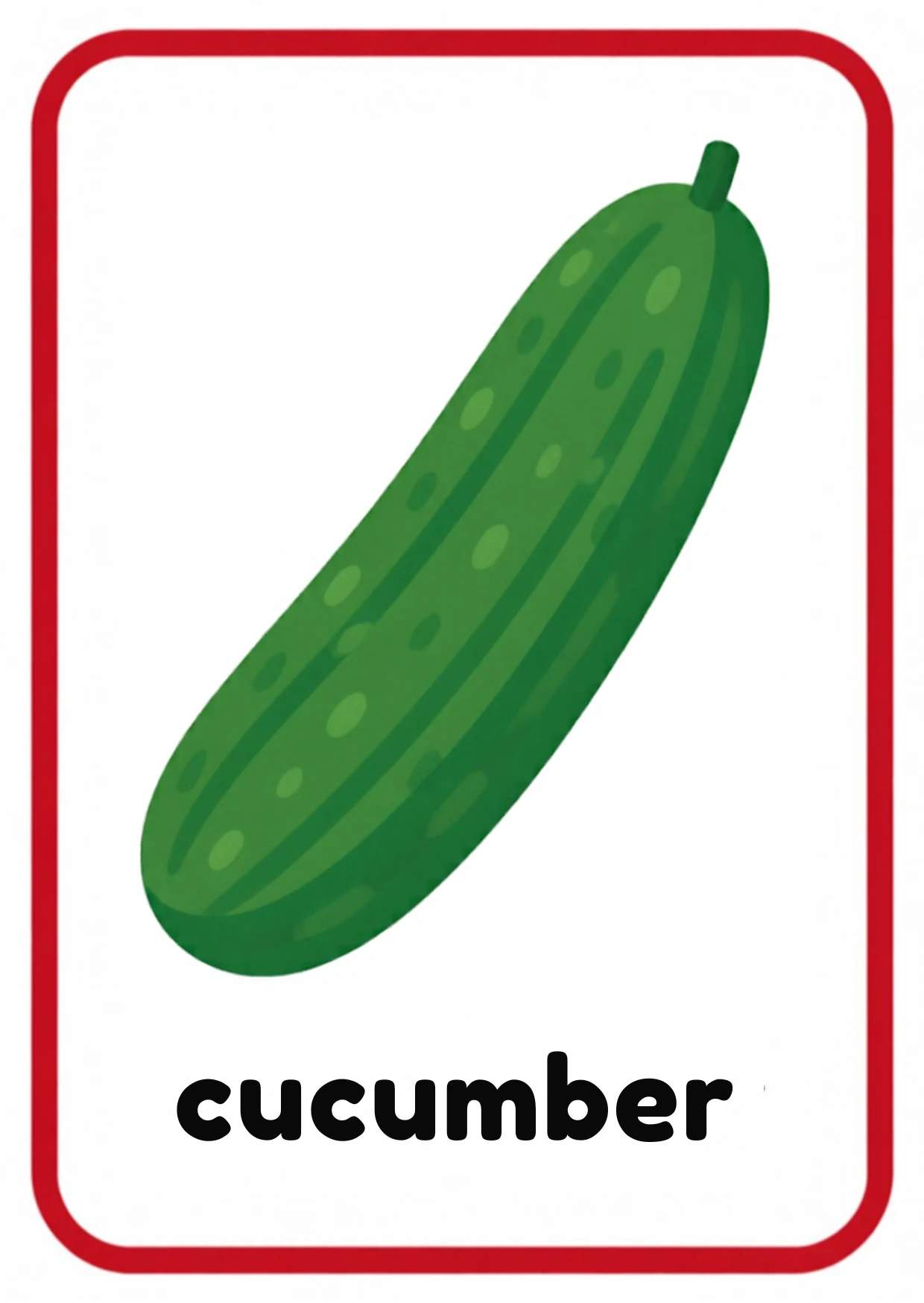
What is this?
A cucumber is a long, green, cylinder-shaped vegetable that grows on trailing vines along the ground or up supports. The card shows a long green cucumber. It is cool to the touch and crunchy inside because it is mostly water — which is exactly why it feels like the fridge’s favorite vegetable.
What does it mean?
Cucumber teaches hidden water: a crunchy vegetable that is secretly a drink. A child who learns that cucumbers are mostly water has planted the idea that foods have insides with jobs — water for cooling, sunshine-colors for eyes, in the carrot’s case — and food science starts exactly there.
What does the child need to know?
Your child needs the word at the card, the vine story — cucumbers trail along the ground like the watermelon, their cousin — and the cool trick: hold a slice against the back of a hand and report the temperature. Then the tasting: washed, cut by a grown-up into coins or sticks, crunched cool.
Why this matters
The cousin comparison — cucumber and watermelon, same bumpy green skin — is early classification: families exist in the vegetable drawer. A child who spots the skin similarity has done real botany with their eyes, and the reward is knowing a secret about two foods at once.
What it teaches
Temperature awareness (cool, cold, room-warm), hidden-water science, plant-family classification by skin, crunchy chewing, and the descriptive vocabulary of long, smooth, green and striped.
Words to learn
cucumbergreenlongcoolcrunchywater
Say this to your child
““Cucumber! Cue-cum-ber — the chilliest vegetable in the bowl! It grows on a vine, trailing along the ground like its cousin the watermelon. Look at the skins — same bumpy green! Now feel this slice on your hand... cool! That is the water inside, having a rest. Crunch, crunch, cold, cold!””
Step by step
- Show the card and say cucumber in three beats — cue-cum-ber — a cool word for a cool vegetable, said with a shivery voice.
- Tell the growing story: cucumbers grow on vines that trail along the ground — the same plan as their big cousin, the watermelon.
- The skin comparison: look at the card, then at the watermelon card — same bumpy green skin, one long and one round. Families look alike.
- The cool trick: a grown-up cuts one slice, and your child holds it against the back of their hand — cool! Cucumbers are mostly water; that is the fridge feeling.
- Tasting: coins or sticks, crunched cold, and the verdict collected — is the inside as cool as the outside? Science says yes.
Look closer at the picture
Look at the card together: it shows a long green cucumber with the word cucumber underneath. Ask your child whether the cucumber is straight or curved, what the skin’s color does from end to end, and how long it looks next to the other cards.
Ask your child
“Why does a cucumber feel cool?” “Who is the cucumber’s big cousin?” “Where do cucumbers grow — on vines or in trees?” “What does the inside mostly hold — water or sand?”
What your child can say or do
Your child might hold cucumber slices to various warm body parts as emergency cooling, report the watermelon kinship to anyone nearby, or crunch coins with a shiver-noise — a temperature fact discovered by hand is a temperature fact kept for life.
Out in the real world
Cucumbers repeat all summer: salads, sticks in lunchboxes, the raita side at dinner. Every slice is another cool trick and another cousin citation — the most refreshing repetition in the vegetable drawer.
Try it together
The coolness experiment: a grown-up cuts two coins of cucumber, your child lays one on the back of each hand, and the verdict comes in — cool! colder than the room! Then the taste test: crunchy, wet, quiet. Mostly-water science, with a snack for a conclusion that usually gets eaten.
Understanding check
Ask: “Why is a cucumber cool? Who is its cousin? Where does it grow?” The water inside, the watermelon, and the trailing vine — that is the lesson landed.
Parent tips
If your child rejects the crunch, serve the coins peeled — the skin’s bumpy texture is a common dealbreaker, and the cool-water crunch underneath converts more skeptics than argument ever will.
Staying safe
Slices and sticks are a grown-up’s cutting work, and the ends get trimmed off before serving — the stem end can taste bitter, and life is short. Whole cucumbers are for holding and comparing, not for biting like apples at this age.
This lesson pairs with the Cucumber flashcard in the library — print it, show it, keep it on the fridge. Back to Fruits & Vegetables Flashcards.