
Carrot — a step-by-step lesson for grown-up and child
The carrot opens the vegetable half of the class with its best trick: it grows hiding underground, pointy end down, leafy hair up. This lesson teaches the word at the card, the below-the-soil story, and the top-and-tail observation that makes the vegetable’s shape a small mystery solved.
What is this?
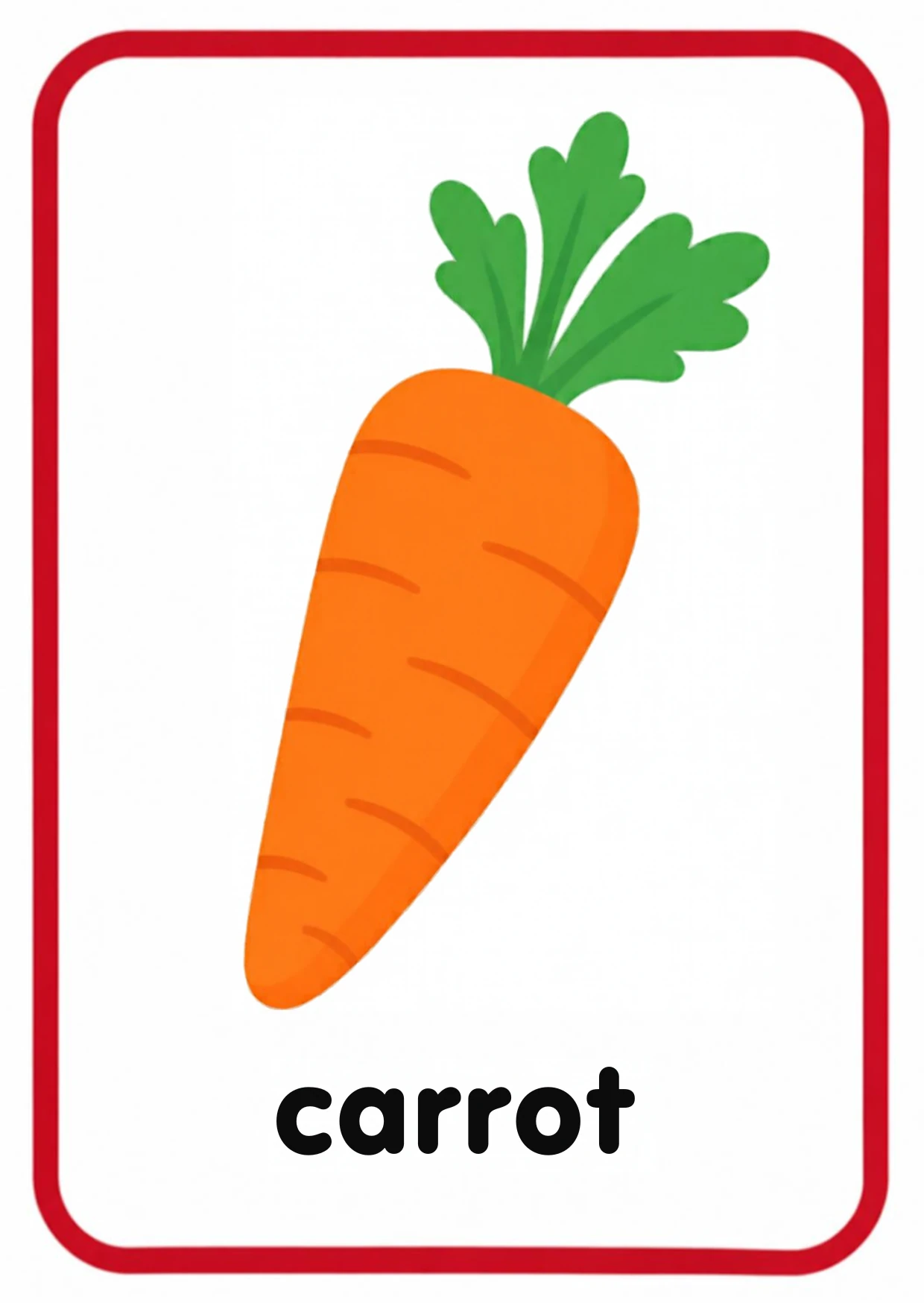
A carrot is a long, pointy, orange root vegetable that grows underground, with feathery green leaves showing above the soil. The card shows an orange carrot with a leafy green top. Rabbits agree it is excellent. The orange inside it is the same sunshine-colored stuff that makes it good for eyes.
What does it mean?
Root vegetables introduce the idea that food has a hidden half: what you see above ground is only the address, and the meal waits below. A child who understands that carrots grow down and beans grow up has a first map of the vegetable world — and maps make new vegetables easier to meet.
What does the child need to know?
Your child needs the word at the card, the underground story — the orange part hides in the dark soil, the leafy top catches sun — and one full crunchy tasting: washed, topped, tailed and cut into sticks by a grown-up, then crunched like a rabbit. The loud crunch is the vegetable class’s signature sound.
Why this matters
The carrot’s shape invites description work: pointy at the bottom, leafy at the top, long all over. Describing parts and directions — top, bottom, pointy, leafy — builds the spatial vocabulary that later handles “put the book on the bottom shelf” without a demonstration.
What it teaches
Spatial and part vocabulary (top, bottom, pointy, leafy), underground-versus-above-ground plant knowledge, loud confident chewing, washing routine ownership, and the rabbit-connection that makes vegetables storybook material.
Words to learn
carrotorangeundergroundrootcrunchtop
Say this to your child
““Carrot! Long and orange and pointy — and it grows HIDING underground! The green hair sticks up, the orange part points down into the dark. Rabbits pull them up. Now we wash it, a grown-up cuts it into sticks... CRUNCH! Can you crunch like a rabbit? Louder! The rabbits will hear!””
Step by step
- Show the card and say carrot — then ask which end was underground: the orange point or the leafy top? Let your child guess before you tell.
- Tell the growing story: the orange part grows down in the dark soil, hiding; the leafy top grows up in the sun. Pull-the-carrot is the classic farm picture for a reason.
- Top-and-tail observation: hold a real carrot and find both ends — the pointy bottom that lived underground, the cut top where the leaves were.
- Tasting job: your child washes the carrots while a grown-up tops, tails and cuts sticks — then everyone crunches like rabbits, loudly.
- Close with the orange round-up: what else is orange? The orange fruit card matches — one word, two foods, both orange on purpose.
Look closer at the picture
Look at the card together: it shows an orange carrot with a green leafy top and the word carrot underneath. Ask your child which end is wider, what the top looks like, and what color the whole vegetable is.
Ask your child
“Where does the orange part grow — up or down?” “What shows above the soil?” “Who else loves carrots?” “What do we do before we crunch?”
What your child can say or do
Your child might pull pretend carrots from the sofa cushions, crunch sticks with theatrical rabbit noises, or inspect the leafy tops at the shop — a vegetable with a direction story gets retold pointing down, every time.
Out in the real world
Carrots repeat all year: sticks in lunchboxes, rounds in stews, the whole ones with feather tops at the market. Each meeting rehearses the word, the direction story and the crunch — the most reliable vegetable in the drawer.
Try it together
The rabbit crunch contest: washed carrot sticks cut by a grown-up, and everyone crunched like rabbits — loudest and longest crunch wins the crown. Then cooked rounds get a turn: soft and quiet, same word. Loud versus soft, raw versus cooked — the carrot teaches both and the rabbits eat the evidence.
Understanding check
Ask: “Where does a carrot grow? What shows above the ground? Show me a rabbit crunch.” Down in the dark, the leafy top, and a loud demonstration — that is the lesson landed.
Parent tips
If your child avoids raw sticks but accepts cooked rounds, serve both and describe the difference: cooked is soft, raw is loud. Both are the same word, and either one keeps the lesson alive at dinner.
Staying safe
Carrots for small eaters are washed, topped and cut by a grown-up — sticks for confident chewers, thinner batons for the newest ones, and grated for the very smallest. Whole raw carrots are a chewing challenge, so the cutting board belongs to the adults.
This lesson pairs with the Carrot flashcard in the library — print it, show it, keep it on the fridge. Back to Fruits & Vegetables Flashcards.