
Seven Flowers — a step-by-step lesson for grown-up and child
This lesson takes counting into the wobble zone: seven is where confident counters start missing, doubling and drifting — and where the real skill, a happy restart, gets practised. The flowers are scattered wide, so every touch has to be earned.
What is this?
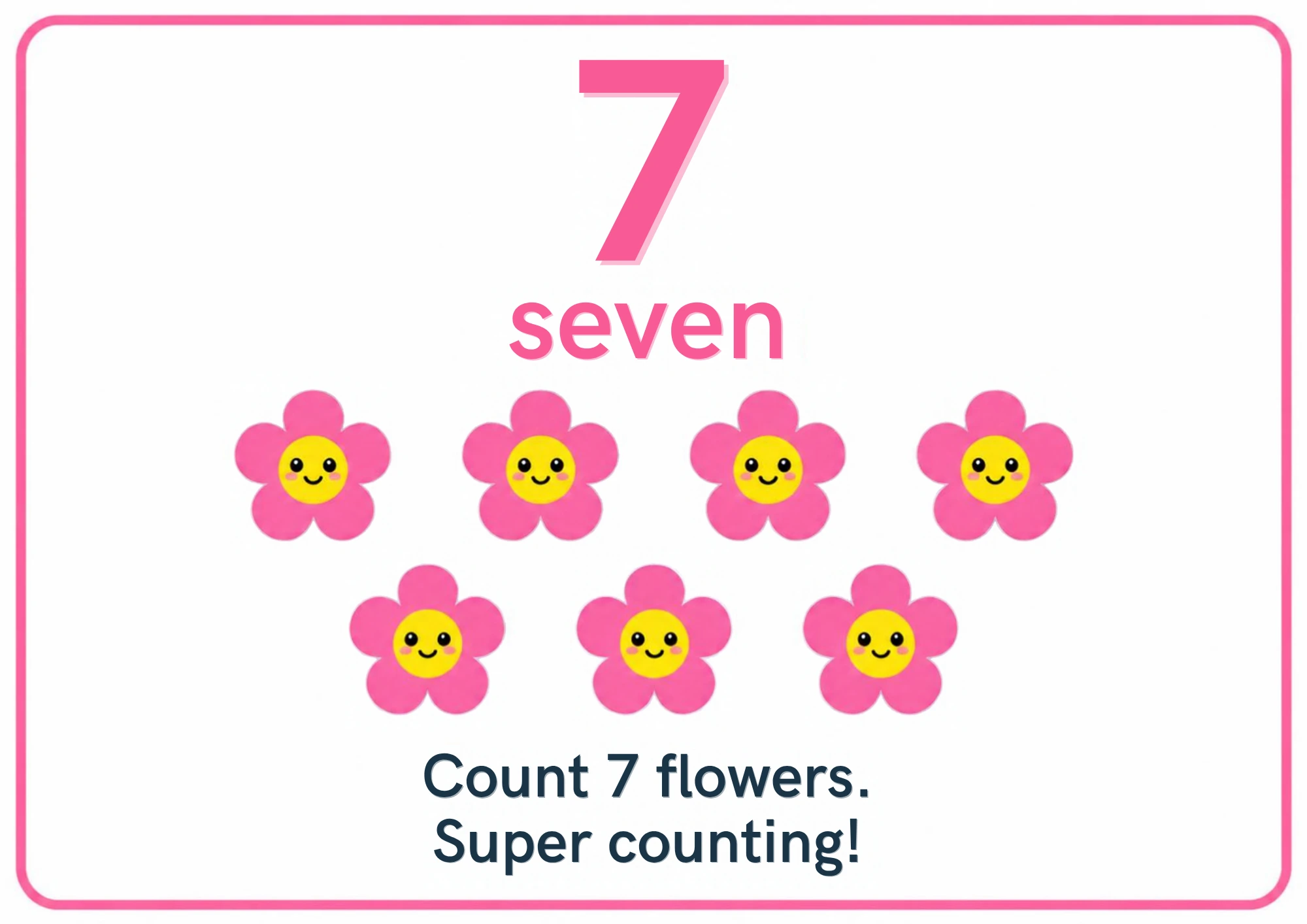
Seven is six and one more. On the card: seven pink flowers strewn from one side of the wide card to the other, the word seven and a big pink numeral 7 — a little garden that rewards slow, careful touring.
What does it mean?
Seven has a reputation, and it has earned it: past five, the counting brain has to hold a growing number in mind while the finger keeps working. The wobble is not a wall — it is the exact spot where the skill gets built.
What does the child need to know?
Your child needs: seven comes after six, each flower gets one touch, and tangles at seven are completely normal — every counter alive has wobbled here. A row of objects keeps count better than a pile, at any age.
Why this matters
The seven-wobble is where children first meet their own attention as a thing that can be helped: slow down, line them up, start again. Those three moves are the entire toolkit of accurate counting, learned on flowers.
What it teaches
Counting endurance past the glance zone, restart patience, organising scattered objects into lines, wide-format card handling, and the quiet confidence of surviving the famously wobbly number.
Words to learn
sevenflowerslineslowwobbleagain
Say this to your child
“"Seven flowers! Let’s walk through the garden slowly and touch each one — one, two, three, four, five... six... seven. Did we lose count? That happens to everyone! Line them up, start from one, and go again — seven careful touches for seven flowers."”
Step by step
- Show the wide card and ask how many flowers bloomed on it — then tour the garden slowly, one touch per flower, no rushing the tour.
- If the count tangles, smile and begin again from one — model the restart like it is the best part of the game, because it is.
- Stand seven blocks or small pebbles in a row and count them left to right — the row shows where the count stopped and what is still to come.
- Draw seven flowers of your own, then let your child touch-count their paper garden — one slow tour, one touch per bloom.
- Finish with seven slow jumps — one per flower — and a deep breath at the end: seven is a marathon, and marathons end in a rest.
Look closer at the picture
Look at the card together: how many pink flowers are blooming on it — are they in a neat line, or scattered wide? Touch each one as you count to seven. Find the big numeral 7 and the word seven — this card lies sideways, which makes the garden feel extra wide.
Ask your child
"How many flowers are on the card?" "Is seven more than six — can you show me?" "Can we line up seven blocks in a row?" "What happens if we lose count?" "Can you jump seven slow jumps?" — answered with patience, blocks and gentle landings.
What your child can say or do
Your child may reach six and stall, or skip from five to eight with total confidence — both are the seven-wobble in action, and both deserve a cheerful recount rather than a sigh. Watch for the day seven lands clean: it is a genuine little triumph.
Out in the real world
Sevens take patience: seven days in the week named at bedtime, seven stairs counted on the way up, seven peas lined up on the plate. Slow counts, real objects — seven repays every bit of care it asks for.
Try it together
Flower line-up: seven paper flowers get arranged in a row by your child, then counted, then rearranged — tall to short, short to tall — and counted again each time. Ordering and counting in one garden bed.
Understanding check
Ask for seven of something tomorrow — seven pegs on the line, seven blocks in a tower: if the count arrives clean, the wobble has been crossed. If not, line the objects up first and tour them slowly together.
Parent tips
Never rush a seven — your pacing is the lesson. Rows beat piles every time, and the restart deserves a happy voice: children keep counting for years when tangles are treated as part of the game, not a verdict on it.
Staying safe
Small line-up objects — pebbles, buttons, beads — stay away from babies and mouths, and the block row gets built on the floor away from stairs. Sideways cards are for tables, not underfoot; counting happens seated or squatting, not stepping backwards.
This lesson pairs with the Seven Flowers flashcard in the library — print it, show it, keep it on the fridge. Back to Numbers 1–10.