
Six Stars — a step-by-step lesson for grown-up and child
This lesson pushes past the fingers: your child counts all the way to six, discovers the hand is full at five, and learns the trick that carries counting forward — six is five and one more, or three and three.
What is this?
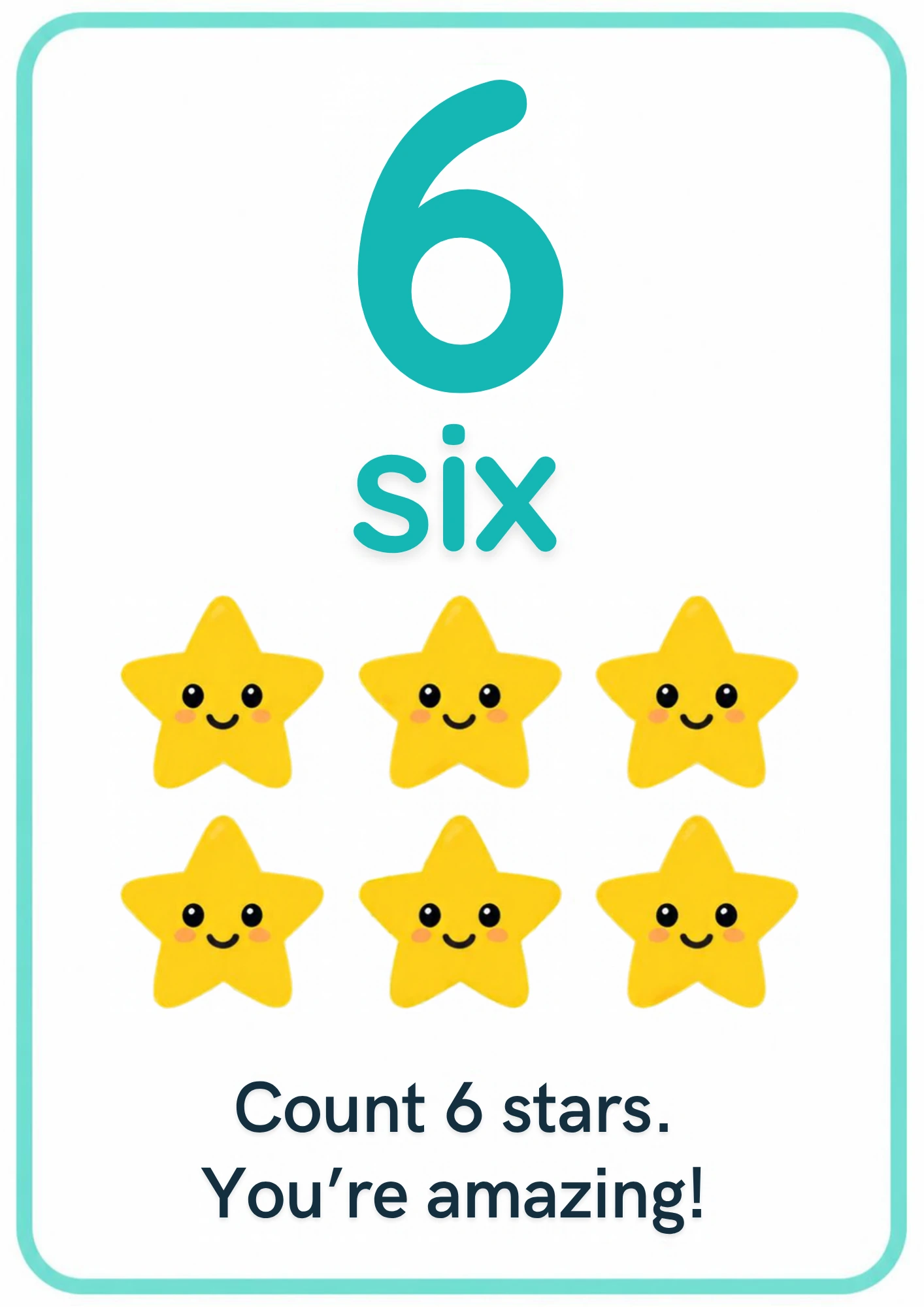
Six is five and one more. On the card: six smiling yellow stars, the word six and a big teal numeral 6 — a sky’s worth of counting, arranged so the count can pause in the middle without losing its place.
What does it mean?
Six is the first number that overflows the hand, which makes it the first that truly needs counting practice. And it is the first with a split inside it — three and three — the seed of adding, discovered rather than taught.
What does the child need to know?
Your child needs: six is one more than a whole hand, each star gets one touch, and two counts of three can stack into one count of six. Losing the count mid-way is normal — restarting from one is the professional move.
Why this matters
Crossing the five-line is a real milestone: from here, counting is a skill practised rather than a fact noticed. The three-plus-three trick teaches composition — numbers inside numbers — years before any plus sign appears.
What it teaches
Counting past the hand, restarts after tangles (the true skill of this age), part-whole thinking in embryo, numeral recognition at 6, and the persistence longer counts quietly demand.
Words to learn
sixstarshandrowsmoretogether
Say this to your child
“"Six stars! We counted five on our hand — and here is one more: six! Let’s count three stars, then three more — three and three makes six! Can you twinkle six fingers? Every star gets its own gentle touch."”
Step by step
- Show the card and ask how many stars are smiling on it — then count together, one touch per star, taking a breath at the halfway point.
- Count five on your hand first, then add one more star: five fingers and one extra makes six — the hand plus a little bit more.
- Play the split game: cover three stars, count three, uncover, count the rest, then count all six together. Three and three stack into six.
- Build six at the table: six blocks in two rows of three, counted into place one tap at a time — then knock one off and recount.
- Finish with six twinkles: fingers opening and closing one by one, both hands, ending on a big star-shaped stretch — six, the full sky.
Look closer at the picture
Look at the card together: how many smiling yellow stars are twinkling on it? Touch each star once as you count all the way to six. Where is the big numeral 6? Where is the word six?
Ask your child
"How many stars are on the card?" "Is six more than five — by how many?" "Can you count three and then three more?" "What happens if we take one star away?" "Can you make six with your fingers and one extra?" — questions that stack.
What your child can say or do
Your child may count to six with tremendous drama and land on a different number each performance. Praise the journey, then count it yourself slowly — the restart, not the result, is the skill being built at this exact station.
Out in the real world
Sixes live past the hand: six eggs in the box, six wheels on the big lorry, six cupcake cases in the tin, six legs on every insect in the garden. Count them slowly — six rewards careful pointing.
Try it together
Egg-box six: take a six-cup egg box and drop one pom-pom into each cup, counting as they land — a full box is six, and every cup holds exactly one. Then empty it and count them out again. Filling and emptying is the whole game.
Understanding check
Ask for six blocks tomorrow in one go: a counted, tapped, correct six means the hand-line has been crossed. A tangle at four or five means replay the split game — three, then three more, slowly.
Parent tips
Two rows of three are kinder than a scattered six — arrangement is scaffolding, not cheating. When a count tangles, breathe and begin again from one with a smile: restarting is the skill this card exists to teach.
Staying safe
Pom-poms and egg cups stay out of baby-sibling territory — the filling game happens at the table with a grown-up nearby. Craft stars get their small parts glued by grown-ups; tiny pieces wait for the older years.
This lesson pairs with the Six Stars flashcard in the library — print it, show it, keep it on the fridge. Back to Numbers 1–10.