
Full glass — a step-by-step lesson for grown-up and child
This lesson names something your child has watched happen a hundred times: the cup that fills to the top. Full is a capacity word — how much space the drink takes — and the sink is about to become the classroom.
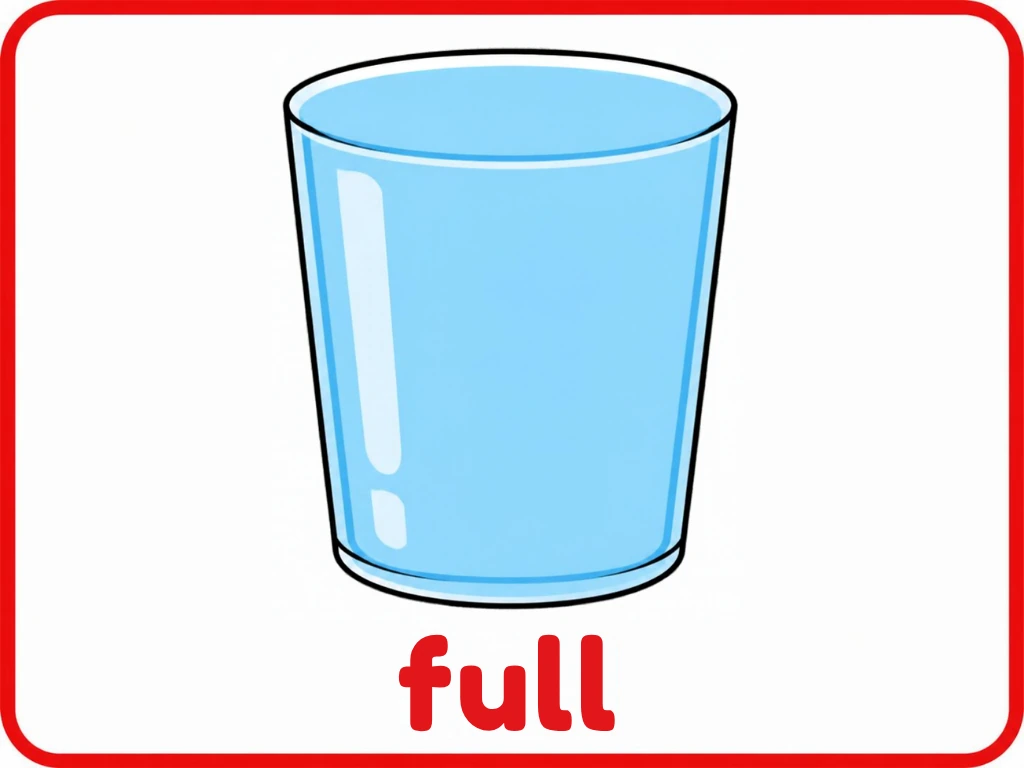
What is this?
Full means holding as much as it can — right to the top, no room left. The glass on the card is filled to the brim with juice. Full is not about the glass itself but about how much of it is taken up: the same glass can be full, half-way or empty, and the word changes each time.
What does it mean?
Full and empty live on the same glass, one sip apart. That is their magic for a three-year-old: this pair moves. Cups fill at the tap and empty at the table, bathtubs fill and drain, and your child stands at the crossing point announcing each change. The word attaches to a process they can watch and cause.
What does the child need to know?
Your child needs to know: full means the top is reached and one more drop spills, the opposite is empty, and pouring is how full turns into empty. Also for you: full glasses are heavy and wobbly — the game below happens at the sink with a towel down, and plastic cups make the best props.
Why this matters
Capacity is measurement’s everyday cousin: enough, too much, all gone. A child who watches a glass travel from full to empty is meeting quantity change — the same idea that later becomes subtraction — with hands and eyes already involved.
What it teaches
Capacity vocabulary (full, half, empty), cause and effect as pouring changes the level, careful two-handed pouring — genuine fine-motor and self-regulation work — and the pride of announcing the states like a scientist.
Words to learn
fullemptypourtopfillbrim
Say this to your child
“"This glass is full — right to the very top, one more drop and it spills! Full means the glass is holding all it can. Now watch at the sink: filling, filling, FULL. And when we pour it out… all gone, empty! You just watched the whole opposite pair happen."”
Step by step
- Show the card and point to the very top of the glass: the juice comes all the way up here — that is full.
- Announce the pair at real meals: as you pour, say filling… filling… full! Then drink down together, narrating sipping… sipping… empty!
- Take the game to the sink with a towel down and two plastic cups: fill one right to the brim and say full — one more drop and it spills.
- Pour slowly from the full cup into the empty one and let your child call the changes: going down… going up… swapped!
- Hand over the jug and let your child do the filling, stopping at full without spilling. Missing the top by a little is fine — the target is the word, not the watermark.
Look closer at the picture
Look at the picture together: how high does the juice come — does it reach the top of the glass? What is the drink? What words sit beside the glass? Is there any room left for more?
Ask your child
"Is the glass full or empty?" "What happens if we pour one more drop into a full glass?" "How does a glass get empty?" "What other things can be full — a bath? a box? your tummy?"
What your child can say or do
Your child may announce "full!" at the water tap with enormous pride, narrate an entire cup from filling to empty at dinner, or hold up a finished cup at breakfast and report "all gone — it is empty!" — the vocabulary running on its own schedule now.
Out in the real world
Full and empty mark the day: the full kettle, the empty lunchbox after school, the full fuel gauge, the empty shopping bag that has just been unpacked. Name the states as you pass them — a full washing basket and an empty one are the same word pair, living in the hallway.
Try it together
The fill-and-pour station: a sink or a basin, a towel, a jug and several plastic cups of different sizes. Your child fills each to full, pours them into each other, and calls out full, half, empty as the levels move. It is water play with a dictionary hidden inside — and the towel keeps the whole thing cheerful.
Understanding check
Ask: "Show me full with the cup. Show me empty. What happens with one more drop?" The brim, the cup held upside down and the spill warning — that is the word landed.
Parent tips
Put a towel down before the game starts and treat spills as part of the science — a scolding about water on the floor ends the vocabulary practice instantly. Plastic cups for the game, glass for the picture: the card can be fragile so the hands do not have to be.
Staying safe
Water on the floor is slippery the moment it lands — the towel goes down first and any spill gets wiped at once, before the next dash across the kitchen. Use plastic cups for the pouring game, and keep the real glass full for looking at, not carrying.
This lesson pairs with the Full glass flashcard in the library — print it, show it, keep it on the fridge. Back to Opposites & Comparing (Preschool).