
Heart — a step-by-step lesson for grown-up and child
The heart is the shape children meet attached to affection — on cards, on drawings, on the family noticeboard — and this lesson keeps that warmth. Two bumps on top, one point at the bottom, and a job no other shape has: it means I love you, which is why children learn it early and keep it forever.
What is this?
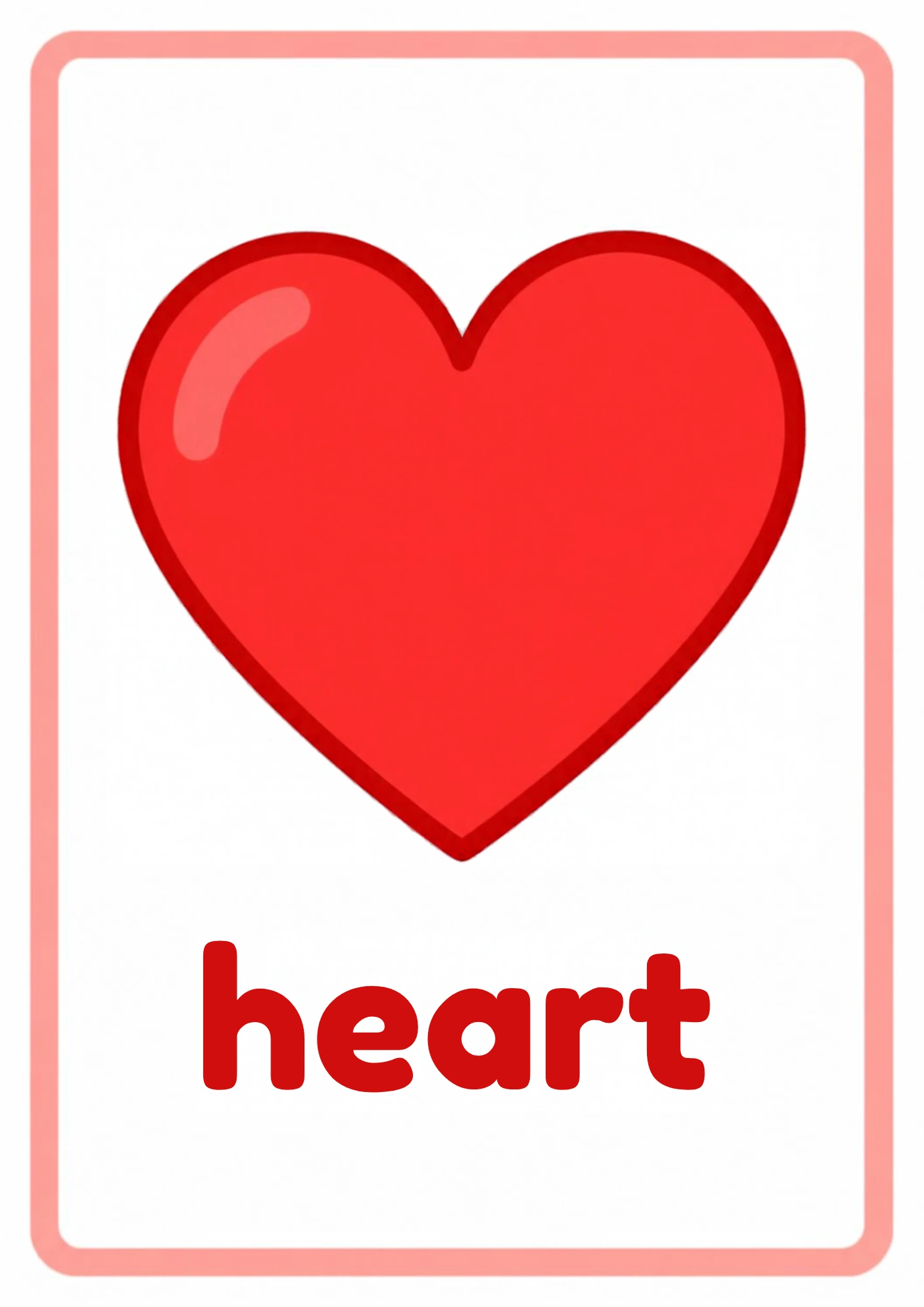
A heart has two round bumps on top and one point at the bottom — a shape made of curves that meets itself in a single point. On the card it is one big red heart with a shiny highlight and the word heart underneath. In life it appears on cards, drawings, biscuits and valentines of every size.
What does it mean?
The heart is the class’s first symbol: a shape that means something beyond its own outline. A circle is a circle, but a heart says love — and children absorb symbols early when the symbol carries feeling. Drawing one for a real person turns geometry into a gift, which is why this lesson ends at someone’s door.
What does the child need to know?
Your child needs the two-part description — round on top, pointy at the bottom — and the drawing practice that puts it in the hand. Keep the feeling-word too: hearts get given away, and giving them is the point. The folded-paper trick below rescues any drawing that goes wrong.
Why this matters
Symbol reading starts here: a mark that stands for a feeling is the same leap as a letter standing for a sound. Children who draw hearts for people they love are practising representation — marks that mean — in the warmest possible register, years before reading begins.
What it teaches
Two-part shape description (round, pointy), drawing and crayon control, emotional vocabulary alongside shape vocabulary, giving and delivering as social practice, and the pride of making something that matters to someone else.
Words to learn
heartloveroundpointycardgive
Say this to your child
““Heart! Two round bumps on top... and one point at the bottom. A heart means I love you — that is its job. Let us draw one: bump, bump, down to the point. Now — who should we give our heart to? Granny? Your best friend? Let us make it beautiful and deliver it!””
Step by step
- Show the card and trace it: round, round on top... down to one point at the bottom.
- Say the description together until it is a chant: two bumps on top, one point below.
- Draw one on paper — bumps first, then the point — and let your child color it in.
- The giving job: decide together who the heart is for — a grandparent, a friend, the cat — and deliver it.
- Spot hearts around the house: cards, books, biscuit cutters, a bag or a t-shirt — hearts hide in plain sight.
Look closer at the picture
Look at the card together: one big red heart with a shiny highlight and the word heart underneath. Where are the two round bumps — top or bottom? Where is the single point? What color did the artist choose for this heart?
Ask your child
“What does a heart shape mean in our family?” “Where are the bumps, and where is the point?” “Who would you like to give a heart to?” “Can you find a heart anywhere in this room?”
What your child can say or do
Your child might produce hearts in every drawing for weeks, declare love mid-lesson without warning, or deliver the finished heart with full ceremony — and if the recipient happens to be the cat, the cat will accept, which completes the lesson nicely.
Out in the real world
Hearts all year round: birthday cards, biscuits, the pattern on a dress, doodles on a shopping list. Each sighting is a two-part description waiting to happen — bumps on top, point below — and each giving season is a chance to draw another one for a real person.
Try it together
The heart delivery service: your child draws and colors hearts — one per person they love — then delivers them around the house, or posts them to faraway people with a grown-up’s help. Each heart gets traced and described as it is made: bumps on top, point below. Shape practice wearing kindness.
Understanding check
Ask: “Where are the bumps and where is the point? What does a heart mean? Who got your heart today?” Top and bottom, love and a name — that is the lesson landed.
Parent tips
If the heart-drawing frustrates, fold a paper in half, draw half a heart along the fold and cut — a perfect heart every time, and a magic trick worth the fold. Expect hearts to keep arriving in drawings for months: that is not repetition, that is ownership.
This lesson pairs with the Heart flashcard in the library — print it, show it, keep it on the fridge. Back to Shapes & Patterns (Preschool).