
Diamond — a step-by-step lesson for grown-up and child
The diamond is the class’s best magic trick: take a square the child already knows, stand it on its corner, and the same shape gets a new name. This lesson performs the trick slowly, draws a kite to prove the shape flies, and goes gem-hunting through drawers, socks and wrapping paper.
What is this?
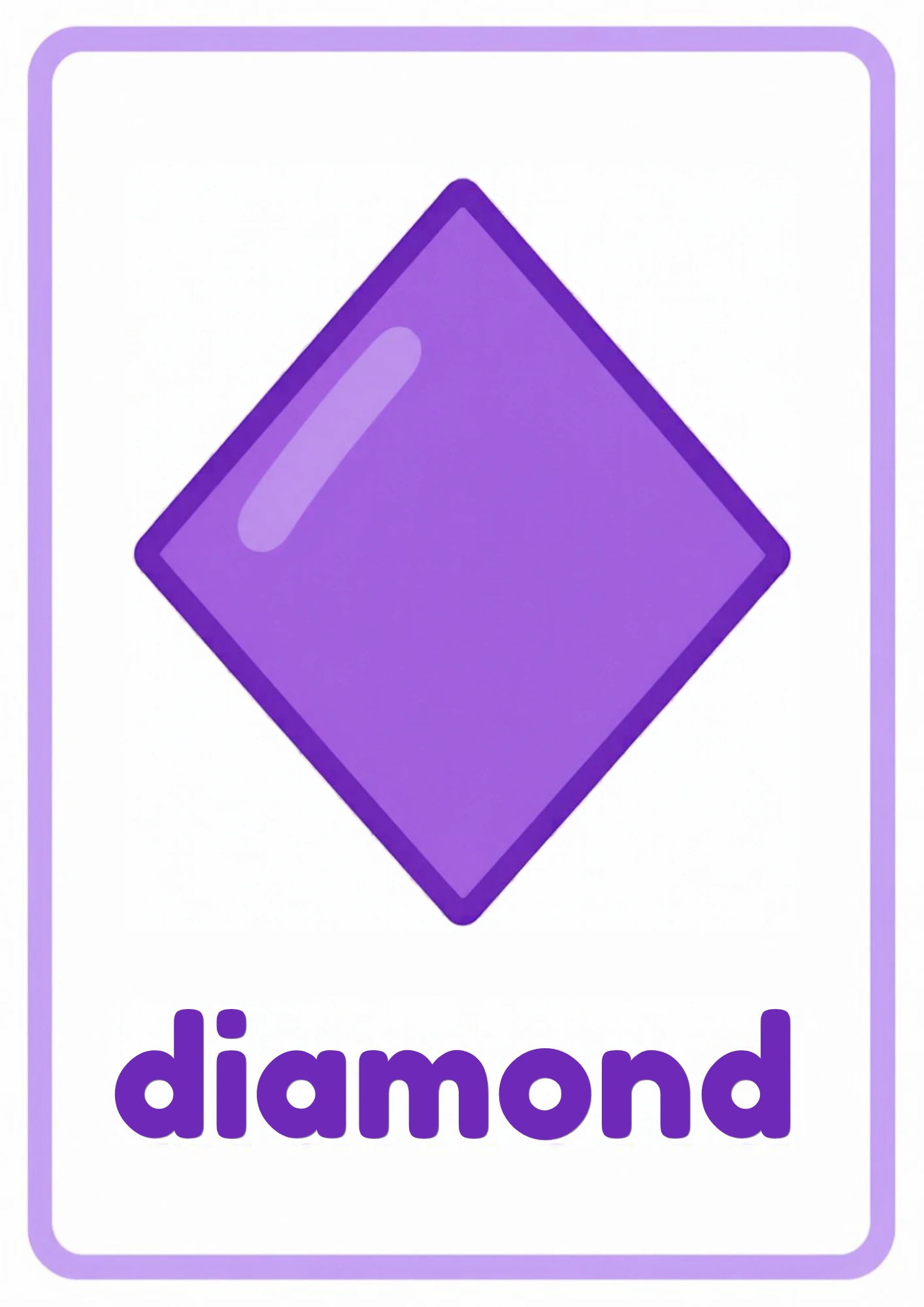
A diamond is a four-sided shape standing on its point — a square turned to balance on one corner, with a point at the top, a point at the bottom and points at each side. On the card it is one big purple diamond standing on its point, with the word diamond underneath. Kites and gems wear this shape.
What does it mean?
Turning changes the name: the same four sides, the same four corners, a new word once the corner points up. That is a deep and delightful idea — position can matter as much as shape — and children find it genuinely funny. A shape with two outfits invites flipping, and every flip is a spatial-reasoning rep.
What does the child need to know?
Your child needs the tilt story — a square standing on its point becomes a diamond — and the four-sides-four-corners count they already own. The kite drawing gives the shape a story with wind in it; the sock-and-paper hunt gives it a habitat in your own drawers.
Why this matters
Rotation awareness is spatial reasoning in its purest form: holding one shape in the mind and turning it. Children who play at flipping squares into diamonds are rehearsing the mental rotation that later handles letters — a b is a d having a turn — and maps, and maths, with a kite attached.
What it teaches
Rotation and spatial transformation, shape-rule flexibility (same sides, new position), drawing diagonal lines — a genuine pencil-control step — and the treasure-hunting attention that spots small shapes hiding in patterns.
Words to learn
diamondkitepointtiltgemsides
Say this to your child
““Diamond! A square that stood up on its pointy corner — look at it balance! Four sides, still. Four corners, still. But now it is a diamond, like a kite in the sky. Let us draw a kite... and then go hunting for tiny diamonds — they hide on socks and paper!””
Step by step
- Show the card and trace from the top point all the way round: point, side, point, side, point, side, point, side.
- The trick: take the square card and stand it up on one corner — look, a diamond! Turn it back: a square again. Let your child do the flipping.
- Draw a kite together: the diamond body, a string, a wavy tail — then let your child color it in.
- The gem hunt: look through drawers and patterns for small diamonds — socks, wrapping paper, quilts, a pack of cards.
- Air-trace the diamond big: point at the ceiling, down to the floor — a shape that travels.
Look closer at the picture
On the card: one big purple diamond standing on its point, with the word diamond underneath. Which point is at the very top? How many corners can your child count? Does the shape look like it is balancing — and on what, exactly?
Ask your child
“What did the square do to become a diamond?” “What flies in the sky shaped like a diamond?” “Where did we find diamonds today?” “How many sides does a diamond have?”
What your child can say or do
Your child might flip cards back and forth narrating the transformation, draw kites in every drawing, or report diamond sightings on clothing and wrapping paper with the excitement of a real gemologist.
Out in the real world
Diamonds live in pattern-land: sock patterns, quilt squares on their points, wrapping paper, tiles laid corner-up, the kite in the park on a windy day. Small, repeated and hideable, they reward a child who has just learned to look for points.
Try it together
Paper kite mission: draw a big diamond, add a string and some ribbon tail bows — each bow a small diamond too, if the paper allows — then take the kite for a run around the garden or the hallway. Flying it is the reward; the diamond was the lesson, drawn and colored before take-off.
Understanding check
Ask: “What does a square become when it stands on its point? What shape is a kite? How many sides?” Diamond, diamond and four — that is the lesson landed.
Parent tips
Some children get briefly worried that one shape has two names — resolve it by doing the turn together: “square like this, diamond like this — same shape, two outfits.” Names can describe positions too, and that is real geometry, not a trick being played on anyone.
This lesson pairs with the Diamond flashcard in the library — print it, show it, keep it on the fridge. Back to Shapes & Patterns (Preschool).