
Rectangle — a step-by-step lesson for grown-up and child
The rectangle is the shape your child has been touching all day without knowing its name — the door, the book, the table, the screen. This lesson names it through its own best trick: it is a square that got stretched. Two sides stay short, two grow long, and suddenly half the house has a name.
What is this?
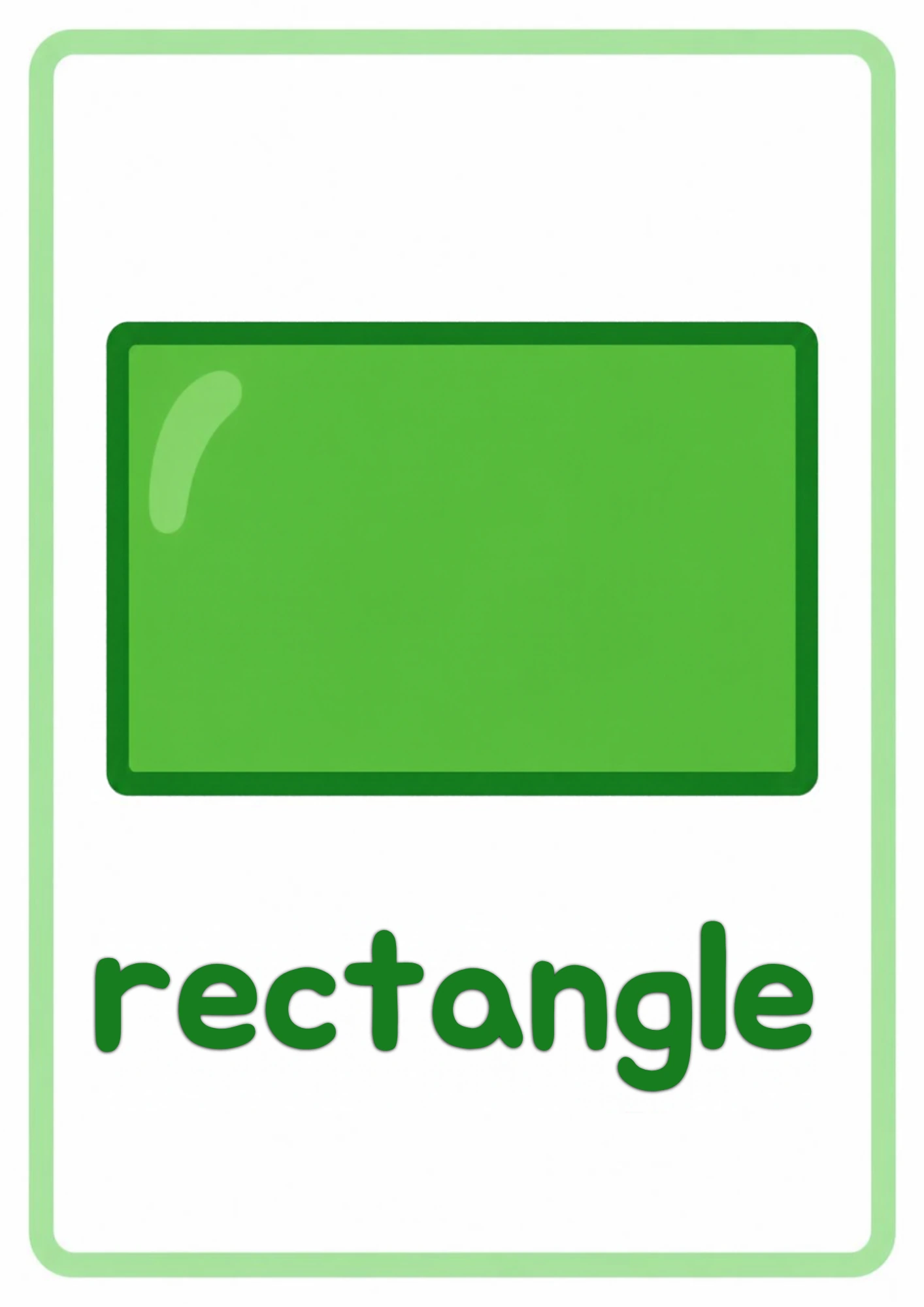
A rectangle has four straight sides and four corners, like a square — but its sides are not all matching: two are long and two are short. On the card it is one big green rectangle, stretched long, with the word rectangle underneath. Stretch a square and you have made one; that story is the lesson.
What does it mean?
The stretch is the idea. Same four corners, same four sides — but pulled, so long sides appear where equals used to be. A child who acts the stretch with their own hands (square arms... pull... rectangle!) has learned that shapes relate to each other: one can become another by growing. That is pre-geometry, met with the whole body.
What does the child need to know?
Your child needs the four-and-four count they already own from the square, plus the new fact: on a rectangle, two sides stretch. The house is the practice hall — doors, drawers, books, biscuit tins and towels all wear the shape, and the door itself is a rectangle your child can stand inside.
Why this matters
Comparing side lengths is measuring’s first step: longer and shorter are the words a ruler will one day put numbers to. The rectangle also teaches transfer — a rule learned on squares stretches to fit a new shape — and children who watch one idea flex like that learn that rules can be trusted to travel.
What it teaches
Length comparison (long versus short sides), straight-edge tracing, transfer of a known rule to a new shape, spatial language (stretched, wide, long), and the door-and-book naming habit that rehearses the word daily without any extra work.
Words to learn
rectanglelongshortstretchsidesdoor
Say this to your child
““Rectangle! Like a square, but stretched — looong this way. Four sides, four corners, but two of them grew. Look — the door is a rectangle, the book is a rectangle, the table is a rectangle! The whole house is wearing this shape. Can you stretch your arms out like a rectangle?””
Step by step
- Show the card and trace all four sides, then ask which two are the long ones — let your child find the stretch.
- Say the story: a rectangle is a square that got stretched — pull your hands slowly apart as you say it.
- Compare side by side: set the rectangle card next to the square card. Same corners? Same sides? What changed?
- The door test: walk to a door and trace its edges — a rectangle your child can stand inside!
- Book hunt: how many rectangles live on one bookshelf? Spines, covers, drawers — count a few, then let the counting wander.
Look closer at the picture
On the card: one big green rectangle, stretched long, with the word rectangle underneath. Which sides look long, and which look short? Which way does the stretch run — up and down, or across? Can your child trace all four sides without lifting a finger?
Ask your child
“Which two sides of a rectangle are long?” “Is a door a rectangle?” “What did the square do to become a rectangle?” “How many rectangles can you find in this room?”
What your child can say or do
Your child might stretch their arms at every mention of the word, call out doors and books across the house, or discover that the fridge is a rectangle and report it like news — a shape with a stretch story gets retold with gestures, every time.
Out in the real world
Rectangles run the household: doors, books, tables, screens, drawers, the bath towel, the rug. Name the big ones as you pass — the front door alone rehearses the word twice a day, and it never once needs a flashcard to do it.
Try it together
Hand-measuring: how many hands long is the kitchen table? Place your child’s hand at one end, yours next to it, and count together — three hands, four hands. Any rectangle becomes measurable, and your child has just discovered why people invented measuring, at snack-table scale.
Understanding check
Ask: “What did a square do to become a rectangle? How many corners? Name a rectangle you can stand inside.” Stretched, four, the door — that is the lesson landed.
Parent tips
If the square-versus-rectangle border gets blurry, answer simply and honestly: matching sides make a square, two long and two short make a rectangle, and looking carefully is how you tell. Do not rush to say a square is also a rectangle — that truth keeps beautifully for age six.
This lesson pairs with the Rectangle flashcard in the library — print it, show it, keep it on the fridge. Back to Shapes & Patterns (Preschool).