
Triangle — a step-by-step lesson for grown-up and child
The triangle is the shape children meet pointing at them — roofs, mountains, pizza slices, the classic rocket. This lesson teaches its one rule (three straight sides, three corners), builds one out of fingers, and finishes at lunch, where a grown-up knife turns an ordinary sandwich into three-sided practice.
What is this?
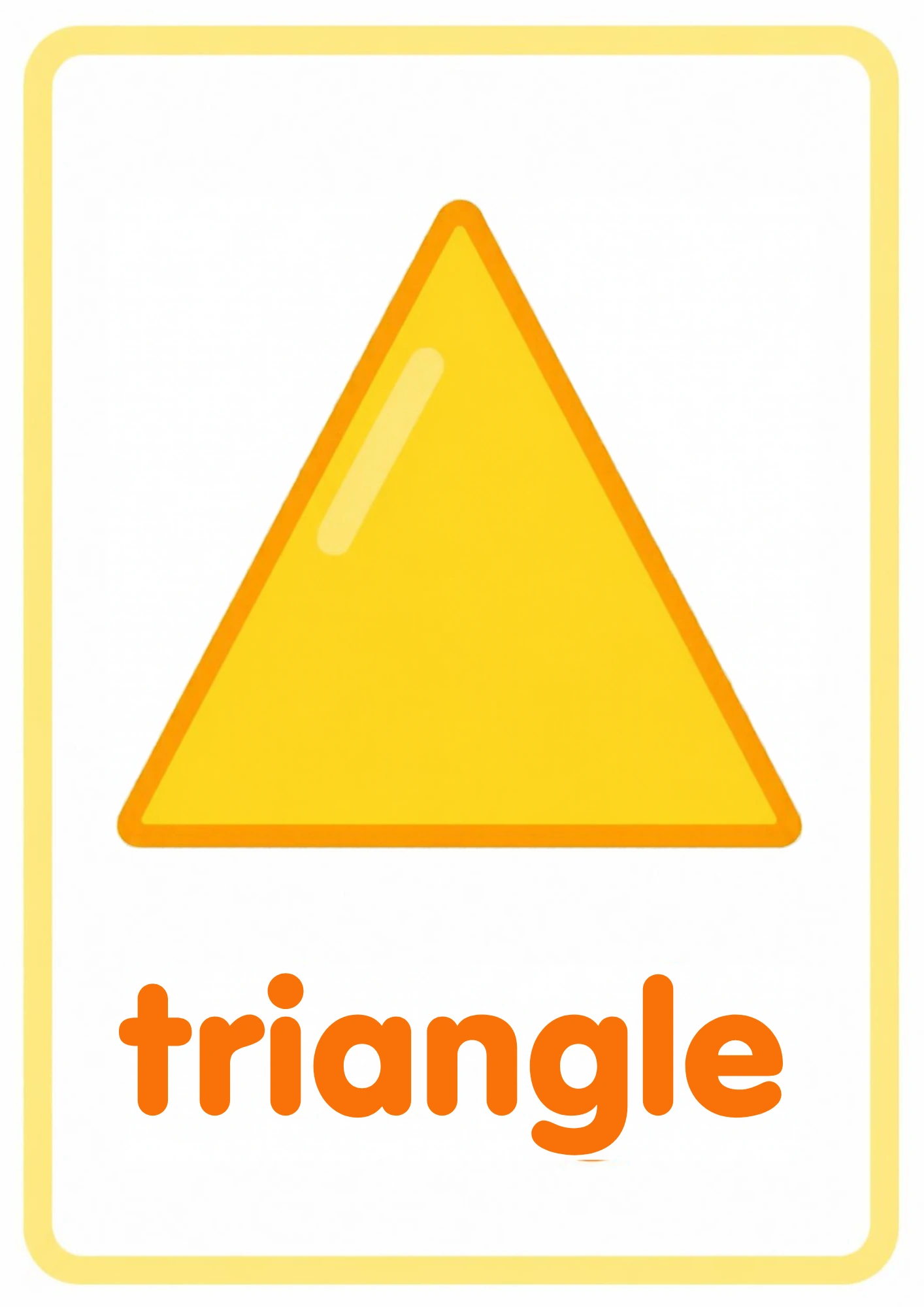
A triangle has three straight sides and three corners — that is the whole rule, and it covers every triangle there is, from wide and squat to long and skinny. On the card it is one big green triangle with a shiny highlight and the word triangle underneath. In the world it is roofs, ramps, sails and slices.
What does it mean?
One rule, many shapes: wide triangles, skinny triangles, upside-down triangles — all three-sided, all legal. That is a genuinely big idea wearing a small shape. A child who accepts a long skinny triangle as a real one has started to classify by rule instead of by picture, which is the beginning of all category thinking.
What does the child need to know?
Your child needs the count — three sides, three corners — and the wide permission inside the rule: skinny counts, tilted counts, any three straight sides make one. The finger-triangle below gives the shape a body your child can carry everywhere, and the sandwich gives it a taste.
Why this matters
Rule-based classification is the quiet engine of early learning: letters, numbers, animals and shapes all sort this way. The triangle is the friendliest trainer because the rule is tiny, the examples are delicious, and the word itself — tri-angle — contains its own clue, three, if anyone cares to hear it.
What it teaches
Counting to three with pointing, rule-based classification, finger positioning and hand strength in the finger-triangle, snack-time patience while the grown-up cuts, and the drawing connection — triangles become roofs and mountains on every page from now on.
Words to learn
trianglethreesidespointycornerroof
Say this to your child
““Triangle! Three sides — one, two, three — and three pointy corners. Make one with your fingers: thumbs together, pointer across... you made a triangle! Turn it sideways — still three sides, still a triangle. Now — who wants their sandwich cut into triangles today?””
Step by step
- Show the card and trace the three sides slowly, counting as you go: one, two, three.
- Build the finger-triangle: two thumbs tip to tip and one pointer stretched across — a shape your child can make anywhere, any time.
- Hunt triangles in picture books — roofs, mountains, hats, sails — and tap each one as it is found.
- The tilt-and-flip test: turn the card on its side — still three sides? Then it is still a triangle.
- Lunch finale: a grown-up cuts a sandwich corner to corner — two triangles! Count the sides of yours before the first bite.
Look closer at the picture
Look at the card together: one big green triangle with a shiny highlight and the word triangle underneath. How many corners can your child point to? Where does the shine sit? Are the three sides matching, or does one stretch longer than the other two?
Ask your child
“How many sides does a triangle have? How many corners?” “Is a long skinny triangle still a triangle?” “Where did we find triangles today?” “What happens to a square if you cut it corner to corner?”
What your child can say or do
Your child might flash finger-triangles at random moments, spot roofs from the car window, or request triangle sandwiches by name — a shape that lives in the fingers gets made everywhere, and every making is a repetition.
Out in the real world
Triangles on every walk and every plate: rooftops, road signs, slices of pizza and toast, the mountain in a storybook. The rule is short enough to repeat at each sighting — three straight sides — and the sightings are constant, which is what makes the word stick.
Try it together
Triangle snacks: a grown-up cuts toast or cheese into triangles of different sizes — wide, skinny, tiny — and your child sorts and names them all before eating. Every one of them is a real triangle, which is the whole rule, served for lunch.
Understanding check
Ask: “How many sides? Make a triangle with your fingers. Is a skinny one still a triangle?” Three, the finger shape and a yes — that is the lesson landed.
Parent tips
Do not police imperfect drawings — three-ish sides at three years old is the idea arriving, and hand strength grows through drawing, not correction. If your child rejects the long word, break it into claps: tri-an-gle, three claps for three sides, and let the rhythm carry the word home.
This lesson pairs with the Triangle flashcard in the library — print it, show it, keep it on the fridge. Back to Shapes & Patterns (Preschool).