
Square — a step-by-step lesson for grown-up and child
The square is the shape children count on first, because everything about it is fair: four sides the same, four corners the same, no surprises. This lesson turns that fairness into a ritual — count the sides, count the corners, find the shape — and then hands over the blocks, because squares are the shape that builds.
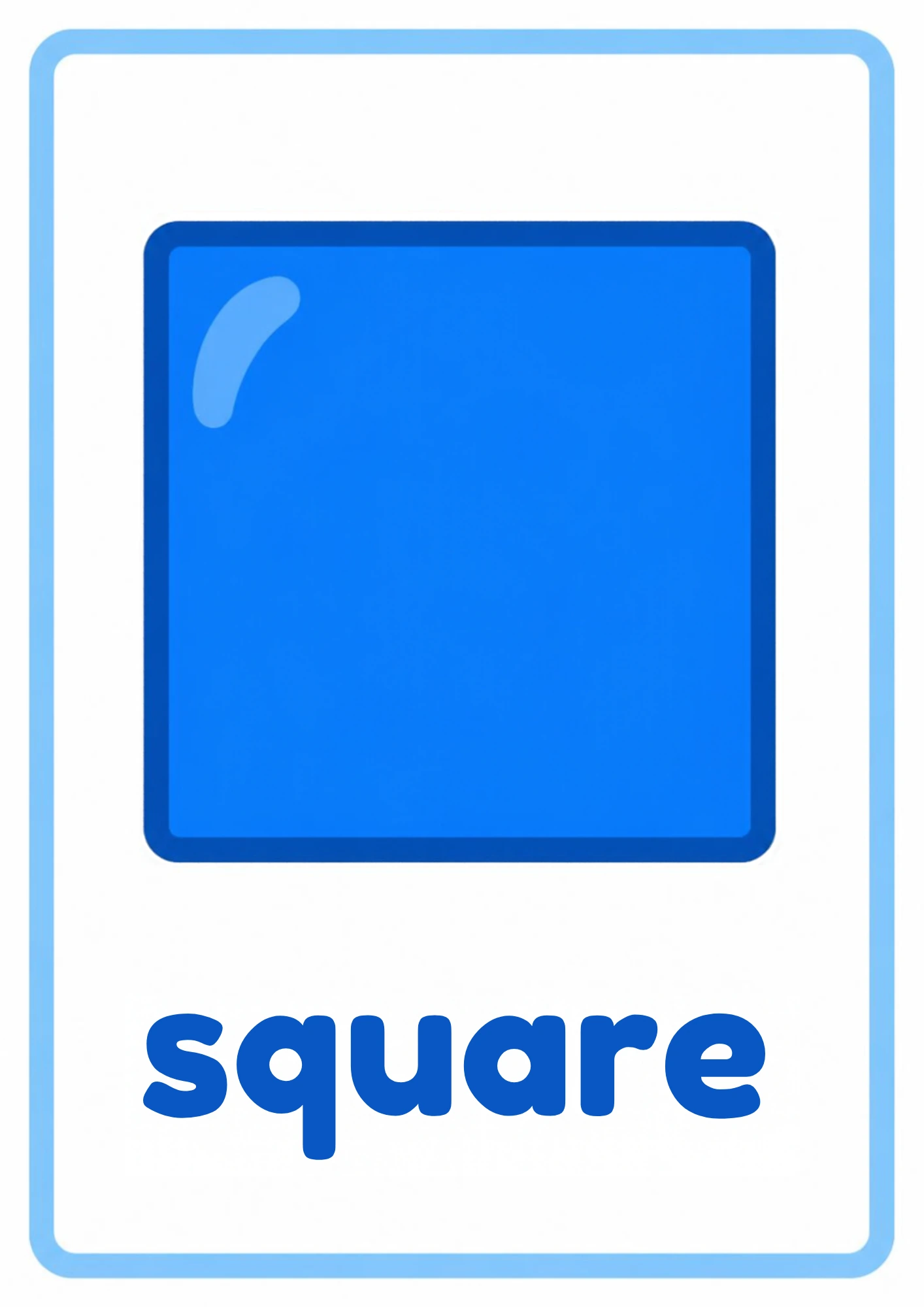
What is this?
A square has four straight sides, all matching in length, and four corners, all matching in size. That equality is its whole character: nothing longer, nothing shorter, nothing leaning. On the card it is one big yellow square with a shiny highlight and the word square underneath — and in your kitchen it is crackers, window panes and the side of a box.
What does it mean?
Fairness is the meaning: same, same, same, same. A child who counts four sides and finds them all equal has met equality in a form they can hold — no arguments, no almosts. That tidy certainty is why squares are the shape of tiles, crackers and building blocks: sameness fits together, and children feel it the moment two blocks stack flush.
What does the child need to know?
Your child needs the count — four sides, four corners, each side matching the next — and the habit of checking by tracing. One idea to hold loosely and kindly: a square tilted on its corner is still a square. Turn a cracker slowly in the air to prove it, then hand the cracker over.
Why this matters
Counting sides and corners is geometry’s first procedure — a rule you can check with one finger. It is also measuring in disguise: same-length sides are the seed of the ruler idea. A child who traces edges now is doing the hand-work that later holds a pencil steady and reads a number line.
What it teaches
Counting with one-to-one pointing, straight-edge tracing, shape-rule language (sides, corners, equal, straight), rotation awareness through the tilt test, and construction thinking — blocks stack because their faces are square, and the tower proves it.
Words to learn
squarefoursidescornersequalstraight
Say this to your child
““Square! Count with me — one, two, three, four sides. Every side the same! And four corners, one at every stop. Now watch the cracker turn... round and round... still a square! Turning cannot trick a square. Now let us go find four-sided things — and build a tower while we are at it!””
Step by step
- Show the card and count the sides aloud, one slow finger trip: one, two, three, four — all the same length.
- Count the corners the same way: four corners, one at every stop, each one a proper pointy pause.
- The tilt test: hold a cracker square and rotate it slowly — still four sides? Still a square? Let your child discover that turning cannot change a shape.
- Build together: stack blocks into a tower and notice which faces make it steady — flat and square stack well; round rolls away.
- Hunt for squares around the room — window panes, cushions, book covers — and trace each one’s four sides with a fingertip.
Look closer at the picture
Study the card: one big yellow square with a shiny highlight and the word square below. How many sides can your child count around it? Where does the highlight sit? Do all four sides look the same length, or is one stretching longer than the rest?
Ask your child
“How many sides has a square? How many corners?” “Is a tilted square still a square?” “What can you find with four matching sides?” “Which stacks better — blocks or balls — and why?”
What your child can say or do
Your child might count corners on everything from biscuits to light switches, report every window in the house, or insist crackers be served point-first — a shape with a count gets counted, and the counting is the point.
Out in the real world
Squares all over the house: window panes, crackers, sticky notes, floor tiles, the waffle iron, the side of the cereal box. Each one is a four-sided rehearsal waiting to be tapped — and four is a small enough number that the whole count fits in one finger trip.
Try it together
Square builders: challenge your child to build the tallest tower that stands still, using only blocks with flat, square faces — then roll a ball against it and discuss why the tower wins and the ball loses. Stacking is geometry the hands can feel, and the crash at the end is the bell for round two.
Understanding check
Ask: “How many sides? How many corners? Is a tilted square still a square?” Four, four and a confident yes — that is the lesson landed.
Parent tips
If your child calls long rectangles squares, skip the correction and set the two cards side by side: “which one got stretched?” The comparison does the teaching, and your child gets to be the one who spots it. Keep a box of square crackers on standby — the tastiest shape rule in the house.
This lesson pairs with the Square flashcard in the library — print it, show it, keep it on the fridge. Back to Shapes & Patterns (Preschool).