
Bat — a step-by-step lesson for grown-up and child
This lesson closes the class with the strangest address of all: the cave, where the bat sleeps hanging by its feet through the day — then flies out at dusk to hunt the night using nothing but sound.
What is this?
A cave is a room inside rock: dark all day, cool in summer, still and sheltered — no wind, no rain, and no light at all past the entrance. To animals that sleep by day, that darkness is not scary; it is blackout curtains.
What does it mean?
The bat sleeps hanging upside down from the cave ceiling, folded in its own wings — feet grab, head drops, day over. At dusk it flies out and hunts in the dark by echolocation: it clicks, the sound bounces off moth or wall or tree, and the echo comes back a picture. Ears as eyes. The cave gives the day’s safe sleep; the night gives the hunt; the bat owns both shifts.
What does the child need to know?
Your child needs three bat ideas: bats rest in caves (and similar dark quiet spots) hanging upside down by their feet; they fly at night and find their way by listening to the echoes of their own clicks — seeing with sound; and they are the only mammals that truly fly.
Why this matters
The bat corrects two fears at once: caves stop being black holes (they are bedrooms) and bats stop being scary (they are pest-controllers with sonar). Ending the class on the animal that turned darkness into a superpower sends children to bed on the class’s bravest note.
What it teaches
Sound-and-echo physics in game form, fear-to-fascination conversion, upside-down body play with trusted grown-ups, and night-day scheduling — the third shift-worker of the class, after owl and fox.
Words to learn
batcavehangupside downechoclickdusk
Say this to your child
“"The bat lives in a cave and sleeps hanging upside down by its feet, all day long. At night it flies out and clicks — and the echoes bounce back, drawing a picture in sound: moth over there, wall over here. It sees with its ears! And every night it eats thousands of tiny bugs for us."”
Step by step
- Show the card: "This is a bat, and this is its home — the cave."
- Read the hang: feet up, head down, wings wrapped like a blanket. Upside down is bat-normal — and handy: drop the grip and flight starts by falling.
- Tell the ear-eyes: in pitch dark the bat clicks — tsk-tsk — and the echo bounces back. Moth here, wall there, friend overhead: a sound picture, better in the dark than our eyes are.
- Retire the scare: bats eat thousands of bugs a night — the night’s own pest control. Nothing about bats wants your hair; they hear it perfectly and steer away.
- Try the echo clap in a hallway, then play the echo game (below) and close the whole class: twenty-two animals, twenty-two homes, every one of them exactly right.
Look closer at the picture
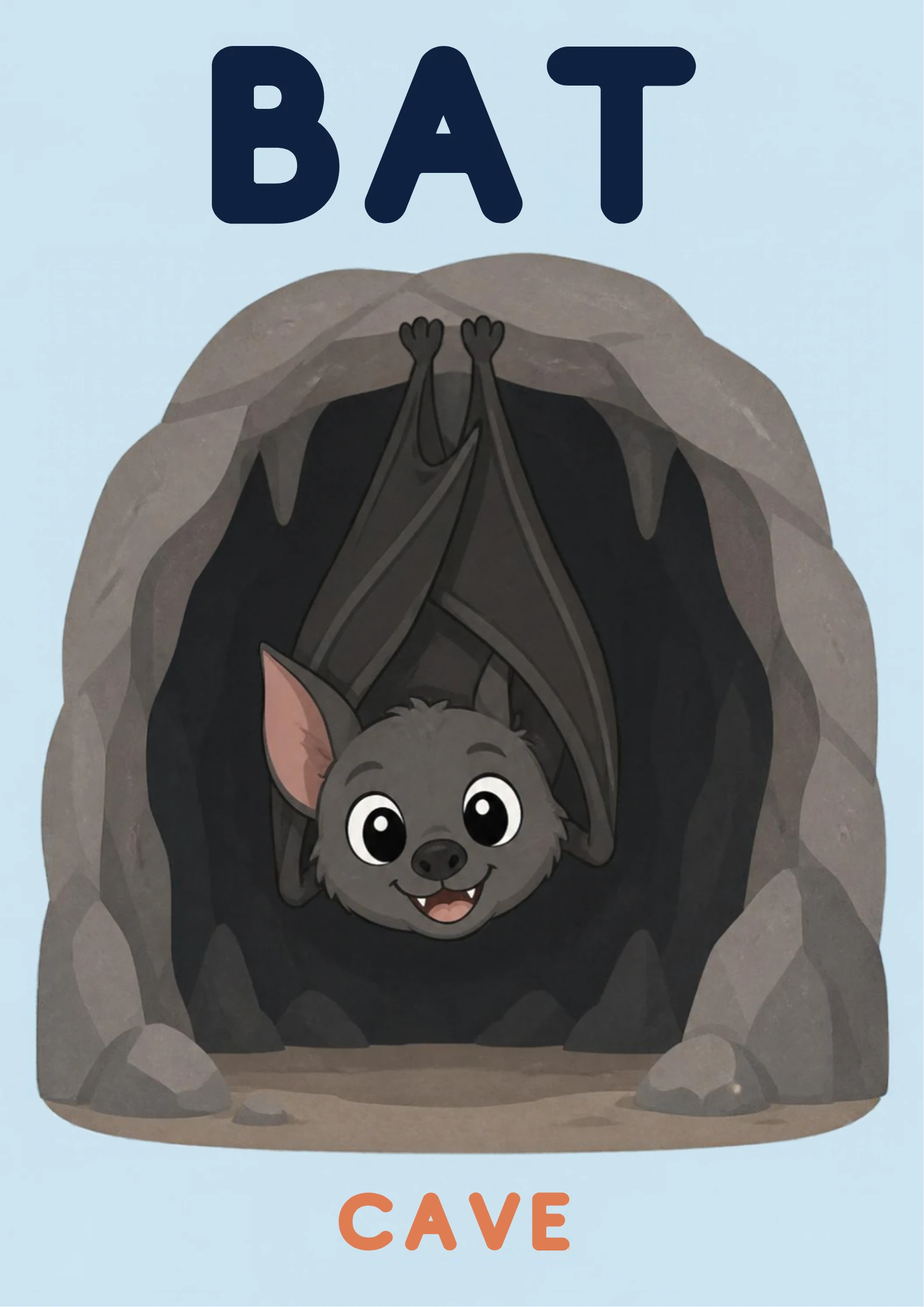
On this card a soft grey bat with round ears, a smiling face and neatly folded wings hangs upside down from the rocky ceiling at the mouth of a cave, stones piled at the entrance below. The word "cave" sits below — the night worker, tucked into the quietest bedroom in the class.
Ask your child
"How does the bat sleep — right side up or upside down?" "What does it click, and what comes back?" "When does the bat fly out?" "What do bats eat at night?"
What your child can say or do
Your child might say: "It hangs by its feet with its wings like a blanket," "It sees with its ears — clicks and echoes!" or the brave line: "Bats eat the bugs — they’re the night’s helpers!"
Out in the real world
Echoes are free: clap once in a stairwell, under a bridge, in an empty hall and listen for the bounce-back — that return is a whisper of the bat’s whole world. Dusk walks gain a mission: bats flicker against the evening sky exactly like fast swallows; point the flicker out and the night shift becomes visible.
Try it together
Echo-location, one-blindfold version: the "bat" sits blindfolded (eyes closed); the "moth" shakes a small box twice from somewhere in the room, then freezes. The bat points to where the sound came from — one click of the box per guess. Harder round: two moths, two corners. The room fills with listening. That is the cave’s gift: darkness worth navigating.
Understanding check
Ask: "Where does the bat sleep, and how? What does it use to hunt in the dark? When does it fly out?" Cave-upside-down, clicks-and-echoes, at dusk — three answers and the class is complete.
Parent tips
End on the tally, out loud, together: meadow, pond, woodland, forest, eucalyptus, bamboo, rainforest, grassland, savanna, desert, river, coast, ocean, poles, cave — the whole class in one breath, your child’s new map of where everybody lives. And if a bat fear lingers, the cure is the fact: a bat that hunts midges over a pond has zero interest in anything with a hairbrush.
This lesson pairs with the Bat flashcard in the library — print it, show it, keep it on the fridge. Back to Animals & Their Habitats (Class 36).