
Polar Bear — a step-by-step lesson for grown-up and child
This lesson finishes the cold pair at the very top of the map: the arctic, and the biggest bear on Earth. The polar bear teaches camouflage at its purest — and patience as a hunting tool that works by staying still.
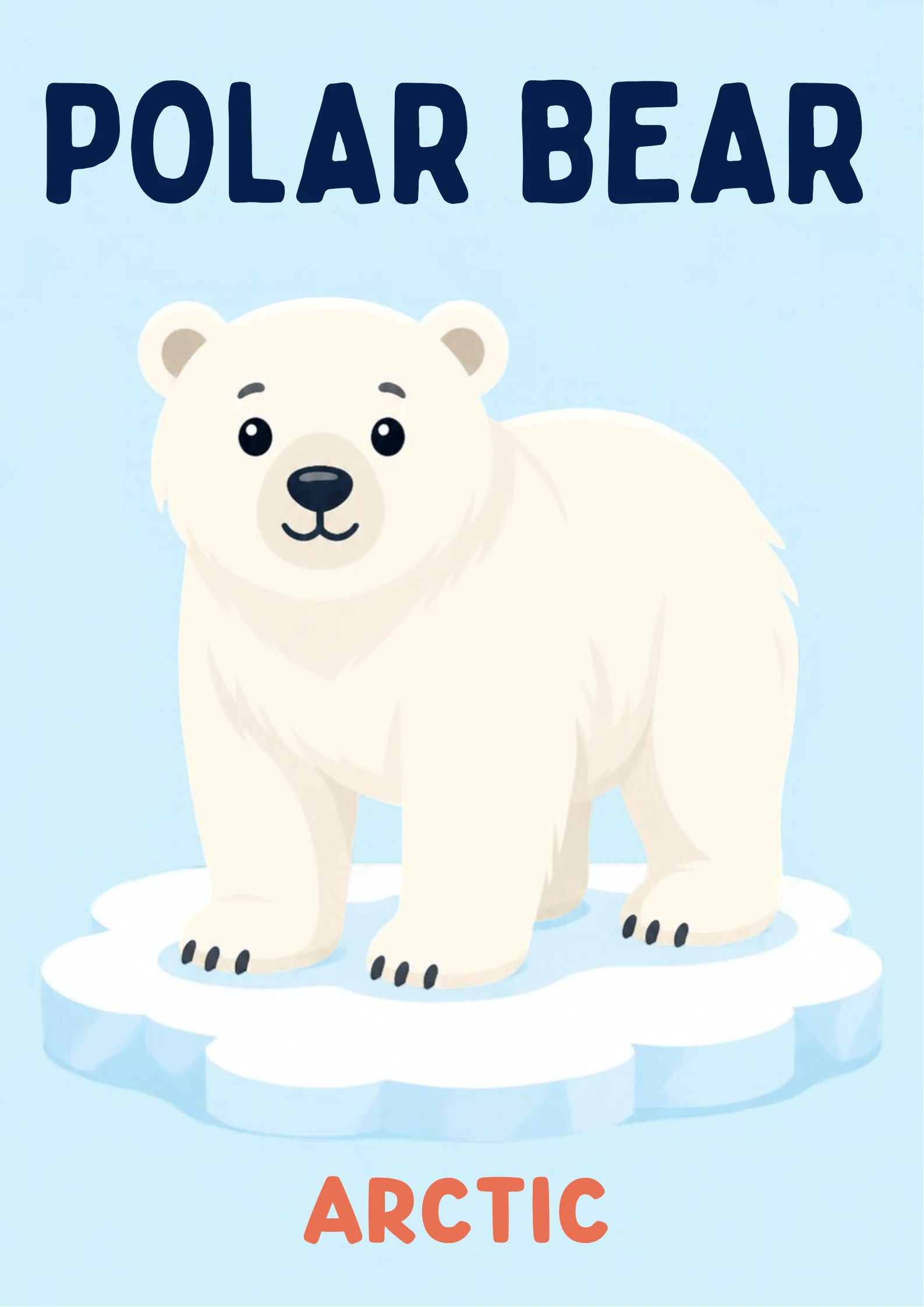
What is this?
The arctic is the frozen ocean at the North Pole: sea ice drifting in slabs and sheets over deep, dark water, months of winter dark, and snow from horizon to horizon.
What does it mean?
A white bear on white ice is nearly invisible — and invisibility is the polar bear’s whole hunting plan. Seals must breathe through holes in the ice; the bear finds a hole, sits down, and waits — still as the snow around it — sometimes for hours, until a nose breaks the surface. One swift paw, and the patient hunt ends. The ice is not scenery here; it is the kitchen floor, the road and the dining table at once.
What does the child need to know?
Your child needs three arctic ideas: the arctic is the frozen sea at the top of the world, all ice and snow; the polar bear’s creamy coat matches it so well the bear can vanish — camouflage in action; and it hunts by waiting, perfectly still, at the seals’ breathing holes.
Why this matters
The polar bear completes the camouflage thread started by the lion (tawny on gold) with its opposite number (white on white) — two hunters, two colours, one trick. And the breathing-hole vigil teaches stillness as strength: the mightiest hunter in the arctic wins by not moving.
What it teaches
Camouflage testing (hide-and-seek science), stillness stamina — genuinely hard and genuinely trainable at four — cold-region mapping (top of the globe), and respect for patience as a real skill, not a passive one.
Words to learn
polar beararcticsea icecamouflagebreathing holewaitstill
Say this to your child
“"The polar bear lives in the arctic, on the ice at the very top of the world. Its fur is the colour of the snow — so when it waits still as a statue by a seal’s breathing hole, nobody sees it coming. The biggest bear on Earth hunts by being patient."”
Step by step
- Show the card: "This is a polar bear, and this is its home — the arctic, the frozen sea at the top of the world."
- Find the bear trick: creamy fur, snowy background. Ask your child to squint — where does the bear end and the ice begin? That vanishing act is called camouflage.
- Tell the hunt: seals keep breathing holes in the ice, like front doors. The bear finds one, sits, and waits — silent, statue-still — until a nose pops up.
- Compare the hunters: the lion wears gold on gold, the bear wears white on white — different ends of the Earth, the same disappearing trick.
- Run the camouflage test and the statue game (below), then close with the map: find the top of the globe — that white crown is the bear’s whole country.
Look closer at the picture
On this card a big creamy-white polar bear with a long neck, dark eyes and black claws stands on a low slab of sea ice, pale sky and paler sea all around it. The word "arctic" sits below — the hunter standing in its own invisibility cloak.
Ask your child
"Why is the polar bear hard to see on the ice?" "What are breathing holes for?" "What does the bear do at a hole?" "Where on the globe is the arctic?"
What your child can say or do
Your child might say: "Its fur matches the snow — that’s camouflage!" "It waits by the seal’s breathing hole, very still," or the map line: "The arctic is at the top of the world!"
Out in the real world
Camouflage hunts work anywhere: count the white things against white walls, the brown things against fences — background matching, street edition. Globe time: trace from your home to the top of the world, and let your child place a finger on the bear’s country.
Try it together
Camouflage test: cut a paper bear in white and one in red. Hold each against the white wall, then a busy poster — which bear vanishes, which shouts? Then Statue Hunt: the "bear" must cross the room toward the "seal" (a cushion throne) moving ONLY when the seal’s eyes are closed — freeze when open. Reaching the seal earns the biggest growl of the day.
Understanding check
Ask: "Where does the polar bear live? Why can’t the seals see it? How does it hunt?" Arctic ice, fur matches snow, statue-still at breathing holes — three answers and the hunter rests.
Parent tips
Keep the hunt honest but gentle: the bear waits because seals are quick and holes are few — patience is not cruelty, it is the job. If your child asks whether the ice ever melts for the bear, answer truthfully and briefly: the arctic ice shifts with the seasons, and the bear follows the ice — the kitchen floor moves, and the bear moves with it.
This lesson pairs with the Polar Bear flashcard in the library — print it, show it, keep it on the fridge. Back to Animals & Their Habitats (Class 36).