
Fox — a step-by-step lesson for grown-up and child
This lesson teaches how the fox uses the woodland differently from the squirrel: same trees, opposite timetable. The fox sleeps through the day and owns the quiet hours — with ears that hear everything and feet that make no sound at all.
What is this?
A fox lives where the woodland meets the open: hedgerows, thickets, bramble corners — good hiding near good hunting. Its den is a hole or a sheltered hollow where cubs are born and days are slept away.
What does it mean?
Two animals can share one woodland by working different shifts. The squirrel works all day; the fox starts at dusk. Big triangle ears catch the smallest squeak in the grass, and paws built for silence let the fox arrive before anything hears it. The woodland offers night and day — the fox took the night.
What does the child need to know?
Your child needs three fox ideas: foxes make dens in quiet corners at the woodland edge; they are most active at dusk and dawn, not midday; and their tools are giant ears, sharp eyes and feet so soft that nothing hears them coming.
Why this matters
The fox gently breaks a pattern: not every animal’s day looks like ours. Meeting an animal whose "morning" is our bedtime stretches a child’s imagination of time itself — and the fox’s famous cleverness becomes concrete when it is explained as ears plus patience plus quiet feet.
What it teaches
Time concepts (day shift and night shift), sound awareness through listening games, body-tool reasoning (ears, eyes, feet), and gentle courage — foxes are the animals children both love and find just a little bit spooky, and understanding dissolves the spooky.
Words to learn
foxdenduskquiettrotbushysharp ears
Say this to your child
“"The fox lives at the woodland edge, in a den among the bushes. It sleeps in the day, and when the sun goes down it trots out on soft, silent feet. Its big ears hear everything — that is how the fox feeds its family at night."”
Step by step
- Show the card: "This is a fox, and this is where it lives — the edge of the woodland."
- Compare shifts: the squirrel naps at night; the fox naps by day and goes trotting when the sky turns orange. Same forest, different clock.
- Point at the ears: those triangles catch the tiniest sounds — a mouse’s squeak from far away in the grass.
- Do the ears test right now: whisper from across the room and watch how fast your child’s fox ears find you.
- Finish with silent feet practice — fox-walk across the room without one creak. If someone hears you, back to the den and try again.
Look closer at the picture
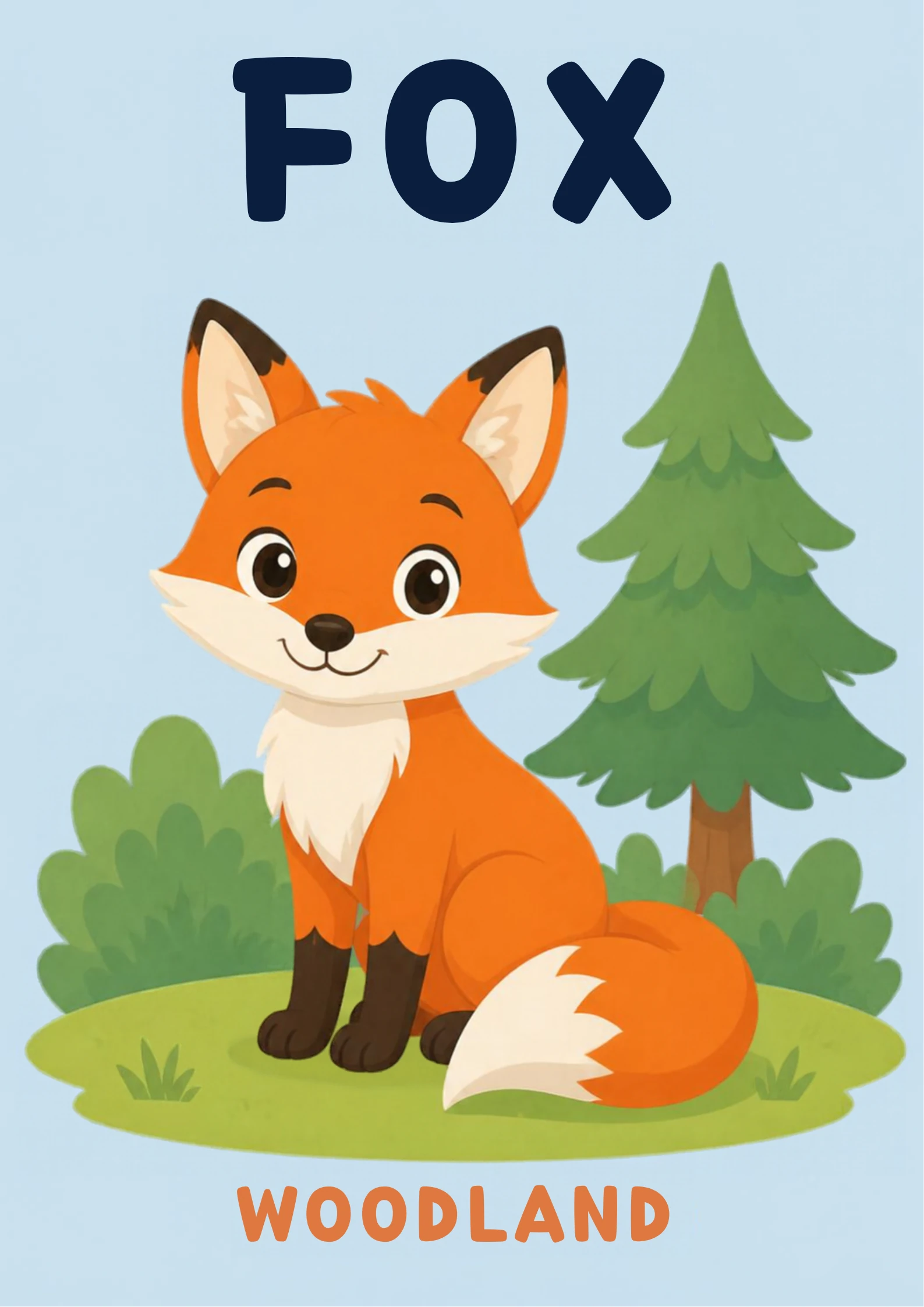
On this card an orange fox with a white chest, black ear-tips and black boots sits calmly in short green grass, a pine tree and round bushes behind it, under a pale blue sky. The word "woodland" sits below — the fox is resting between its night shifts, right at the trees’ soft edge.
Ask your child
"When does the fox wake up — morning or evening?" "How do its feet help it hunt?" "What do those big ears hear?" "Where does a fox sleep through the day?"
What your child can say or do
Your child might say: "The fox sleeps in the day," "Its feet are so quiet nobody hears it," or the ears line: "It hears a mouse far away with those big ears!"
Out in the real world
At dusk, open a window and listen for fox sounds — a short sharp bark carries far in the evening quiet. In towns too: foxes live along garden edges and railway lines. Early morning paw prints in soft ground tell last night’s trotting route.
Try it together
Fox-and-feathers: one player is the fox and must cross the room and lift a toy from a shelf without the "rabbits" (lying on the floor, eyes closed) hearing a single step. Any twitch of the rabbits’ ears sends the fox back to the den. Silence is the whole game — and the whole fox.
Understanding check
Ask: "When is the fox busy — day or night? How does it walk? What do its ears do?" Night, silent feet, hear everything — three answers and the den is warm.
Parent tips
If your child finds foxes a bit frightening, lead with competence, not creepiness: the fox is not sneaky for fun, it is a parent bringing food home to cubs in a den. A tired working parent with excellent ears is a very friendly monster to be.
This lesson pairs with the Fox flashcard in the library — print it, show it, keep it on the fridge. Back to Animals & Their Habitats (Class 36).