
Doctor — a step-by-step lesson for grown-up and child
This lesson shows your child what doctors actually do, what their tools are for, and how a check-up works — so the real thing feels known instead of scary.
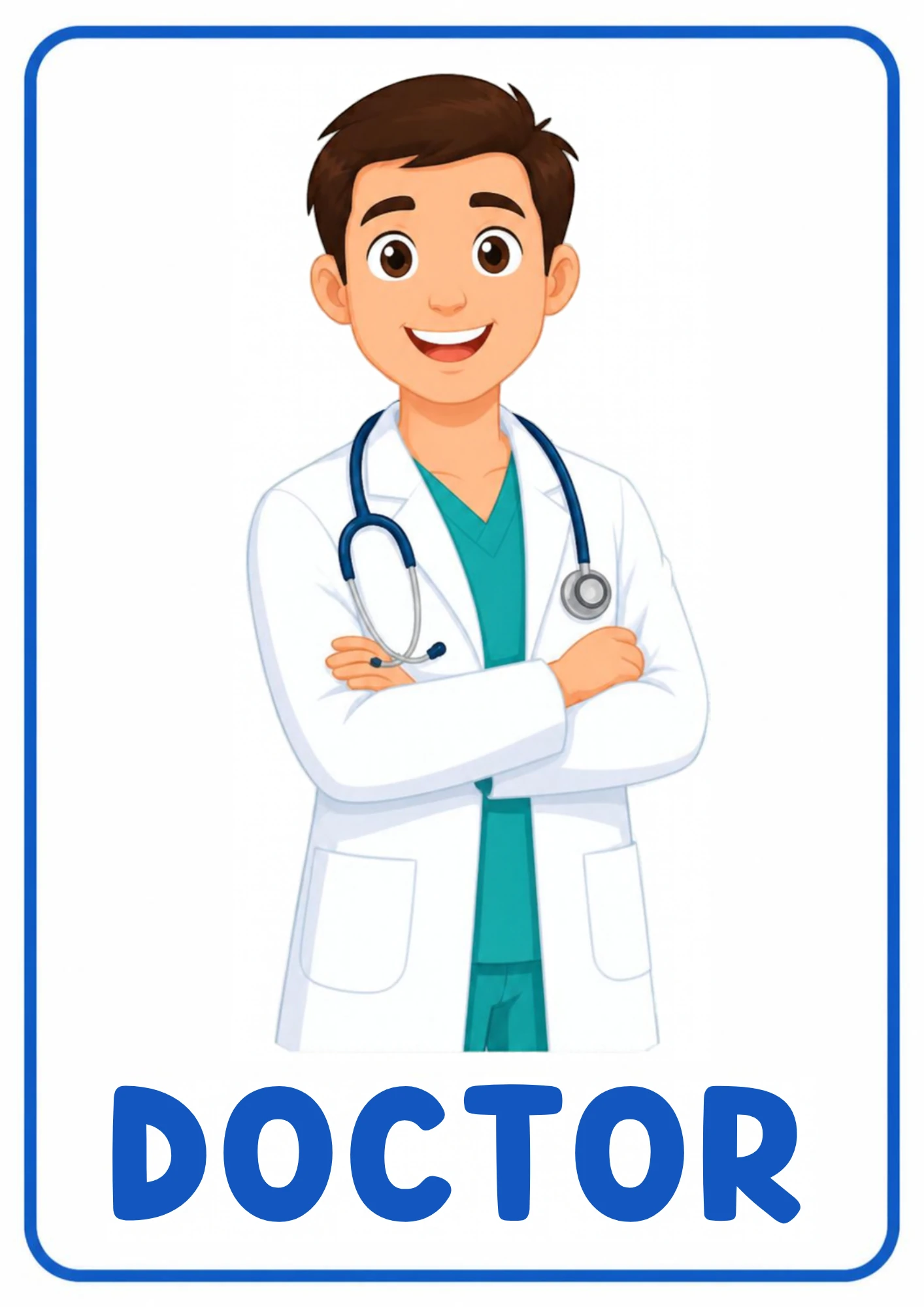
What is this?
A doctor is a body helper. When someone is sick or hurt, the doctor checks, finds out why, and treats it.
What does it mean?
Doctors work in clinics, hospitals and health vans. Their tools each have a job: a stethoscope listens to heartbeats, a small torch lights up ears and throats, a bandage protects a healing cut.
What does the child need to know?
Your child needs to know three things: doctors help bodies get better; a check-up is looking and listening, one small step at a time; and telling a grown-up where it hurts is the fastest way to get help.
Why this matters
Doctor play and doctor talk give your child the words and the script for real appointments. A known story is a calmer story — for both of you.
What it teaches
Vocabulary (doctor, patient, stethoscope, check-up), body awareness, asking-for-help skills, and trust in helpers — plus sequenced thinking as your child retells the visit in order.
Words to learn
doctorpatientstethoscopecheck-uphealthymedicine
Say this to your child
“"When something hurts, you tell me and we visit the doctor. The doctor looks and listens very carefully, and then your body gets a plan to get better. You can always tell the doctor how it feels."”
Step by step
- Show the card: "This is a doctor. Doctors help our bodies when we are sick or hurt."
- Point to the picture: find the stethoscope, the coat, the kind face. Ask what each might be for.
- Explain the visit in order: we say what hurts, the doctor looks and listens, then we get a plan to feel better.
- Be honest: some checks feel odd — a cold stethoscope, a puff of air, a look up your nose. Saying how it feels to the doctor is always allowed.
- Practise the visit end to end in pretend play before any real appointment.
Look closer at the picture
Ask your child to find: what is on the doctor’s head or neck? What is in the doctor’s hands? Where do you think the doctor is working? Who is the doctor helping?
Ask your child
"What does a doctor do all day?" "Which tool listens to your heart?" "What could you tell the doctor if your tummy hurt?" "How could we make a check-up feel easier?"
What your child can say or do
Your child might say: "The doctor helps me get better," "The stethoscope goes thump-thump on my chest," or practise the brave sentence: "My knee hurts here."
Out in the real world
Point out doctor things in daily life: the clinic you pass, the nurse at preschool, the first-aid box at the pool, medicine with a "grown-ups only" label at the pharmacy.
Try it together
Teddy clinic: your child is the doctor. Listen to Ted’s heart with a cardboard-tube stethoscope, look in his ears with a torch (off), wrap a tissue bandage, and say kindly: "Tell me where it hurts." Swap roles so your child is the patient too — that is the bravery rehearsal.
Understanding check
Ask: "Who do you tell when something hurts? What does the doctor listen with? What could you say to the doctor at your check-up?" Three answers = lesson landed.
Parent tips
Never use the doctor as a threat or a punishment — it turns a helper into a bogeyman. Read a doctor-visit book the day before appointments, let your child pack a toy, and afterwards name the brave moments out loud.
Staying safe
Medicine is only given by grown-ups — never take pills or syrup like sweets, even when it smells nice. Sharp things at the clinic are the doctor’s tools only.
This lesson pairs with the Doctor flashcard in the library — print it, show it, keep it on the fridge. Back to Community Helpers & Our Neighborhood (Class 33).