
Gardener — a step-by-step lesson for grown-up and child
This lesson walks the gardener’s round — planting, weeding, watering, trimming — and ends with a plant your child adopts and owns.
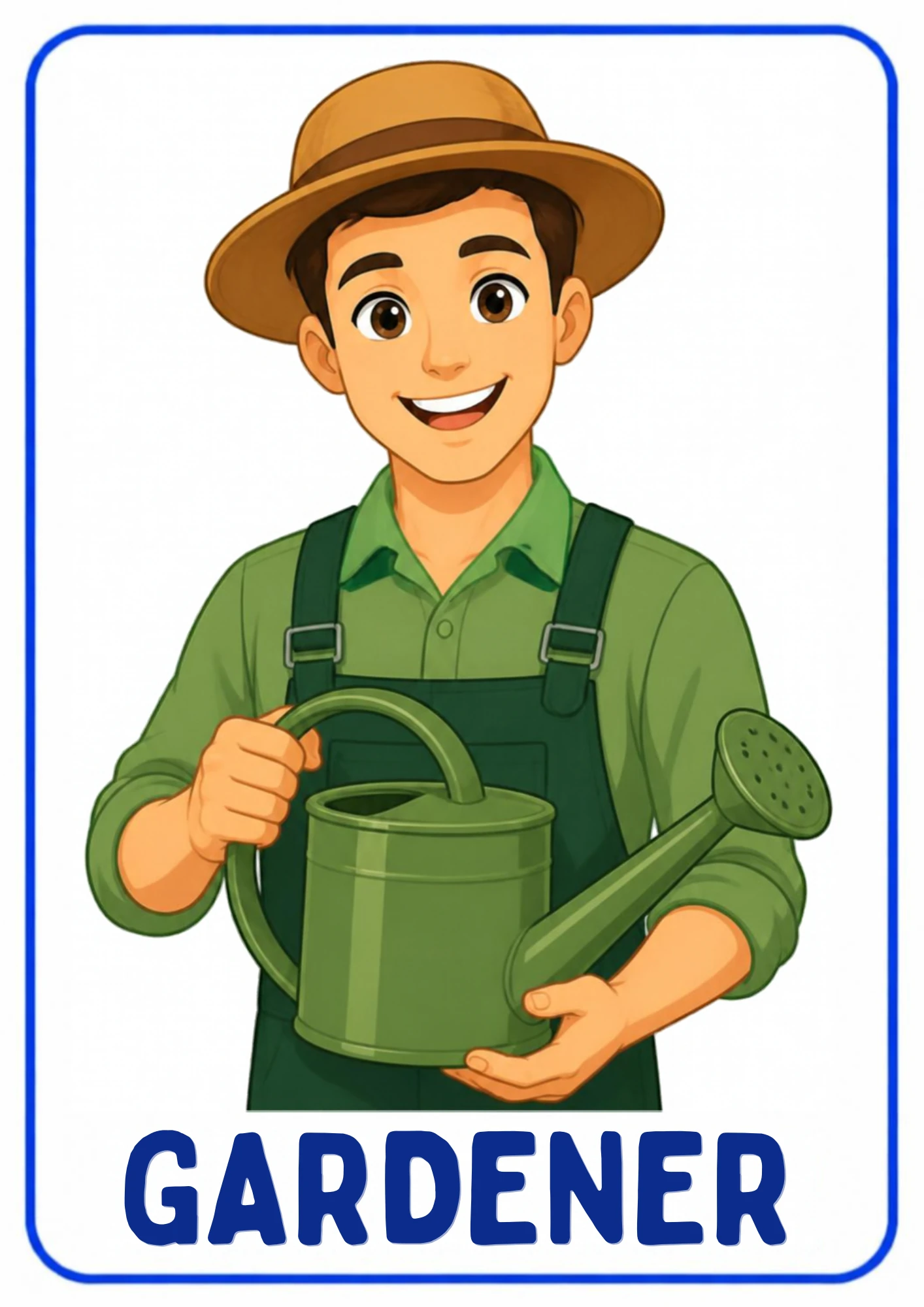
What is this?
A gardener is a plant helper who takes care of gardens and parks so flowers bloom and trees stay healthy.
What does it mean?
Gardeners plant seeds and seedlings, pull weeds (plant robbers!), water, trim hedges, feed the soil with compost and sweep the paths.
What does the child need to know?
Plant needs in child-size: water, sunshine, soil and time. And the gardener’s secret: weeds steal the water, so out they come.
Why this matters
Gardens run on patience — nothing rushes a seed. A child who waters a plant daily learns responsibility the honest way: something alive depends on them.
What it teaches
Daily-care responsibility, plant-need reasoning, patience across weeks, fine motor (pinching weeds, gentle watering), and nature observation habits.
Words to learn
gardenerseedweedcompostbloomroots
Say this to your child
“"The gardener waters the plants and pulls the weeds. Water, sunshine, soil and time — then one day: a flower! Growing things cannot be rushed, and that is the fun."”
Step by step
- Show the card: "This is a gardener. Gardeners help plants grow big and strong."
- Find the plants, the watering can, the tools. "Every tool has a job — watering, digging, trimming."
- Name the plant’s needs with your fingers: water (rain fingers), sun (arms up), soil (wiggle toes), time (tap wrist).
- Introduce the villain kindly: "Weeds are plant robbers — they drink the water. The gardener pulls them out so flowers can eat."
- Adopt a plant today: one pot, one name, one job — your child’s.
Look closer at the picture
Ask: what is the gardener doing first? Can you find a flower and a leaf? What does the soil look like — wet or dry? What tool would you pick up first?
Ask your child
"What do plants need to grow? Why does the gardener pull weeds? What is your plant’s name? How will you know it is thirsty?"
What your child can say or do
The needs list, counted on fingers: "Water, sun, soil, time." And the care report each morning: "My plant is… (dry/droopy/happy)."
Out in the real world
Walk the park as gardener-detective: fresh mulch here, trimmed hedge there, new tulips — someone did all of it. Community gardens love little visitors.
Try it together
Adopt-a-plant: one sturdy pot plant (herbs are forgiving), named by your child. Their job: check leaves, test soil with one finger, water gently with a small can. A ribbon measures growth; a calendar tick marks the care.
Understanding check
Ask: "What do plants need? Why do we pull weeds? Whose job is our plant?" Needs + weeds + theirs = pass.
Parent tips
Choose forgiving plants — mint, geraniums, spider plants. A wilted plant is not a failure, it is a clue: droopy = thirsty, yellow = too much love (water). Gardeners solve problems; so can fours.
Staying safe
Wash hands after soil play and wear gloves for digging. Some plants — berries, mushrooms, sap — are not for touching or tasting: ask a grown-up first, always.
This lesson pairs with the Gardener flashcard in the library — print it, show it, keep it on the fridge. Back to Community Helpers & Our Neighborhood (Class 33).